Of Iron Fists and Velvet Gloves: The Role of the Democrats

from Anathema

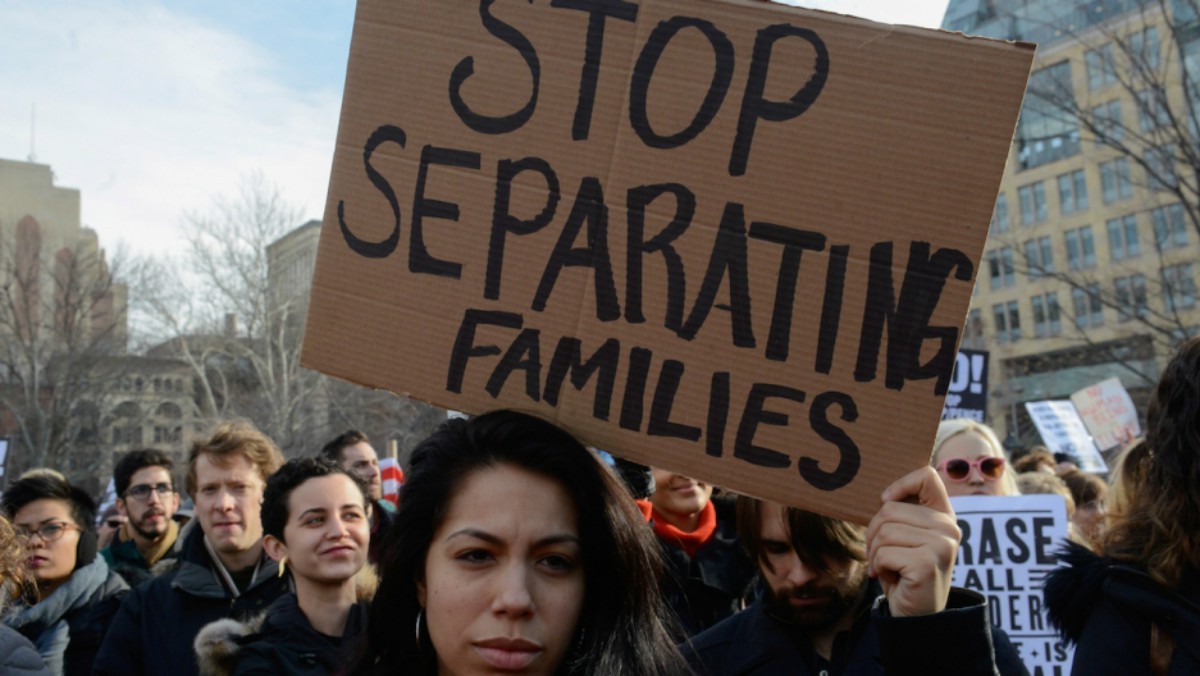
On February 8th, Congress passed a budget bill to end the government shutdown that did not include protections for DACA recipients. This budget would not have been possible without Democratic participation — in the Senate, 37 out of 49 Democrats voted for the bill, along with 73 House Democrats. Efforts by Congress in the following week to pass a new bill on immigration failed due to pressure from Trump’s administration. The fate of DACA now lies with the court system.

“Fascism, then, is a way of channeling discontent and hostilities into a consolidation of the status quo when democracy is no longer able to do so.”

Democrats had put up an appearance of resistance to the bill, symbolized by minority leader Nancy Pelosi holding the floor for eight hours to rail against it. Pelosi could have gone all out and used her leverage to whip up Democrats’ no votes, but chose not to. Despite the fact that, according to a Public Policy Polling/Center for American Progress poll, 58% of Americans wanted to include Dreamers as part of the deal to reopen the government, Democratic and Republican lawmakers colluded to ensure that this would not happen.

That means that what looks a lot like a new stage of an ethnic cleansing project by this settler colonial nation-state and its openly white nationalist presidential administration is set to move forward. Hundreds of thousands of people of color in the United States are facing the threat of deportation. In January, the government ended Temporary Protected Status for Salvadoreans, Haitians and Nicaraguans. DACA, which protects 690,000 people, expires on March 5.

Immigration and Customs Enforcement (ICE) removed 226,000 people from the country in the 2017 fiscal year, a slight decrease from Obama’s record last year because of Trump’s enhancements to border security. ICE’s immigration arrests are up by 42%, however. At least 8% of the approximately 110,000 arrests are “collateral arrests,” i.e. other people that the agency finds and kidnaps along the way while arresting an intended target.

ICE has specifically targeted migrants who are leading activist resistance to U.S. immigration policy. In early January, ICE suddenly detained and deported Ravi Ragbir, the executive director of the New Sanctuary Coalition of New York City. This was the second arrest in one week by ICE of a leader in that coalition. Despite New York being a sanctuary city whose Democratic mayor has pledged safety for migrants, the NYPD colluded with ICE to arrest 18 people who attempted to stop the ICE vehicle from carrying away Ragbir.

Though the government has usually tried to excuse deportations by blaming migrants for their “criminal” records and going after low-income people, ICE arrests have now also started to target non-white American residents regardless of how much time they’ve spent in the country, their lack of criminal history, or their class position. In January, ICE kidnapped Syed Ahmed Jamal, a chemistry professor who has lived in the U.S. for 30 years, outside his home, and deported Amer Adi Othman, a Youngstown, Ohio business owner who had lived in the U.S. for nearly 40 years.

Taking measures to limit legal immigration is also now on the table for the first time in many years. This is notable because authorities are only discussing restricting immigration from majority non-white countries, and further indicates that the primary motivation on issues of immigration, on the part of both the Trump administration and his grassroots supporters, is to keep the U.S. a majority-white nation-state.

The U.S. is heightening its borderline-fascist state polices, and Democrats have shown they will go along with anything when the stability of the federal government is at stake. Regardless of individual lawmakers’ reasons for their decisions — the inner workings of which are nearly impossible for lowly plebian commentators like ourselves to know anyway — both political parties now seem willing to toe the line between so-called democracy and fascism in order to deal with the escalating crisis of capitalism and the accompanying threat of mass uprisings.

Because the state’s function is to unify civil society in such a way that preserves the economic system, fascism is not a subversion of capital, but a tendency that, like representative democracy, the state can turn to so as to maintain order. Historically, signs of a crisis in the state’s ability to maintain social cohesion have included an inability by democratic states to impose order after waves of revolts had been snuffed out, continual governmental crises, and imaginary plots against the nation. As with the current U.S. administration, states often respond to such crises by inventing an internal enemy and deflecting domestic conflicts by pursuing militaristic projects abroad.

The current crisis of capital requires a consolidation of force in the hands of the federal government, which either instating a dictatorship or pursuing more modest proto-fascist measures can accomplish. As in Spain, Germany, and Italy in the first half of the last century, economic misery and the rebellions it has produced in the U.S. are currently being channeled into anti-fascism, on one side (which tends to deprive revolutionary tendencies of their original anti-capitalist content) and grassroots fascism that rallies to consolidate the current administration. Meanwhile, Trump’s administration continues to accumulate resources for its police and military forces, fortify its borders, blame migrants and radicals, mysteriously kill off or deport black and brown rebels and activists, and threaten large-scale warfare abroad.

As economic theorist Gilles Dauvé noted in 1998, “An essential aspect of fascism is its birth in the streets, its use of disorder to impose order, its mobilization of the old middle classes crazed by their own decline, and its regeneration, from without, of a state unable to deal with the crisis of capitalism. Fascism was an effort of the bourgeoisie to forcibly tame its own contradictions, to turn working class methods of mobilization to its own advantage, and to deploy all the resources of the modern state, first against an internal enemy, then against an external one” (Endnotes Vol. I, 23-24).

Fascism, then, is a way of channeling discontent and hostilities into a consolidation of the status quo when democracy is no longer able to do so. Fascism, or proto-fascist governance like what we’re currently seeing in the U.S., historically has thrived off of grassroots support that mimics revolution, while drawing anti-capitalist tendencies into a “popular front” approach that gives control back to more liberal agents and institutions and no longer threatens to totally transform the miserable conditions of our lives.

Many radicals and progressives recognize that there’s a rupture in U.S. society and have in response called for rebuilding democratic power — for example, as Bernie Sanders and the Democratic Socialists of America have done. This mass movement strategy should be avoided, as it is another way of rebuilding the social unity that capital needs.

Pursuing false alliances with those who want to defuse hostilities and reform the socioeconomic system will not help us get free. The ruptures and antagonisms within this society are what the state is straining to reconcile because they threaten capitalism — they are serious disadvantages for capital, and thus advantages for us. In the face of the state’s white supremacist maneuvers, we can try various short-term strategies depending on our inclinations — for example, looking out for those who will first be targeted, helping people cross the border, or attacking agencies like ICE and impeding their ability to function. But ultimately it is the borders, and capital along with it, that must go.
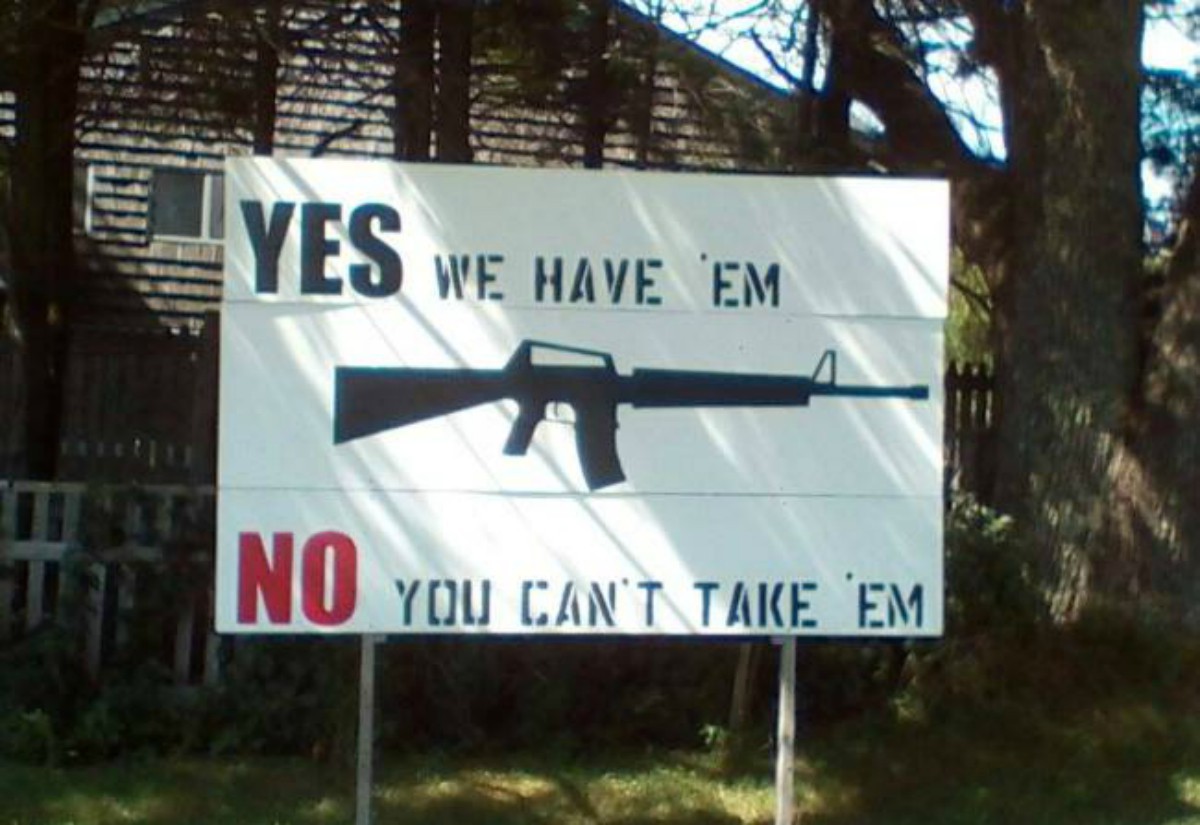

Gun Control: Some Critical Thoughts in a Historical Context

from Anathema

There have been so many mass shootings in recent years that they rarely get national coverage unless they set a new record, precedent, or it is a slow news day. They have been on the rise to such a degree that the United States has been averaging one school-specific shooting a week. In the aftermath, wherever the shooting occurs, blame is always assigned to political agendas, religious radicalism, advanced weaponry, mental health, or whitewashed for the sake of maintaining order in a way that assigns no blame to “random” or “thoughtless” crimes – the latter being most often assigned to white male shooters. But the return to calls for gun control most disempower the marginalized and reinforce the same authority that murders with impunity.

Mass shootings are said to have begun with a white military veteran in Camden, NJ in 1949, who bought the Luger he used in Philadelphia, the day after he had felt scorned by a lover. The story is too familiar, but the idea that this was the first mass shooting ignores the massacres of indigenous people on this continent by white settler-colonialists that have contributed to Native American genocide (like the nearby Conestoga Massacre of 1763, at least some of which occurred without guns). Still, it is of note in that “the first mass shooter” murdered 13 people and wounded 3 with only a pistol, and not anything resembling the AR-15 that has been so focused on lately. More to the point, mass killings preceded the existence of semi-automatic weapons and largely targeted non-white people.

It was only when non-white people picked up the gun to defend themselves that gun control became a popular political stance. Some of the less-remembered gun control advocates of the past include a post-Civil War Ku Klux Klan, the National Rifle Association, and California Governor Ronald Reagan, who sought to prevent Black Panthers from carrying loaded rifles while patrolling their neighborhoods or protesting at government buildings. Before Reagan signed the bill that outlawed such practices, there were reported occurrences of Black Panthers avoiding unjustified arrest and murder when white police stopped and harassed them on the street by being armed.

Presumably, little has changed from the legal lynchings of the past except that the police have less to fear from civilian elements, as they continue to be criminalized and othered without the fear of return fire as reprisal. Shootings of police in Camden, NJ and upstate PA, which occurred last year after police approached young men, have even been described as self-defense because the police have been known to shoot people with similar profiles for little or nothing in other situations, often to be exonerated for their transgressions later. Gun control has historically sought to keep guns out of the hands of black and brown folks, when it is clear that a gun in hand could keep them alive.

While sympathies lie with those trying to reduce violence in their inner city communities through gun control, it still fails to address the problem. Inner city violence often pits the most marginalized against each other, in attempts to overcome the violence of poverty thrust upon them. The logic of capital, after all, being that one must conquer others in order to move up in the economic strata. As such, one cannot end inner city violence without abolishing capital, as hierarchies (and poverty) are necessary to its operation, as it institutionally brings down violence from the upper echelons onto the lower.

This is why elements of left and anarchist circles have recently renewed advocacy for arming of marginalized peoples, in addition to bringing up concerns regarding civil war with conservative elements that tend to be better armed and more familiar with weaponry. The same conservative element that has been doing research on the best “truck gun” with which to “defend” themselves against protesters who tend to disrupt traffic, as was written about in a recent issue of Guns & Ammo magazine.

The same political associates of white supremacist organizations that are currently calling for armed escalations and lone-wolf murders of their opposition – organizations of which many mass shooters have been members. This, again, in a country where the first machine gun, invented by Richard Gattling, was created to deal with anarchists and other dissenters.

There is no need for romanticization of armed conflict and related imagery, but there is a real need to know how to defend ourselves from the threats we face. And the threats we face include murderous white supremacists, governments, and even gun manufacturers, who favor disarming and killing dissenters whenever they can get away with it – indeed there is significant historical precedent from Haymarket, to massacres of striking workers and their families, to the biased trials and execution of “reds.”

Yet none of this gets down to perhaps the most significant contributing factor to an increasingly violent society – the continued alienation by and violence of civilization at large. The division of labor, especially along gendered lines, and the creation of private property that resulted from the agrarian revolution that birthed civilization marked a notable development in the existence of hierarchies. Gender and racial divisions might not exist on the same level, if at all, without this development. The degradation of the environment, our separation from the natural world, and our separation from each other have been steps in a process that have increased rates of depression, anxiety, suicide, in addition to mass shootings. The New York Times reported a steady increase of suicides over the last 30 years, with 42,773 recorded in 2014 – not a sign of an healthy society.

In such a society, built on and maintained by violence, any attack on its institutions can be painted by the marginalized as self-defense. But framing the argument is perhaps less interesting than an attack that actually inspires and destabilizes, without the possibility of recuperation.

Gun control won’t stop the police from murdering people every single day. It won’t stop the military from imperializing and murdering abroad. It makes sure those forces are likely to be the few who have guns. Gun control won’t stop the cycle of violence perpetuated by poverty and authority. Those most prone to suffering violence at the hands of institutional oppressors are the ones whose survival is most inhibited by those measures, including those that intend to dismantle the root causes of those oppressions. The patriarchal and white supremacist entitlement that empowers both individual and group “mass shooters” can only be halted after the toppling of institutions that teach them they are right (i.e. churches, schools, government). And the alienation that drives people to senselessly murder will only cease after unplugging a civilization that drives us apart, mediating interactions through screens and algorithms, to reconnect with a simpler way of life.

Philadelphia, PA: Friendly Fire Retreat to Spark a Religious Revolutionary Fire, May 1st-3rd

from It’s Going Down

The following is a call for a gathering in Philadelphia, PA from May 1st to May 3rd.

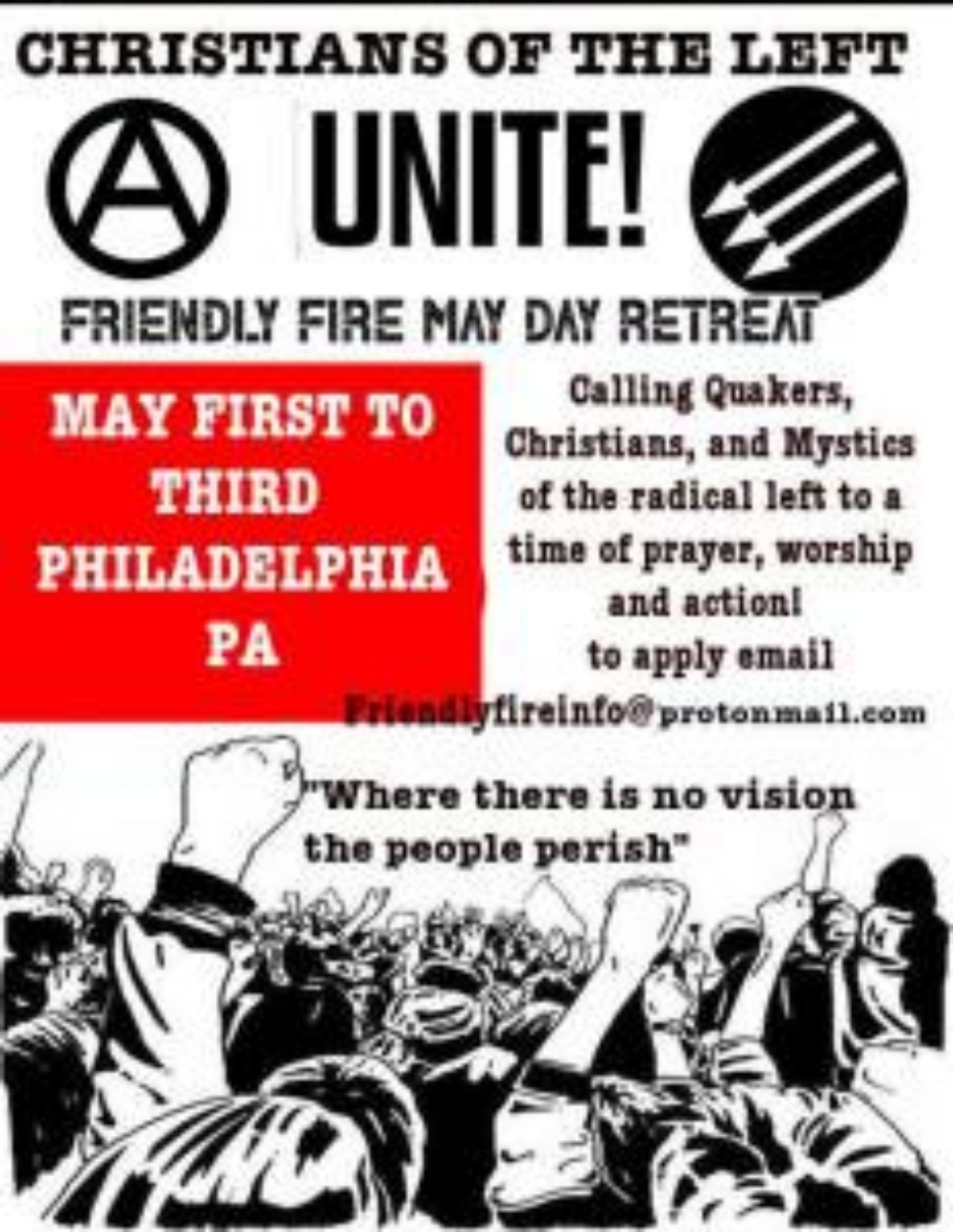
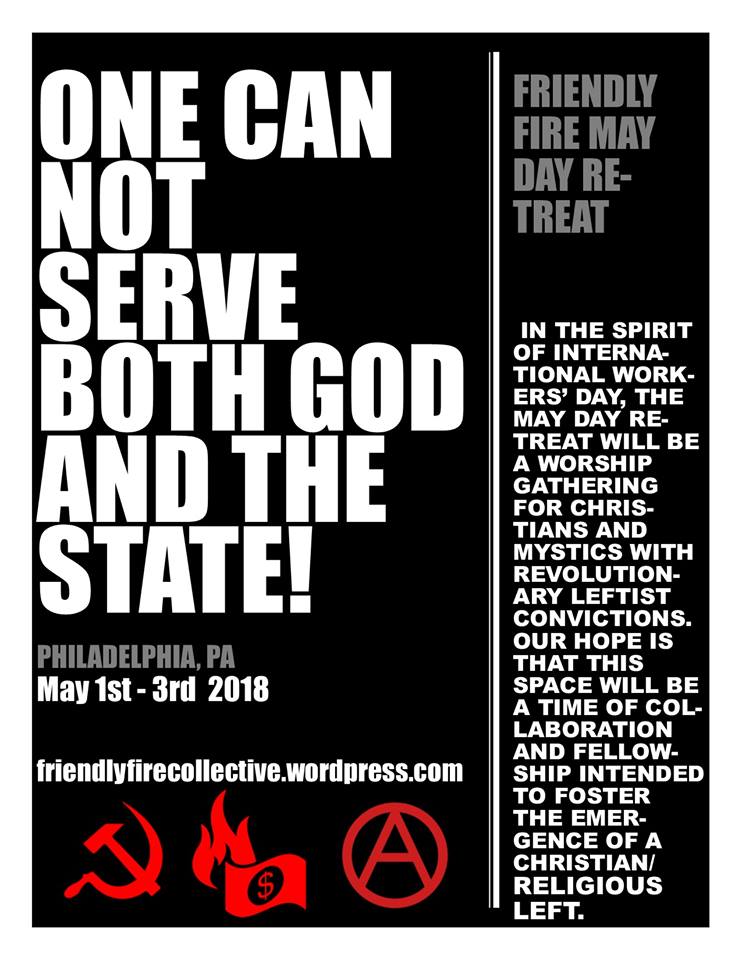
Local Quakers and friendly mystics from around the so-called “United States” are gathering outside of so-called “Philadelphia,” from May 1-3rd for direct action, worship, collaboration, mysticism, and fellowship to stir-up an emerging revolutionary Christian/religious Left. We invite mystics and people of faith from all traditions who share our struggle “against the rulers, against the authorities, against the powers of this dark world.” (Ephesians 6:12)

Our desire for this retreat is it will serve to strengthen and connect the forming Christian/religious left. This retreat is coming at a time when we are seeing our institutions of religion crumble before our eyes as the evangelical Right is endorsing fascism, white supremacy, and xenophobia. The Friendly Fire Collective is a loose network of anti-fascist, anti-imperialist, anti-capitalist Christians and mystics seeking to eradicate this institution and share in the act of Creation by building new religious traditions that lift up the oppressed instead of tearing them down.

May day 2.jpg

In the Spirit of International Workers’ Day, we will be participating in various direct actions which are currently being planned by our ever growing planning committee. The retreat fee will be a sliding scale of $45-95 and we will have scholarships available to ensure accessibility. If you would like to donate to allow poor, qpoc, and other marginalized people come to our event please email us.

For safety concerns we will not be discussing the location of our event until a few weeks out.

We are currently taking applications for the May Day retreat! Apply here!

For more information: friendlyfireinfo@protonmail.com https://friendlyfirecollective.wordpress.com

may day 3.jpg

Reflections on Time and Monuments: 14 Photographs and and Essay

From Radical Education Department

You can find another RED article by the author on monuments here.

Cetin-Monument-4

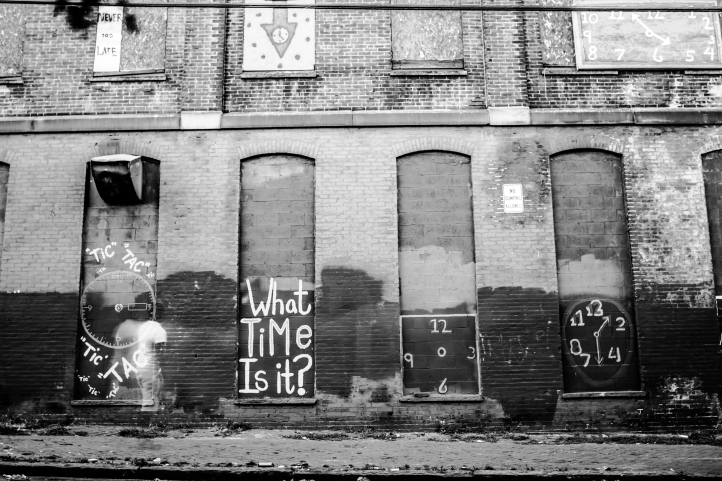
“What time is it?” asks artist Tyree Guyton in his mural installation at Kensington, Philadelphia. A question I take to asks more than what the clocks show at the present moment. As if the name of the installation, The Times –in plural, not the singular time of the one accurate clock– asks how many times are there that order this monumental space, how many temporalities cross-cut each other at the walls of that old Kensington factory, now being a special installation within the city wide temporary public art and history project: Monument Lab.

Monument Lab: A Public Art and History Project was a temporary installation of monuments across 10 sites of Philadelphia, produced by a curatorial team and Mural Arts Philadelphia. It centered on an overarching question: “What is an appropriate monument for the current city of Philadelphia?” which is posed initially to 20 artists. It exhibits artists’ responses in the form of temporary monuments at 10 different publics sites between September 16th and November 19th, 2017. Installations accompany with research laboratories where visitors participate through proposing their appropriate monuments for the current city of Philadelphia, and shared with public on a mapped here. I think it is fair to say that Monument Lab was a majestic collective inquiry and experimentation on the ordering of public spaces of the city with art installations and citizen participations.

The project was topical as well. It opened within the heated national debate around the politics of the monuments, primarily of the confederate monuments in the Southern states and protests for the removal of Frank Rizzo monument at Philadelphia’s Thomas Paine Plaza. It provided a local venue to carry out the debate on a proper monument in a positive form of proposing new monuments that would tell the story of Philadelphia. Monument Lab Research Director Laurie Allen’s call in the project’s newspaper summarizes the historical-political starting point of the project: “Our monuments have meaning. They are city’s way of telling its story, of picking out moments in history for elevation, and for making a statement about who and what deserves to be honored and remembered. In 2017, we must recognize that the story told by our monuments is not our city’s full history. Help us elevate a richer reading of our history and move creatively toward a better future” (3).

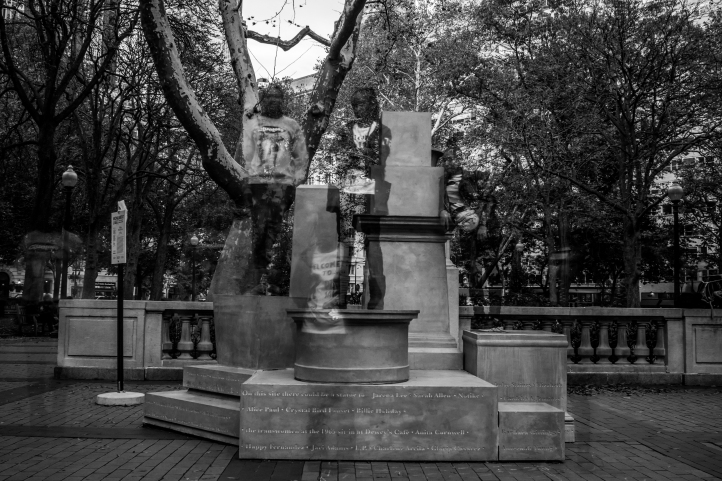
Some of Lab monuments, such as Sharon Hayes’ “If They Should Ask” at Rittenhouse Square, marks precisely this selective historiography of the existing monuments in Philadelphia. Hayes problematizes that in the entire city there are only two monuments that are dedicated to women: French heroine Joan of Arc and Bostonian Quaker Mary Dyer. By half-scaling nine pedestals of the existing monuments in Philadelphia and writing dozens of names of public women figures from the Philadelphia-area on the pedestals, Hayes monumentalizes the absence of women’s monuments and powerfully makes the case for the exclusion of women in the public memory.

Rittenhouse Square

“A monument” writes Jane Golden, the executive director of Mural Arts Philadelphia, is what “commemorates something or someone, in order to uplift and keep it in public memory –an enduring symbol.“[1] Monuments are mostly[2] deliberate symbols engrained in the build environment of the city/town that encapsulates a particular past to carry it to the future. Most monuments are symbols of the state and commemorate the founding acts and heroes of the nation to remind whose heritage that land is loyal to. For critics such as Kim Dovey, “Public monuments often use the memory of a past use of force by the state to signify such future possibility.”[3] Others uplift political principles such as the human rights monuments, cultural figures or commemorate past tragedies such as genocide memorials. Each monument’s commemoration of the past has a particular purpose in the present to frame future social and political relations. Monuments’ symbolic universe dictate a certain code of conduct, a way of thinking and acting in the public, and depend on the material they are made and the surrounding social-political relations, they usually do so for long durations.

Art historian William J.T. Mitchell, in his lecture “What do Monuments Want?” observes that the desire of the monument is “to live forever, to defeat death and history.” He says that they express power and desire to immortality while at the same time; almost all of the monuments eventually scum to the blows of history and crumble. Monuments are temporal, in both sense of the term. They are made to remain intact over time, defeat death and history, but they are also products of history and the social-political relations that erect or remove them. In that sense, the time of the monument is not less frail than human time in the longue durée.  Nevertheless, when it is intact and granted its demand of honor, monuments’ time poses a contrast to human temporality. Our mobility and short life span stand out against the background of monuments’ claim to stability and immortality.

Lab’s exhibit of monuments, installed for a short period of time, defeats this conventional logic of monument-time from the outset. It occupies what art critic Krauss Rosalind calls a “negative condition of the monument” where monument becomes nomadic by resigning its usual position of established place and entering into a field of “sitelessness, or homelessness, an absolute loss of place.”[4] With temporary monuments, Lab not only experiments with various monumental contents fitting for Philadelphia, but also questions the temporal logic of monumentality.

The purpose of this photography project is to contemplate on the contrast between the time of monuments and that of human beings against the background of the questions Monument Lab opens up. It can be considered as a visual dialogue with, or maybe rather an ocular ode to, the artists, curators and participants of the Monument Lab. Maybe it is even a photographic attempt to immortalize the passing of multiple times at each monumental site before they migrate to their next location. Each photograph in the series is taken with the same long exposure technique using an ND filter in daylight, which allows the photographic moment to be as long as 25 seconds. I am grateful to people who kindly accepted to be in the frames even though their faces are not really recognizable.

You can view all the images here:

PHL 2017

Submission

It’s been a year since Donald Trump took office, and Philly has been stepping it up. Let’s take a minute to celebrate all the determination, courage, and endurance of all the rebels who’ve poured sand in the gears of the system that makes his presidency possible. This is a timeline of some of the anarchic activity that’s happened  over the last year. Let’s look back to learn from our mistakes, and continue to build our strength against everything that brings oppression into the world.

Against Trump and the world that makes him possible.

Monday, March 5th: Letter-writing for Cleveland 4 prisoners

from Philly ABC

We’re back on our normal first Monday of the month schedule in March and will be writing letters to Josh Stafford, Connor Stevens and Doug Wright of the Cleveland 4.

They were arrested on April 30th, 2012. They were accused of plotting a series of bombings, including that of an area bridge.  However, the real story is that the FBI, working with an informant, created the scheme, produced the explosives, and coerced these four into participating.

Connor and Doug took non cooperating plea deals and pled guilty to all charges.  The judge applied a “terrorist enhancement” charge to each of them, elongating their sentences as well as subjecting them to harsher prison conditions.  Doug is serving 11.5 years, Brandon 9 years 9 months, and Connor 8 years 1 month.

Skelly took his case to trial. He went pro se and acted as his own lawyer. The FBI offered him a non cooperating plea deal with a 3 year sentence, if he would have plead guilty. Josh refused to plead guilty to something he wasn’t guilty of doing. He was found guilty on all counts by his jury and sentenced to 10 years. Even though Skelly had the most minimal role, he got the second longest sentence because he took his case to trial.

Doug and Connor plead without an agreement while facing the threat of life in prison. On appeal of there sentencing they were primarily fighting against the life long probation that was handed down at sentencing. Doug also fought against being branded the leader. After months of waiting for a verdict on the appeals, we got word back. The appeal have been denied.

They all continue to fight against the government’s attempt to brand them as terrorists and to expose the techniques of entrapment employed by the FBI and their informants.

Dinner will be served by North Philly Food Not Bombs and we will sign birthday cards for Joy Powell (the 5th), Andrew Mickel (the 13th), Cinque Magee (the 16th), and Jaan Laaman (the 21st).

[6:30 pm at LAVA (4134 Lancaster Ave)]

TAAKE that garbage out of Philly

From Philly Antifa

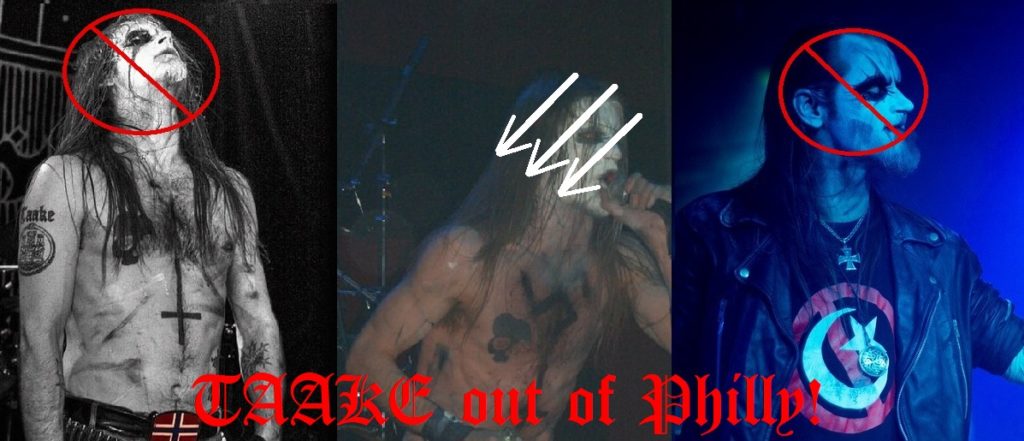
Norwegian black metal band Taake is scheduled to play Underground Arts on Monday, March 26th. This band is nothing more than a group of hate spewing bigots, and they are NOT welcome in Philadelphia.

Taake’s frontman Hoest painted a swastika on his chest and performed a show in Germany in 2007. When the appropriate fury surfaced, his response of “I’m not a Nazi” included anti-muslim comments and a racist slur from Nazi era Germany. More recent offenses include their song “Orkan”, which is ripe with islamaphobic and nationalist lyrics; including “to hell with Muhammad and the Mohammedans” and their “unforgivable customs”.

King Dude, who was set to tour with Taake, has already dropped off amidst the backlash against this band. So far, shows in Kansas City, Salt Lake City, Denver, Chicago and New York have been cancelled due to the work of antifascists and community members. Even well known hip hop artist Talib Kweli cancelled his own show after learning that same venue was going to host Taake. This eventually led the venue to cancel Taake’s show.

As more and more outrage gathers around this tour, we want to make sure these scum don’t slip into our city and play at all! Contact Underground Arts! Let them know you’re not ok with a racist band playing anywhere in your city!

No platform for Nazis! No music by Nazis, or for ’em, either!

Taake, stay out of Philly!

Call them at: 267-606-6215

Email them at: info@undergroundarts.com

Message their Facebook page: https://www.facebook.com/UndergroundArtsPhilly

Hit up their Twitter: @undrgroundarts

Hit up their Instagram: @undrgroundarts

Old fashioned visit them:

Underground Arts

1200 Callowhill St.

Philadelphia, PA 19108

Flash Mob Productions is culpable as the promoter for this show, give them a piece of your mind at:

FLASHMOBPRO@GMAIL.COM

https://www.facebook.com/pg/FlashMobProductions/about/?ref=page_internal


Fascist and Racist Band Booked to Play in Philly

from Instagram

Racist and fascist band Taake are booked to play at Underground arts this march. Call them and let them know Philly doesn’t fuck with islamaphobic Nazis. 267-606-6215

Info to tell the venue http://red-and-anarchist-black-metal.tumblr.com/post/160968887321/hoest-of-taake-was-and-still-is-a-nazi-piece-of

[Philly Anti-Cap note: The phone number listed has been updated to match Underground Arts’ current phone number.]

Anathema Volume 4 Issue 2

from Anathema

Volume 4 Issue 2 (PDF for printing 11 x 17)

Volume 4 Issue 2 (PDF for reading 8.5 x 11)

In this issue:

  • Gun Control
  • Of Iron Fists and Velvet Gloves
  • What Went Down
  • Letter to the Editor
  • War of the Words: Antifa
  • Fly Eagles Fly
  • Class War on Broad Street
  • Against Amazon
  • Joseph “Joe Joe” Bowen
  • Ozymandia

Whammo!: MOVE9 Parole; Addicted to Screens; Anarcho-Syndicalism in Kosovo

from The Final Straw Radio

This episode contains three segments:

Move 9 Parole
“Stare Into The Lights My Pretties”
Anarcho-Syndicalist Organizing in Kosovo

Audio Player

00:00
00:00

MOVE9 Parole

First, there’s the interview that Bursts held with Michael Davis Africa Jr., a member of the MOVE organization.  MOVE is a Philadelphia-based black liberation group founded by John Africa in 1972. The group lives communally. During the conversation, Michael Jr. talks about the case of the MOVE9, who were 9 members of that group who were arrested and accused of the killing of a police officer in 1978 in Philadelphia, a charge they each deny.  Officer James Ramp was killed following a year of the Philly PD blockading the house for a year under an eviction order and the police besieged the house on August 8th, 1978.  The MOVE 9 have been incarcerated for almost 40 years now, with Merle & Phil dying behind bars.  Police and white supremacist affiliated groups have successfully gotten parole denied for Eddie, Michael and Delbert Africa over the last 9 months as they do for many Political Prisoners from the 1960’s through 80’s in the U.S.  There are upcoming are parole hearings for Janet, Janine and Debbie Africa and more info on who to petition for their release can be found at http://onamove.com/move-9/. The name of the D.A. who prosecuted the MOVE9 in 1978 and who is still on the paperwork and has a say on the parole of the MOVE9 40 years later is named John Straub.

Coming up this Saturday, February 24th starting at 4pm there’ll be an event called “Framed In America: The Making of Political Prisoners”.  This will take place at The National Black Theater, 2031 5th Ave in Harlem, New York and will include presentations by Ramona Africa, Fred Hampton Jr, Pam Africa, Roger Wareham, Betty Davis, Ralph Poynter and Johanna Fernandez.  More info can be found on the Justice for the Move 9 fedbook group.

Black Rose Movie Night: The Black Panthers: Vanguard of the Revolution

from Instagram

There will be a showing of The Black Panthers: Vanguard of the Revolution at Wooden Shoe Books on Sunday, Feb 25th @ 7pm followed by a discussion of the Black Panther Party from an anarchist perspective.

[Wooden Shoe Books and Records 704 South St]

Food for the Body and the Mind-a MOVE Fundraiser

from Facebook

Big tasty dinner, brought to you by Food Not Bombs Solidarity!
Chili, cornbread, soup, greens, rice/veg, salad, cupcakes-
ALL VEGAN-ALL YUM!
This is a fundraiser for the MOVE organization, also a panel discussion event live-streamed from NYC will be shown here.
Free-will donation, $7-10 requested
sit n eat n watch the livestream , or take your dinner home!
FREE ALL POLITICAL PRISONERS!

[February 24 from 5PM to 8PM at A-Space 4722 Baltimore Ave]

Attack on Construction Site

Submission

A cold clear night. We silently walk through the shell of a long-decayed factory. There is no roof to this post-industrial late-capitalism graffiti haven and I stare up to the stars through the fallen iron beams, preparing for attack…

I am thinking…

They are building atop our memories, and they’ll never stop building. The monster of development grows and spreads and there are fewer and fewer places left untouched by its destruction. “Gentrification” is on everyone’s tongues along with sadness and frustration. And through the helpless complaints all we hear is, “but what can we do?” It feels so far gone already, like by the time we can see it it’s already in too deep. But it is not too far away from us.

The developers’ and planners’ construction and machinery are right here in front of our faces, in our neighborhoods! We pass them everyday.

With each new condo and institutional expansion we are watching them bury our memories, our misery, and our culture of all we have left before their comforts of security and promises of technology completely sweep us away into their consumerism and an even deeper alienation.

But we know that our memories and imaginations are some of our strongest weapons. So in our fight to not let them take this away from us, we will attack with what we’ve got and from where we stand.

With that in mind we used glass etch (some mixed with water, some not) to paint messages that said “stop building” and circle A’s (to let them know who we are, lest they forget) across the glass windows of their machines, or just covered the entirety of the windows so the workers would not be able to see through them. Both consistencies of glass etch worked great! We also tried adding sugar to the gas tanks, but to little avail as it seems their engines still functioned the following morning.

Our enemies want our secrets and to take away our hideouts, but we’re here to let them know we won’t go down without a fight! For the destruction of all private property! Solidarity to imprisoned anarchists and friends who cannot taste the night air, especially Tamara Sol, members of the Conspiracy Cells of Fire, Informal Anarchist Federation, and the International Revolutionary Front – you are on our minds and an inspiration. We attack with you in our hearts and intend on keeping the fire alive outside, fighting for total freedom and awaiting your escape.

There are limitless opportunities to attack power, and every act of sabotage makes a difference – no matter how small! Power to all rebels and all those that refuse servitude!

Let’s get creative!
Don’t wait!
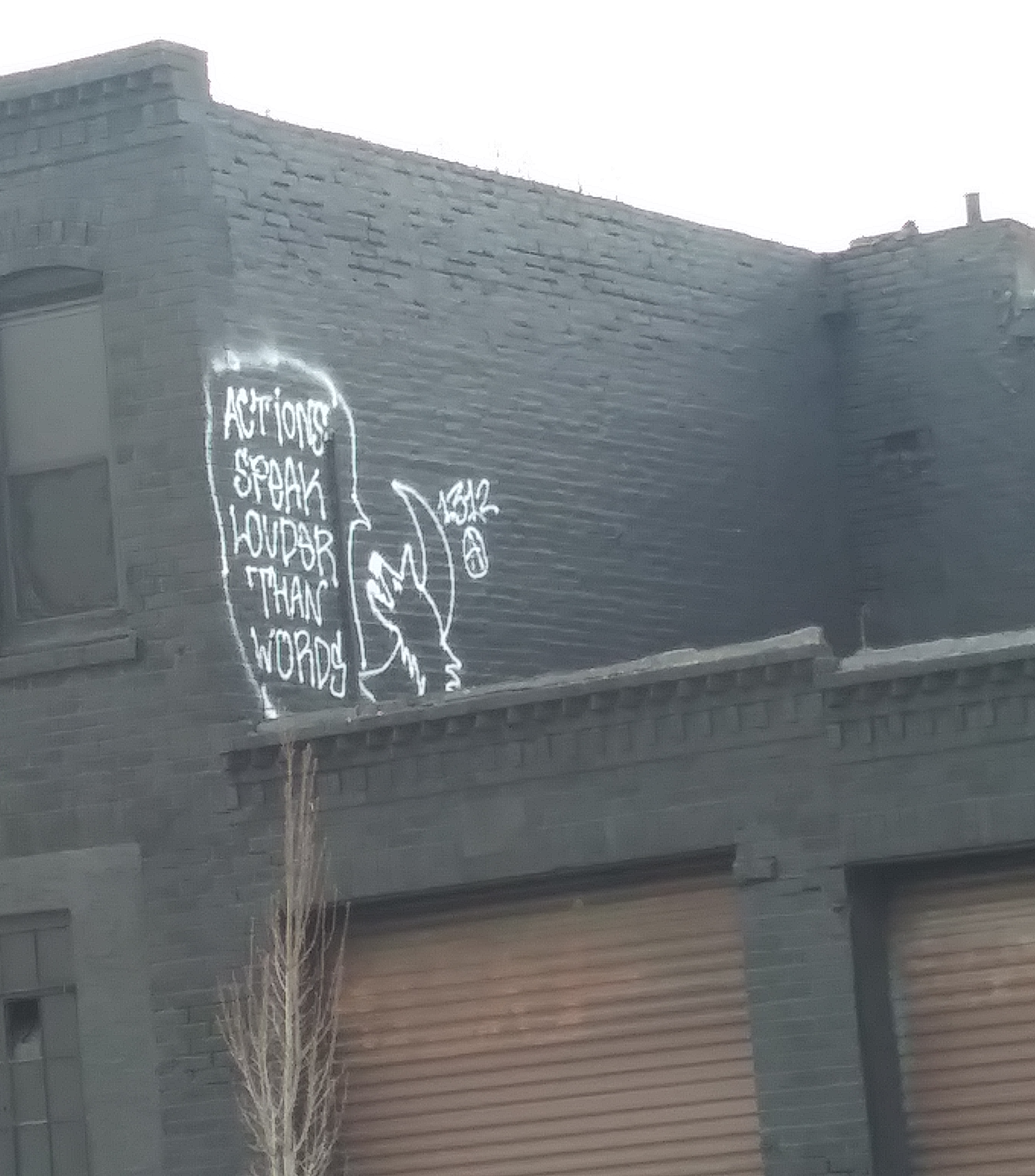
Actions speak louder than words!

Fuck The Law 4eva!

Stand Up, Fight Back: a Charlottesville torch rally Report Back

Submission

The following report back was written days after the Unite The Right rally that took place in Charlottesville during August 11th and 12th of 2017. We have chosen to release our collective accounts on the 6th month anniversary of the torch rally because we believe that as anarchists and anti-fascists, it’s critical for us to remember our history and to learn from it.


Friday, arriving in Charlottesville our crew knew what to expect. For weeks we had been aware of the Alt-right’s plans to have a torch march the night before the Unite the Right Rally. Having known about the torch march, we had no choice but to oppose it. We feel that as anti-fascists, we don’t “save our energy for the big fight,” we must oppose fascism whenever and wherever it chooses to rear its ugly head. Other traveling counter protesters we networked with for the weekend events were made aware of the size of the demo we were expecting Friday night, and we consider it a tactical failure that so few fellow anti-fascists came to oppose the torch rally with us. To those who did, we hope we’ll you see on the barricades.
 We were aware of the level of danger of the situation, and decided it was best to try to plug into the area and see if the locals were planning anything, as well as figure out the most tactically logical way to oppose the march with so few numbers. We found out about a gathering at St. Paul’s Church for local radicals and progressives. In order to learn more and connect with the locals, two of our crew went to the church to find out more. The following is an account from that encounter in the words of our crew members who attended:

The church was conducting a non violent direct action training, and later hosting an interfaith sermon featuring Cornell West calling for 1000 faith leaders to oppose the hate driven Unite the Right Rally. We were able to meet with a local radical minister deeply involved with the struggle in C’ville, and discuss the churches worries, plans, and needs for the upcoming troubles. The good Reverend shared with us that he had personally been doxed, the church had received multiple threats, and white nationalists were attempting infiltration. There was a lot of concern about the Neo Nazi torchlight display of force that was in the works very, very, very nearby the doors of the church. We offered to assist with the physical security of the church. The Reverends response to paraphrase was,” Sure, we can use an extra set of hands. But we recognize and appreciate a diversity of tactics. Perhaps what is just as important is that the Nazi torchlight march is opposed and disrupted.” From there we were introduced to other radical actors on the ground. 
 This was something that struck our delegation, some of us who have been involved in Anti-Fascist politics for a number of years thought,”Wow- this is the first time we’ve ever basically received a Reverends blessing for doing this kind of work.” 
A small number of us returned to the church in the evening to see where we could fit in and support the local community and the larger community of faith. Redneck Revolt and a number of other groups and individuals had set up a layered security perimeter to ensure the physical security of the church. The people and the church were at serious risk as it was standing room only, packed to full capacity with a fascist paramilitary force wielding fire as weapons across the street.

While members of our crew were in the church, the bulk of our group was scoping out the scene. As the nazi’s started to amass in Nameless Field, we quickly realized our numbers were nowhere near as high as we had hoped. We decided the best course of action would be to meet them at the statue of Thomas Jefferson, their end point, and disrupt their photograph. In total the number of people opposing the group of nazis was under 40. Around 15-20 anti-fascists circling the scene as well as 15-20 peaceful student demonstrators. As the march commenced, we got word that there were around 250-300 nazis on the field lighting their torches. The students linked arms and circled the statue, chanting and singing in protest. The small group of anti-fascists floated around them ready to fight and defend the protesters from the oncoming group of nazis snaking their way over and down the steps towards us. The nazis encircled us, chanting “Jews will not replace us, you will not replace us.” They came ready to kill any protesters, bearing not only torches, but also bottles of kerosene, cans of mace, and other miscellaneous weapons. Then they attacked, And we fought like hell.

That evening, we had noticed police lurking around, even having walked by a group of officers who greeted us, suspecting nothing wrong. While we were waiting for the nazis to arrive, A police vehicle was parked at the bottom of the steps across the street as well as one not more than 100 yards further. During the battle at least 4 officers stood less than 10 feet away and watched while unmasked student protesters were attacked by a violent, angry, torch wielding, mob. We are not in the least bit surprised. The entire concept of “police” supports the agenda of white supremacy, and with it the systematic murder of the oppressed.
 The battle was madness. Every member of our crew was pepper sprayed and beaten, with multiple people doused in kerosene. Nearly every protester was injured during the altercation, and a team of medics did their best to aid them during and immediately after the battle. 
 However, even though we were heavily outnumbered we were successful in stopping them from taking the boastful picture they had planned. When the nazis began to lose momentum, and the police finally told everyone to disperse, about 50 of the nazis took a picture without torches that hasn’t since made it onto any social media because of how defeated they were. 
 Around the same time, a group of between 35-40 racists dressed in the American Vanguard uniforms approached the steps of the church chanting “You will not replace us, Jews will not replace us” again. There was a call from Redneck Revolt and the Socialist Rifle Association to defend the church using the high ground and our smaller numbers managed to keep the marchers from reaching the church. 
 The entire evening was a terrifying reminder of the level of growing seriousness in the alt-right movement. What was even more powerful, however, was what we managed to accomplish when a small number of people stood their ground and fought back.


Charlottsville revisited: moving forward in the antifascist struggle


We’ve come a long way since Charlottsville. In the days following these events, it felt like most of the world was flooded with a storm of media coverage, interviews, report backs, and solidarity actions. For a brief moment, one could almost feel like we had beaten the nazis back into their caves and we could once again focus on combating our real enemy, the State. However, as Charlottesville fades further into history, we are aware that this is not the case. Fascist activity around the so called United States is slowly picking back up, with a myriad of gatherings and speeches being coordinated to happen over the next few months. We feel that it is critical to analyze the tactical choices made in August, and how we can learn from them.

For us, one of the most glaring tactical missteps was that the general consensus from counter protestors that the torchlit march held by the nazis would be significantly smaller than it was, even when we had reliable intel regarding the numbers who planned to be present. As antifascists, we believe that we should never underestimate our opponents, especially in situations such as these. Solidarity is our most powerful weapon against the rising fascist creep and we need to make sure we use it. Moving forward, with the Alt-right conference (Detroit, MI March 4th-5th), the TPUSA regional conference (April 14-15th Chicago IL), The NSM meeting in Temple, Georgia (April 20th-21st) and the American Renaissance conference (Burns, TN April 27th-28th) on the horizon, we recognize that we must grow our networks of solidarity both within more clandestine circles and local communities. We’ve beaten them before and we’ll beat them again.

The solidarity actions that took place after Charlottesville were incredibly powerful. With these, antifascists around the world were able to not only support comrades fighting in Virginia, but to send a message to those in power and the paramilitary far right organizations that defend them: We will never stand down. We are everywhere. Once again, we want to analyze this level of solidarity and how it can be used to further support each other in the future. From our perspective, anarchists and antifascists in North America could do a better job of supporting both local and international struggles through solidarity actions. The fight against fascism goes far beyond street battles and we recognize that any struggle against domination anywhere, is our own. We want to send our love and support to every crew, friend, and stranger who supported the struggle in Charlottesville.

6 months later, we still feel the pain of Heather Heyer’s murder and with it, the burning rage we hold towards each and every fascist scumbag that’s infected our communities. With every action we take, we carry the memory of everyone who’s lost their lives in the struggle against fascism and in the fight for a better world. We have a long battle and a long road of healing ahead of us.

In Love and Struggle,
-LCA

Signals of Disorder in West Philly

Submission

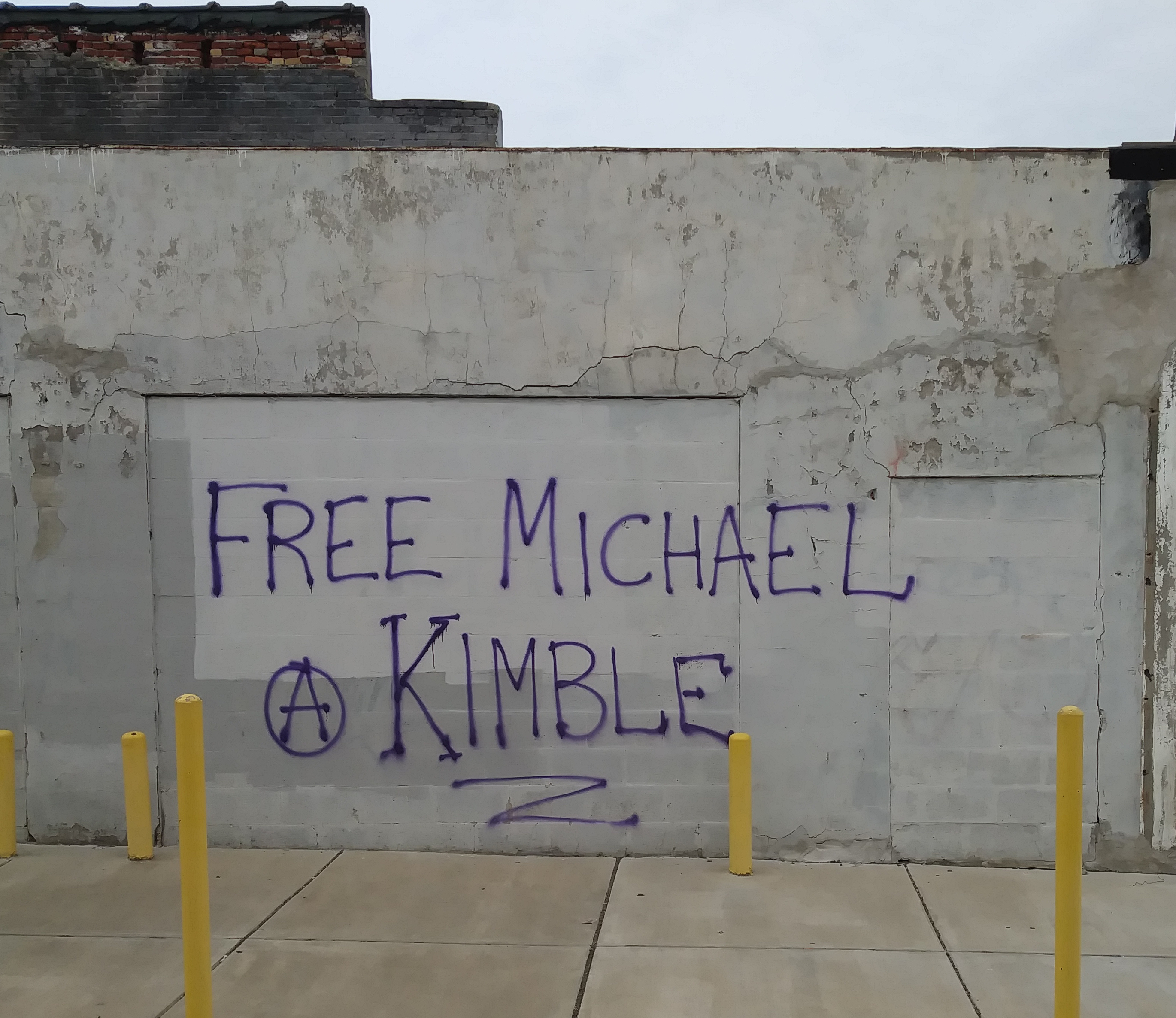
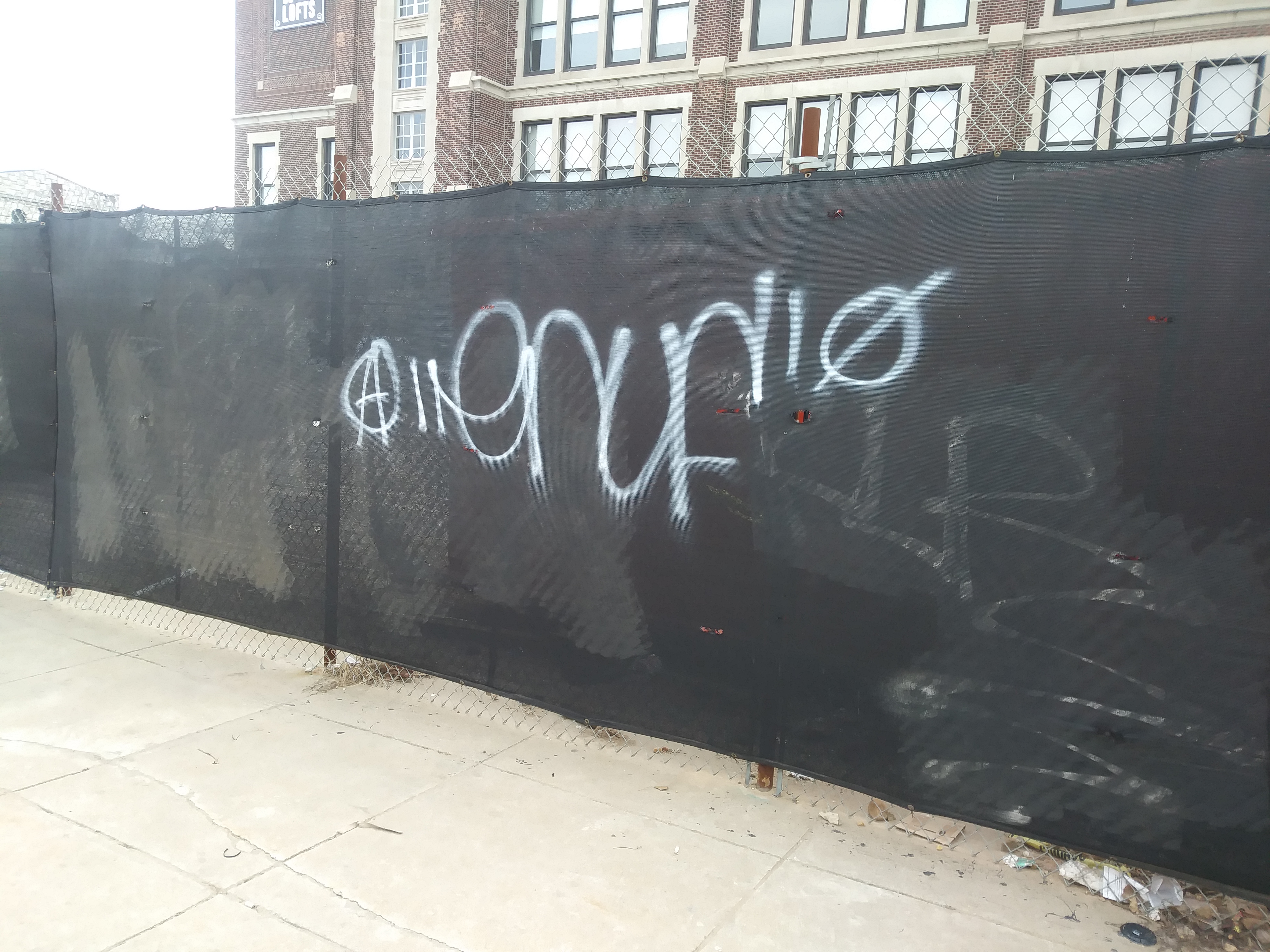
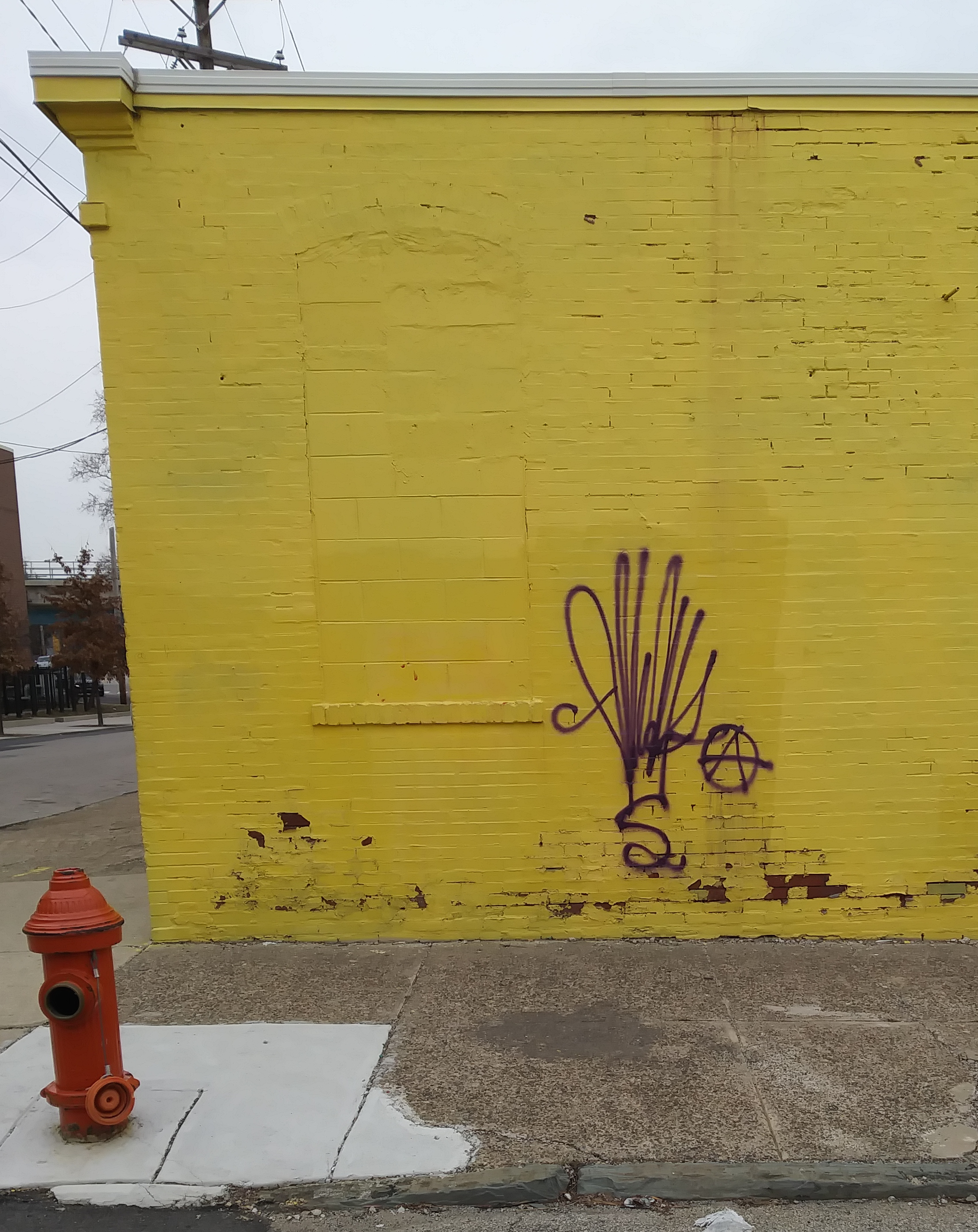
Took these photos over the last few weeks.