Nothing for Snitches: For a Revolutionary Anti-Repression

Submission

“The paramount issue is the character and integrity of the movements we are building. We must confront, vilify, and destroy traitors at every opportunity; deal with them as the dehumanized vipers that they are; instill ‘the greater fear.’ The political terms must always be clear: discredit and destroy all traitors.” – Sekou Odinga, Kuwasi Balagoon, Judy Clark, David Gilbert, Silvia Baraldini

In the wake of draconian sentences handed down to the Prairieland 8, each ranging from 30 to 100 years, much has been said about the role of Trump’s NSPM-7 in establishing new repressive tools for criminalizing activism. Less discussed has been the critical role of cooperation—by at least 6 of the Prairieland defendants—in securing these devastating convictions. While the terrain of repression is ever changing, what remains evergreen is our most powerful tool of anti-repression: the principle of non-cooperation with the state.

This statement is a call for unity against the forces that would nip any nascent revolutionary movement in the bud by suffocating its most basic survival instinct with equivocation about the need to keep out snitches. From its inception, the DFW Support Committee has chosen to include the cooperator Meagan Morris in its collective prisoner support effort, against the objections and concerns of many in the movement. Despite this controversy, the “anti-repression collective” known as Fire Ant Movement Defense has lent DFW significant media support, helping them popularize the “Prairieland 9,” despite there only being 8 non-cooperating defendants.

On July 7, 2026, Fire Ant published an essay called “Manufactured Betrayal” in CrimethInc. which serves as a justification for their practice. The piece proposes the possibility of an “off-ramp” for snitches, focusing in particular on Meagan Morris as an example of someone who “restore[d] their commitment to struggle” after informing on their comrades. By publishing this snitch apologia—along with Eric King’s rebuttal “No Way Home”[1] four days later—CrimethInc. has presented the question of if snitches should be welcomed back into the movement as if it is a debate with two sides—it is not.

By taking this position, these formations are setting the precedent that people can cooperate with the state and continue to receive the support of collective movement resources. We can only assume that welcoming snitches back into the fold is a position that DFW, Fire Ant, and CrimethInc. will continue putting into practice.

Meanwhile, those of us serious about building a revolutionary movement must unite around a collective commitment to the principle of non-cooperation. As a political, strategic, and ethical practice that prioritizes the collective movement over the individual, it is our only hope of withstanding escalating repression. Compromising on this principle destroys our basic capacity for self-defense. There can be no revolution without solidarity, and solidarity has no meaning without a commitment to non-cooperation.

– The Facts of the Situation –

Fire Ant claims that it is a strategic decision to bring cooperators back into the movement:

“At this moment, thousands of inexperienced new participants are flooding  into the fight for liberation. We probably won’t be able to educate all of them before they find themselves in confrontations with the state. Some of them will experience intense repression designed to scare them into cooperating before they fully understand the political implications, the options available to them, or their basic rights. When they find themselves staring down the barrel of a gun, some may well say something they shouldn’t. If we immediately make permanent enemies of everyone who do so, this may further endanger others.”[2]

This, however, is a complete distortion of the facts of Morris’ betrayal, and is the exact opposite of a strategic decision in relation to cooperators. To address the dangerous position of allowing snitches to enter back into the movement that they have betrayed, we must first address how this is a complete minimization of the extent of Morris’ cooperation.

According to her statement to law enforcement, Morris joined the Socialist Rifle Association in 2020 and learned of the noise demo from a Signal chat she joined “years ago after attending a protest.”[3] In another Signal chat that members suspected of being infiltrated, she stated that “if there are 4 or more liberals in a chat, there’s likely law enforcement.” This demonstrates that not only had she been active in movement spaces long before the noise demo on July 4, 2025, but she was also well-acquainted with movement norms regarding antagonism towards informants and agents of the state.[4]

Furthermore, the information law enforcement credits Morris with sharing could only have come from someone known and trusted by others as a comrade. By weaponizing the information she had been privy to in order to save her own skin, she became a willing accomplice in the state’s effort to construct a conspiracy narrative, which relies on criminalizing our relationships to each other.

Contrary to Fire Ant’s narrative of cooperators caving under “repeated torture,” Morris waived her Miranda rights and began snitching on her comrades within hours of her arrest.[5] Law enforcement credits her with identifying Autumn Hill, who was her live-in partner at the time and had not yet been apprehended.[6] Hill was arrested the next day on July 5, 2025, during a raid on the home she and Morris shared.[7] Morris also helped identify Joy “Rowan” Gibson and Benjamin “Champagne” Song, who she claimed to have met online and invited to her home before driving the group to the noise demo.[8]

While Song was still on the run, Morris provided additional information which led to their capture. She helped locate Rebecca Morgan—who law enforcement suspected of transporting and sheltering Song—by naming Morgan’s workplace and linking her identity to her Signal handle. The next day, an FBI SWAT team raided Morgan’s home, where they apprehended Song and took them into custody.[9] However, Morris’ betrayal did not end there.

In a follow up interview Morris requested after her initial statement, she linked the gunshots fired on July 4, 2025 outside the Prairieland Detention Center to Song, claiming that the sound was consistent with a binary trigger he had on his rifle. She also suggested that the shooting was premeditated, and that Song had intended to use the demo as cover:

“I don’t think it was an accident. A person set things up to have cover… I felt disgust and betrayal.”

“My suspicion is Song wanted to do this the whole time. To shoot someone. Have us all there with our guns… [his] jackoff fantasy… and get away.”[10]

Not only did she help deliver Song into the hands of the state, she actively contributed to its narrative of “attempted murder” in an attempt to scapegoat her former comrade. Furthermore, her “admission” to the existence of a coordinated plan serves as the linchipn for the state’s conspiracy dragnet, which attempts to link a loose network of comrades, friends, partners, and unaffiliated individuals in a “coordinated ambush” involving the shooting of a law enforcement officer:

“One of the suspects, Meagan Morris, admitted this was a planned protest of the detention facility that was coordinated online [emphasis ours] with numerous subjects bringing weapons, firearms, body armor, ballistic helmets, face shields, tourniquets and extra magazines and ammunition.”[11]

There would have been no “conspiracy” if not for the cooperators constructing such according to the wishes of the state. Far from a minor misstep which can be reversed via an “off ramp,” Morris’ cooperation was an essential element in the state’s case against the Prairieland defendants, without which her comrades Joy “Rowan” Gibson, Benjamin “Champagne” Song, Rebecca Morgan, and her own partner Autumn Hill might still be free. The extent of the damage she did was only possible because she had been trusted by those engaging in action alongside her. We have nothing to gain and everything to lose by making that mistake again.

– DFW Commitee’s Role –

The DFW Support Committee has decided to include the cooperator Meagan Morris in the court and prisoner support efforts, alongside the non-cooperating defendants. The DFW Committee offered no clarity or transparency as to who had cooperated and when they did so until January of 2026, shortly before the trial began. All of this information, however, was already available in the criminal complaints and other court documents released publicly in the early stages of the case. That cooperation had happened was a known fact, as well as the identities of the cooperators, and what specifically they had done. When slogans like the “Free the Prairieland 19” began circulating from the DFW Support Committee while paperwork revealed that 6 had already cooperated, people were left to wonder whether or not the cooperating defendants were receiving support. Fire Ant entered early on into the effort to gather public support for this case, while themselves being silent about the extent of the cooperation, as well as which defendants were receiving support.

While these concerns continued to circulate as more informed parties attempted to address these formations that were generating support, a story began to circulate that Morris had admitted she had made a mistake, and had re-committed to her co-defendants. When the DFW Support Committee began to attempt to rehabilitate Morris’ betrayal just before the trial, no insight was offered into what her reversal actually entailed in practice. It is still the case, however, that Morris’ actions before this reversal had already stolen people’s lives and aided the construction of the legal fiction of the “Antifa cell” that the state will now use at its will against anyone. The damage cannot be undone.

– No Room for Cooperators –

We have demonstrated that what Morris did was beyond the pale, and that there is no strategic reason for the pro-cooperator position of Fire Ant in the Prairieland case. But what about beyond this case? Can we ever allow someone who has betrayed the solidarity of their comrades to return? Fire Ant offers this answer:

“We must ask ourselves what we can offer defendants who have erred but  have yet to decide whether to continue to assist the state. If we cannot offer those who have begun to cooperate any incentive to stop doing so, that all but ensures that once someone starts cooperating, they will become a permanent addition to the state’s arsenal against us.”[12]

The problem with this, however, is that once someone cooperates, they have already become a permanent part of the state’s arsenal against us. Whether through informing on co-defendants, complying with a grand jury subpoena, or helping police identify other targets in order to take the heat off themselves, cooperators hand the state information that can and will be weaponized against the movement indefinitely. Once this is done, deterrence or reversal is not a possibility. In the Prairieland case, the only way to mitigate the damage done by Meagan Morris’ cooperation was for her co-defendants to challenge her credibility in court. By maintaining unity with her and standing trial together, they were left with no avenue to discredit her statements, thus compromising their ability to defend themselves.

Furthermore, cooperation is rarely an isolated incident. When police succeed in pressuring someone to snitch even once, whether by interrogation or other means, that individual becomes their first stop any time they seek information. By levying threats against those who wish to keep their initial cooperation a secret, promising them individual leniency, or using some other form of leverage, the state is able to cultivate longtime informants embedded in movement spaces. Thus, if known cooperators attempt to return to the fold, we must block them from doing so at every step.[13] Not only have they demonstrated that they will betray comrades if given the chance, but we can never truly know if they seek to rejoin with the intent of informing further.

In the case of Prairieland, making a lesson out of Morris and communicating to the broader movement why there is no return from what she did would serve an important function in teaching newcomers that complete social exclusion and disconnection from collective movement resources is the expected minimum consequence for snitching. It would establish clear lines against cooperation and eliminate room for confusion. However, Fire Ant would rather we teach people the opposite lesson:

“We reject simplistic generalizations that frame all mistakes as unforgivable, rendering it impossible to create an off-ramp [emphasis ours] for those who have previously cooperated with the state to change course, make amends, and restore their commitment to struggle.”[14]

Instead of offering clarity, the idea of an “off ramp” opens the door to endless ambiguity and hairsplitting around what constitutes a redeemable snitch. It teaches potential revolutionaries that there is a way back into our movement for those who have decided to save themselves by giving the state the means to take away the lives of other people. It undermines our power to enforce any standards and creates an incentive for opportunists to play both sides. Self-interested people could exploit the movement for their own gain, all the while being easy targets for future pressure by the state. Accommodating such elements would only weaken our movement by cultivating an individualistic logic of cowardice and self-preservation, leaving it defenseless against escalating state repression.

Soliciting cooperation is in fact one of the most powerful weapons the state can use against us, because it undermines the very fabric of solidarity that holds revolutionary movements together. We must prepare all partisans to expect this kind of pressure, and arm them with the knowledge that the only way to protect ourselves and each other is to remain silent and insist on speaking to a lawyer. When we are approached by law enforcement for information, we must immediately inform others publicly of what occurred and what the police are inquiring about, while making clear that we remained silent. When someone fails to do this, they cast suspicion on themselves if the incident is later discovered through court documents or other means, contributing to a destructive atmosphere of paranoia. The only way to protect ourselves against such paranoia is through a consistent practice of transparency and expelling any known cooperators in our midst.

Furthermore, we must teach people to expect that if they choose to join the struggle, jail and prison will always be a possibility. We recognize that what some activists call “torture” is simply the routinized violence of jail, and those who wish to join a revolutionary movement must steel themselves to withstand those conditions, and worse treatment, as Frantz Fanon helped revolutionaries do in the past.[15] Any breath wasted on justifying the betrayal of snitches takes our attention away from those prisoners who demonstrate behavior exemplary of a revolutionary in refusing to cooperate. With this comes an understanding of the contempt with which snitches are treated inside prison, and that those who cooperate jeopardize their own safety behind bars as well as the credibility of a revolutionary movement in the eyes of other prisoners. If we are seen as a movement that provides support to snitches, then we will be rightfully treated as enemies by the average prisoner.

Thus, where Fire Ant sees cooperation as an inevitability to which we must accommodate ourselves, we understand that a revolutionary movement must be capable of enforcing a hard line of non-cooperation at every turn.

– Revolutionary Anti-Repression –

This leads us to the question of the role of anti-repression work in the development of a revolutionary movement. We can turn this attack from the state into an opportunity to unite strategically along the political practice of non-cooperation and antagonism to the state and capital. Maintaining the consistency of non-cooperation in practice means that the work of organizing against repression must be conscious of its political character. The logic of the “off-ramp” that Fire Ant proposes is not that of building a revolutionary movement, but of a project of service provision to potential consumers.

Revolutionary anti-repression will not be for everyone. If anyone cooperates, they must receive no support, and be publicly made known to others. In order for anti-repression efforts to be revolutionary, they must be integrated into the effort of building a revolutionary movement. This entails identifying and engaging with cases of repression for political activity and providing support for those defendants. Support can provide material support such as funds for defense, as well as political, by helping coordinate defenses along collective movement principles. Defendants will need to be advised on how to assemble support committees, on the dynamics inside jails and prisons they should understand, and on how the carceral institutions they are engaging with function. This will demonstrate to defendants that revolutionaries can be trusted, and that solidarity is rewarded with solidarity. They will know that they receive this support because they resist becoming a tool of the state. In doing so, they become examples to others who we inform about this case, and to other prisoners inside.

Every political prisoner is a potential comrade. Revolutionary anti-repression must exist in order for defendants to know what their case means practically to the movement supporting them. They must know how the outcome of their case could set a precedent that will affect many others. This must inform the defense strategy that they choose to take. Lawyers cannot be expected to be the source of political clarity. Defendants that work in a tradition of revolutionary anti-repression need to be directly supported enough by revolutionaries to direct their legal representatives to construct legal strategy to accommodate the collective needs of the revolutionary movement. This means that the movement must be organized such that its political lines know how to enhance the efficacy of a defense’s strategy.

These points of tactical engagement in revolutionary anti-repression are at the level of dealing with an active case. However, this work cannot be confined to the exigencies of the courtroom, forced to always operate on the terms set by the state. This is what always keeps us on the back foot, unable to maintain any firm position in developing our forces. A defensive position can be made advantageous if an offensive strategy can be developed within the means of defense. What is learned from engaging in and studying the changing landscape of repression will allow us to develop practices of struggle that lead to the development of offensive capabilities that outmaneuver state repression. We must learn how to turn the weight of the leviathan against itself.

The fact that we are experiencing an influx of newcomers into the movement makes it all the more important that we must hold clear and unambiguous lines around snitching to eliminate any room for confusion. In doing so, we build a movement based on who demonstrates the most potential to become committed and trustworthy revolutionaries, if they are not already. That means prioritizing the interests of those who are able to remain steadfast in non-cooperation with their comrades, and having no qualms of casting those aside who cannot. We have no need for them or their accomplices in this treachery. Simply put, we will find tougher people.

For these comrades who will make up the truly revolutionary struggle, we cannot afford to be ambiguous or cowardly. We will better learn what we must build together to outlast this current wave of repression by preparing ourselves to engage in and enforce non-cooperation wherever we must. There will be cooperators left to fend for themselves in prison, but their own actions have already abandoned the struggle. That is the choice they have made and which has rendered us free of any responsibility to them. We make this choice ourselves because we recognize that the cost of compromise is much higher.

Revolutionary anti-repression cannot end with the support of direct cases of political repression. It begins here in our context, but the objective of state repression is to isolate layers of the population engaged in political activity from the potential mass base that could also become an organized force against the state. The state knows that the conditions for its own existence are those of the antagonistic social relations of capital. They reproduce this antagonism in order to produce capital, and in order to make that process stable, they expand the policing and carceral apparatus to keep the proletarians in line that their society produces, exploits, and oppresses.

Our era of mass uprisings against the police amongst racialized proletarians has shown that this population has revolutionary potential, but the failure of these uprisings to advance further also demonstrates that contradictions exist amongst those very proletarians that are barriers to their development into an organized social force, thus rendering them vulnerable to the eventual crackdowns by the state. These uprisings have emerged amongst specific populations and extended beyond them because of the history of the development of this repressive apparatus against both political movements and the activity of de-politicized layers of these classes. As such, it has created a value of non-cooperation that exists as an ideal among criminalized segments of the racialized proletariat.

The instinct towards a liberal appeal—forgiveness by the Democratic Party, individual redemption over collective resistance—and away from one of the most basic codes of honor amongst those engaged in illegality, reveals a politics oriented towards individualism, and a composition influenced by middle class values whose intended audience are those who share the same, and not those surviving through proletarian criminality. Needless to say, we are not making an appeal to victimhood or proposing a posture of deference to all who are victimized by capital and the state. We are saying that the normalization of snitches would only amplify the effects of the counterinsurgency that is already devastating radical movements, as well as the criminalized segments of the proletariat where we see an expression of latent revolutionary potential. This culture and strategy of non-cooperation has emerged because it is necessary for the survival of formations that are antagonistic to the state. As comrades have recently said, “the codes revolutionaries live by exist to keep a movement alive long enough to find possibilities of emancipatory horizons.”[16] The development and victory of our revolutionary forces depend upon our solidarity.

— Communists and Anarchists for Revolutionary Anti-Repression

Endnotes:
[1] https://theanarchistlibrary.org/library/eric-king-no-way-home-an-anarchist-ex-prisoner-s-response-to-fire-ant-movement-defense
[2] https://crimethinc.com/2026/07/07/manufactured-betrayal-a-statement-from-fire-ant-movement-defense-on-solidarity-and-betrayal-in-the-prairieland-trials
[3] page 5: https://prairielanddefendants.com/wp-content/uploads/2026/01/gov.uscourts.txnd_.406323.1.0.pdf)
[4] https://prairielanddefendants.com/court-notes/march-4th-federal-trial-day-8/#witness-lynette-sharp-cooperating-witness-in-handcuffs-and-striped-jumpsuit
[5] https://prairielanddefendants.com/court-notes/march-4th-federal-trial-day-8/#witness-lynette-sharp-cooperating-witness-in-handcuffs-and-striped-jumpsuit
[6] page 2: https://prairielanddefendants.com/wp-content/uploads/2026/02/Cofer_Luster_motion-to-exclude-meagans-testimony_2026-01-22.pdf
[7] https://yournews.com/2026/01/21/6233321/two-transgender-defendants-in-texas-ice-protest-case-describe-misgendering/
[8] page 6: https://prairielanddefendants.com/wp-content/uploads/2026/01/gov.uscourts.txnd_.406323.1.0.pdf
[9] page 21: https://prairielanddefendants.com/wp-content/uploads/2026/01/complaint-morgan.pdf
[10] https://prairielanddefendants.com/court-notes/march-4th-federal-trial-day-8/#witness-lynette-sharp-cooperating-witness-in-handcuffs-and-striped-jumpsuit
[11] page 25: https://prairielanddefendants.com/wp-content/uploads/2026/03/JohnsonCounty_Probable_Cause_Affidavit.pdf
[12] https://crimethinc.com/2026/07/07/manufactured-betrayal-a-statement-from-fire-ant-movement-defense-on-solidarity-and-betrayal-in-the-prairieland-trials
[13] See the case of Suzie Savoie in the Green Scare wave of repression and successive attempts that had to be made to continually remove her from related spaces after her cooperation: https://anarchistagency.com/an-anti-snitch-oral-history-of-the-seattle-wto-protests/
https://itsgoingdown.org/snitch-suzie-savoie-swarmed-and-deplatformed-in-southern-oregon/
[14] https://crimethinc.com/2026/07/07/manufactured-betrayal-a-statement-from-fire-ant-movement-defense-on-solidarity-and-betrayal-in-the-prairieland-trials
[15] For information of Frantz Fanon’s work in helping prepare revolutionary combatants for withstanding torture, see: https://www.parapraxismagazine.com/articles/fanons-revolutionary-gaze
[16] https://freepeppyandkrystal.noblogs.org/in-defense-of-dignity/
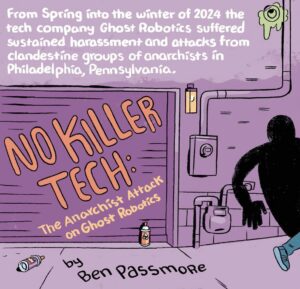
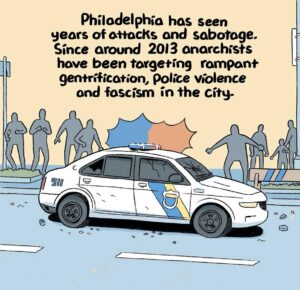
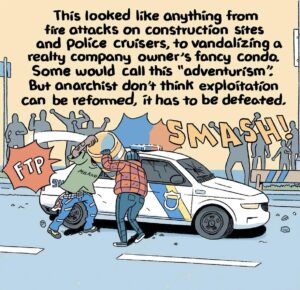
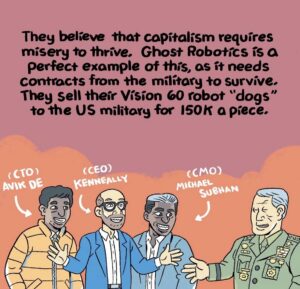
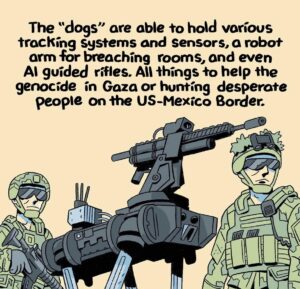
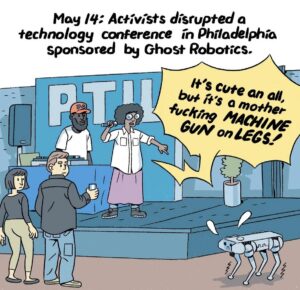
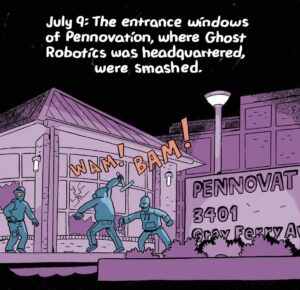
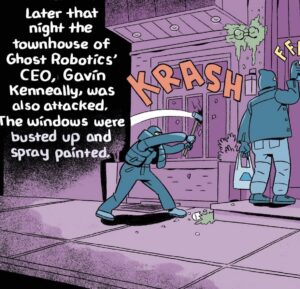
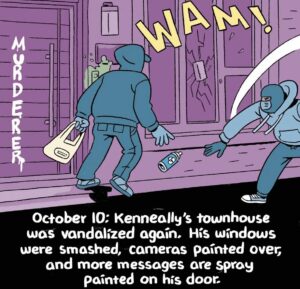
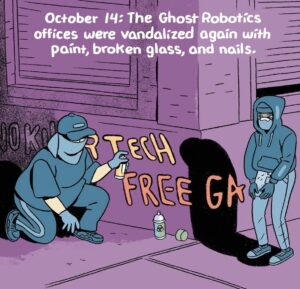
An Illustrated Chronicle of Attack – Philadelphia, PA

from Unravel

Found on Social Media

Anti Grifter action- a quick tactical handbook

Submission

Our crew has noticed increasing infiltration of right wing grifter-streamers into protests, namely Frank Scales and his Cameraman/bodyguard Ian McGinnis. These people generate rage bait content for the right wing media landscape by conducting bad faith “gotcha” interviews and debates to farm and selectively crop clips that get injected into the right wing outrage ecosystem. They use this tactic to generate money for their operations and create propaganda. They are disruptive and destructive and demand a response.

It is not so simple as normal bash the fash tactics sadly- this is actually a strategy built into their program, similar to Christian hate preachers like Aden Rusfeldt or the Westboro Baptist Church that stoke conflict and then use legal warfare and press charges to go after those who oppose them. They do want you to hit them, so they can record content, dox you, sue you, and generate income streams from playing victim. Frank scales is already pressing charges against a woman who confronted him on a bus and is weaponizing police to seek a man who he claims maced him at a protest. We need to adapt to these tactics very strategically.

Our crew has found simple content denial and disruption to be the most effective deterrence. This has been observed to stop them from generating content during several specific incidents. We point to two specific instances that were effective in stopping these grifters from getting a foothold-

In one case, a grifter and his camera man were attempting to generate clips from an anti ICE protest. An operator observed from afar, made sure their identity was fully protected and they weren’t in view of the camera in question, and in a moment when the grifter was physically separated from police by a crowd and distracted by protest marshals physically walling him out, they quickly snatched the phone recording and threw it into the crowd, where it was not recovered. Phones can be smashed if there is time or thrown into storm drains (apologies to the Delaware watershed) or locked solar trash compactors. This immediately denies the material ability to generate content. It is an extremely easy point of vulnerability and can be quickly exploited with a few people acting as diversions. Operators can quickly change clothes and disperse from there with the mission accomplished. Flags and banners can also be used to block cameras and generate confusion and block visibility to ensure these operations go smoothly. Anyone can do this and immediately disappear into a crowd or into the city. Dedicated teams should be set up to ensure this security at every protest.

In another case, operators interjected at every attempted interview or debate to just sound bomb the stream with declarations of the streamer’s support for the Epstein-pedophile class- this is messaging that resonates with their intended audience that should be reinforced. No clips from this day were used in later content because of this disruption. Alerting speakers to the presence of these streamers and having them address the crowd and laying down specific disruptive tactics that deny them their rage bait content also seemed highly effective. We think speakers at rallies should identify the targets as bad faith actors and encourage people not to engage beyond physical interference of their ability to generate content.

Optics matter and these are delicate situations that must be approached with intention and specific tactics to ensure that their effectiveness is rendered inoperable. We cannot be doing solely a brute force approach, we need specific tactics. The simple denial of content generation seems to be the best move going forwards. By all means, bash those fash when feasible, but make sure the cameras are off first. It should be done quickly and quietly without turning into grand confrontations that they salivate for. We have the power to easily and decisively counter these tactics. They will suffer in a silence that we can easily enforce.

Expect counter measures like security details and securing vulnerable devices to persons. Find creative workarounds. Stay adaptable, This is an optics battle that we can win if we make sure to go straight for the eyes.

Anon – Whither Black Anarchism? : An Anarchist Critique of Contemporary Black Anarchist Culture in the United States

from Muntjac Magazine

Part of Muntjac Issue 2. 

[A4 PDF] [US-Letter PDF]

Note: This is a self critique and a critique of communities I’ve been a part of my entire adult life. It was very hard to write especially in a moment where it feels like anarchist activity is low but revolutionaries have to remain honest especially in these perilous times. I speak about Black anarchists cause those are the people I spend most of my time around however many of these critiques could be extended to Non-Black POC and Indigenous anarchist tendencies as well.


It is unclear if Black anarchism matters. Despite those who would say to the contrary, Black anarchism is not a primary vehicle actively pursuing the short term goal of destruction of the United States and the longer term goal of social revolution. Despite the rise of podcasts, social media accounts, publications, zines, articles, Black anarchist organizing projects remain sparse. To the authors’ knowledge, Martin Sostre House (a social center/housing collective), Balagoon Boxing Gym (unclear if this project is still active), Black Autonomy Federation-LA, Black Autonomy Federation-Chicago (unclear if this project is still active) and Black Lantern Book (a bookstore) are the only projects that exist in the United States with a clear commitment to Black anarchist politics. It should be acknowledged that some projects and affinities must remain clandestine but regardless of that, it remains a relatively poor showing for a tendency that has existed for decades at this point.


Despite the constant Black anarchist critique of white anarchist subculture as ineffectual or disconnected in texts such as Black Anarchism and the Black Radical Tradition published by Daraja Press, Black anarchists themselves have failed largely to organize amongst themselves let alone amongst Black people. This is a failure. If all Black anarchists can offer is zines and critique, they are no better than white leftists who stick their heads in books all day. While it is easy to blame white anarchists, Black anarchists refuse to look to their own failures. If there’s a true belief that white anarchists or authoritarian socialists are as fascist or counter revolutionary as some proclaim, then why are they not being organized against? Why are they not being robbed or beaten? If the Black leftists and the non-profits are such a threat to our movements, why are they not being robbed or beaten? The threats are all rhetorical. Instead, Black anarchists act like liberals as they demand reparations/accountability from white radicals.The unfortunate truth is that Black anarchism as a tendency in the United States is still rooted unfortunately in a politics of victim-hood rather than agency.


Furthermore, Black anarchism is going the way of the non-profit industrial complex or academia as more books, articles and lectures are published. Numerous opportunists see Black anarchism as a way to make a quick buck so they build their personal brands around it. I’m not gonna name names cause it’s actually so common though at this point, the only Black anarchists I trust are the ones who publish anonymously. These “black anarchist” personalities are no different than enemies like Patrisse Cullors or Opal Tometi from BLM. Black anarchism no longer exists in a subversive sense. And perhaps, it never did (although Lorenzo, Ashanti and Kuwasi’s brave actions certainly must be acknowledged). Anarchism is fundamentally a set of practices that revolutionaries use to pursue revolution. But if the anarchists in question are not building towards any type of revolution or insurrection, then the practices make little to no sense as they are not being practically applied. Again, I ask myself how are Black anarchists any different from many white radicals who simply read books and make critiques while refusing to get their hands dirty alongside the oppressed and exploited? Podcasts, memes, edgy twitter threads, cookouts, patreon accounts, and gofundmes are not an organizational orientation that is compatible with a revolutionary anarchist set of politics. Platitudes, complaints, hanging out and slogans are not substitutes for action. Idealizing anarchist movements in other places and posting riot footage is not a substitute for action here. And unfortunately, there is quite little action from Black anarchists these day. But there’s a whole lot of tweets.


Despite anarchist critiques of the following formations, the Black Panthers, the Black Liberation Army, the Black Guards, RAM, various New Afrikan formations, the Black Unity Council, Black Guerilla Family and others had an organizational orientation that built towards revolutionary struggle. There is nothing equivalent to that in the United States in terms of Black anarchists. Instead of a movement that organizes, there is a rampant culture of individualism (not the cool kind either), complaint, cowardice, and opportunism. The refusal of Black anarchists to organize and provide alternatives to all of the things they hate is proof of a weakness that is rooted in a racist self hatred, inferiority and victim-hood mentality that is inherited/taught by the legacy of from slavery and its afterlives…the non-profit industrial complex, academia, racist public schools, and prisons.


The abandoning of our political prisoners is evidence of this racist self-hatred as well. Big names in Black anarchism do nothing to uplift and support the various Black prisoners of the George Floyd uprising such as Malik Muhammad or Mujera Benjamin Lunga’ho. While Black anarchists make constant claim of revolutionary politics, there is little to no support for Black revolutionaries in prison. Perhaps it is because many Black anarchists are simply subcultural scenesters scared of the real revolutionaries who have sacrificed their freedom and ended up on the inside of the enemy’s prison? Or perhaps many Black anarchists are so divorced from real struggle that they have no knowledge that some Black people have taken real risks for our movement while they complain about crackers online? Perhaps it is because Black anarchism similar to the white anarchists they constantly set ourselves up in opposition to remains a petit-bourgeois tendency that cares little for the struggles of the lumpen-proletariat? I don’t have a clear answer. I know that’s not the case for me and my comrades but we are few and far between in the existing Black anarchist tendency. And it makes me wonder, what is the point of any of this? Shouldn’t we just be anarchists?


Maybe to find revolutionary organizing efforts oriented towards Black liberation (albeit imperfect), it is better to look to some of the Black nationalist groups such as Community Movement Builders, Cooperation Jackson, Huey P. Newton Gun Club, Malcolm X Grassroots Movement, Black Men Build and others. These groups despite their contradictions are making efforts to build a Black revolutionary trajectory albeit one that I am largely uninterested in personally. Doubtless some readers will admonish me for referencing these groups due to their political failings but the reality is that these groups are at least attempting to building capacity while many Black anarchists remain inactive or adjacent to ineffectual white anarchist subculture. These spaces may be contested perhaps while the Black anarchist spaces themselves do not seem to exist besides the projects mentioned earlier.

The author believes these questions must be asked because the current culture around “Black anarchic radicalism” as some call it is not a revolutionary culture. It is a culture largely for those with proximity to white anarchists, the Black left or the non-profit industrial complex to voice their frustrations and then sit at home. There is no revolutionary horizon with this current trajectory. Critique is not a stand in for attack. Critique is not a stand in for organization. Critique is not a stand in for capacity. Critique is not a stand in for affinity. Critiques only hold weight if there is a desire and effort to out-organize the enemies or even comrades you are critiquing, otherwise your politics hold no weight.


Black anarchists should tweet less and attack more. I no longer feel committed to the Black anarchist project. Instead, I remain simply an anarchist with a desire for Black liberation. Various anarchists I know (regardless of their apparent to Black anarchism as an ideology) are more committed to these struggles than most self identified Black anarchists. Political identity especially when it comes to race can only go so far. Black anarchism remains mired in the muck of opportunism, inferiority, self hatred and cowardice. Until Black anarchists commit to a politics of comradeship, bravery, experimentation, and love of other Black people, it is unlikely I will rejoin the tendency. I learned my anarchism from the Black anarchist theorists but I cannot willingly remain a part of a tendency that has done so little for ourselves let alone the broader Black struggle. Black anarchism was meant to be a weapon to be wielded for Black liberation. If the current Black anarchist culture in the United States is the example, it is a faulty weapon that would backfire and kill me.

My comrades who I remain most inspired by take inspiration from many other tendencies other than just Black anarchism. While understanding the importance of our historical legacy from Black anarchist elders, my comrades politics are much more grounded in different strains such as insurrectionary anarchism, Islam, Black nationalism, nihilism, and queer militancy. These things seem like better jumping off points for building a revolutionary culture than Black anarchism even if some of them contradict one another as these origin points are a set of politics not built entirely on complaint as Black anarchism seems to be. Anarchy pulls from many different strains, the insistence on Black anarchism or an anarchism that is non-white is uninteresting as it is simply reactive. So I think for the moment, anarchy will just have to suffice.

Anonymous Submission, if this article made you feel some kinda way, consider writing a reply to it… (or better yet, go do some cool shit and mention you’re a Black anarchist in the reportback)

Words Mean Things Zine

from Anathema

This compilation is coming together in a moment when it feels that many anarchist ideas are losing their meanings. Dragged out of anarchy into leftism or activism, drained of their radical content. Mutual aid is giving away supplies, direct action is a more aggressive form of begging, anti-fascism is reduced to publishing personal details about our enemies, attack is left to gather dust or spectacularized as a social media aesthetic.

Lining up anarchist ideas and practices is not always easy, which is no reason to lower the bar. It’s with this in mind that it felt useful to compile these articles, to clarify just how radical anarchist ideas really are, to encourage people to keep imagining and moving toward absolute hostility with authority and anarchic relations with everyone else.

Screen reading PDF

Zine printing PDF

The Anarchist Bookstore That Shouldn’t Be!

from Anarchist News

wooden shoe

From Fifth Estate # 417, Winter 2025
by Carl Craft

Wooden Shoe, as a publicly facing anarchist infoshop, was established in 1976 and, using capitalist projections, shouldn’t exist. Amazingly, it still does. Many visitors share stories about their parents as youthful hippies or punks hanging out on South Street in Philadelphia and coming to the Shoe to learn about the system.

As a current volunteer described: “Wow, I was in my twenties coming out of the early New Left, SDS-gone-vanguard, mass mobilization against the Vietnam War, anarcho-curious, and searching for an anarchist project and practice or at least an attempt. The early Wooden Shoe gave me such a project in collaboration with others. Now, in my seventies, I’ve returned to Wooden Shoe as a volunteer.”

According to the U.S. Bureau of Labor Statistics, the average lifespan of a new business is about eight and a half years. So, how has the Wooden Shoe remained active for almost 50? There are several explanations.

The all-volunteer shop, which takes its name from the sabot, literally a wooden shoe worn by French peasants that would be thrown into the gears of a machine as sabotage, is located in a tourist area of Philadelphia, so the store gets a steady stream of curious visitors. It stocks a wide array of book titles, including a section on anarchism as well as LGBTQA, feminism, poetry, graphic novels, children’s and more. Monthly events also create interest.

At its start, some people involved with Wooden Shoe funded the proposed project. However, as anarchists, left libertarians and new left individuals, many with experiences in top-down leftist organizations and parties, acting as a capitalist and expecting a return on their investment was not their expectation. Rather, it is voluntary, collaborative participation that runs the Shoe and makes it a place where people want to be.

The pleasure of involvement is clearly expressed by two volunteers.

“I love the community that the Shoe cultivates. Between the volunteer collective, event organizers, and our patrons, staffing the store ensures you will meet new, like-minded people,” says one.

The other echoed that feeling, saying, “I like that being part of the Shoe allows me to make a difference in ways I wouldn’t be able to on my own. If I have a project idea that betters the communities around us, I can propose it to the collective and have their support in pursuing it.”

From the start, a fundamental aspect of anarchist relationships—consent, free of coercion, among equals—was tried. But the conundrums and contradictions were and are many. The ugh factor can be large and a sense of humor and even sarcasm is needed. Wooden Shoe exists within retail capitalism among all the other hierarchies associated with racism, patriarchy, class and other forms of systemic oppression. The store puts prices on peoples’ creative efforts and thus turns use value into price points (commodification) for books, pamphlets, patches, t-shirts, zines. It needs a legal identity to sign a commercial retail lease, and more.

The shop currently has a nonprofit status with governments, its landlord and the world at large. All this requires designated officers, bylaws, and the filing of yearly financial statements with the Pennsylvania Department of State and the IRS. So, at times participants ask themselves, is the store an authentic anarchist-oriented project or just another small retail business?

What makes Wooden Shoe an anarchist project, in addition to the store’s content, is the volunteers’ ongoing attempts within the project to relate and interact with each other based on a wide array of anarchist constructs—non-hierarchical interactions, consensus among equals, including in decision-making, inclusivity, and transparency with sharing on procedures, finances, history. They also strive for ongoing self-awareness and self-evaluation of our identities and personal histories and their impact on involvement and relationships in the Shoe. Many view the project in the context of the long-standing anarchist tradition of prefigurative politics, trying to embody the visions of a collective anarchist future. Often this is a difficult effort and participants fall short.

Those involved with the Wooden Shoe describe themselves as a volunteer collective. Since inception, people volunteering their time and energy have operated the project and this is a wondrous reality. Bringing in new volunteers is an ongoing process. People interested in volunteering are asked to be in general agreement with the store’s written mission statement and statement of values and to complete three training orientations. Staffing volunteers determine to what extent they will staff and/or participate in working groups as well as decision-making.

All this sounds pretty straightforward. However, every volunteer has an ongoing life—which may involve employment, relationships/family, childcare/parenting, schooling, other volunteer activities, and their own physical and mental health needs.

Thus, there are significant differences among volunteers related to how much time and energy they can give the Shoe project. This leads to an unequal distribution of in-house knowledge of projects and procedures. Sharing information and knowledge about these is an ongoing necessity for volunteers on a daily basis and at collective meetings. The arrival and exit of volunteers is continuous and is to be expected. This creates an unequal hierarchy of know-how.

Given these realities, there are practical aspects of sustaining the project. Volunteer collective meetings are currently twice a month and the bylaws state that those volunteers attending a meeting make decisions as needed. No quorum required. The notes from a collective meeting are sent to all volunteers. Anyone who cannot attend a collective meeting, after reading the notes, is welcome to question and even block a reported decision by sharing their opinion/ objections and any proposed alternate ideas within three days of receiving them. Once they do that, then the decision is not implemented and the expectation is that whoever objects will participate in the next collective meeting to attempt to reach a consensus.
Then there’s the money thing. Leading up to the Trump election in 2016 and since then, revenue beyond expenses at the Wooden Shoe has increased. What to do with this money has been an ongoing decision for the collective. Funds have been set aside as a safety margin. The preference of the collective is to give away most of this additional money. At monthly collective meetings, funding proposals to organizations, including other nonprofits, are considered. Some groups request funding—from local Philadelphia-based organizations to ones around the world. This past year, the collective has donated funds or printed materials to thirty organizations and groups. (Fifth Estate note: Including to this publication. Thank you, comrades!)

In addition, Wooden Shoe is a supporter of the Philadelphia Area Cooperative Alliance (PACA). Through PACA Wooden Shoe offers no interest loans to Philadelphia based cooperatives. We expect to soon provide loan funds to an immigrant craft outlet and a BIPOC herbalist collective.

Carl Craft is a Wooden Shoe volunteer. The collective would like to thank the founders and early volunteers—Frank, Ben, Louise, Adrian, Steve, Barbara, and Albo. woodenshoebooks.org or sabot@woodenshoebooks.com for more information.

Local Streamer Frank Scales Exposed For Lying By Police Scanner

from Philly Fash Watch

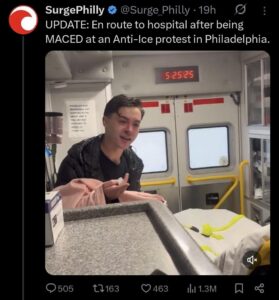
Philly has a new entry in the right wing rage bait streamer category, 23 year old Frank Scales. This is a very brief introduction to Frank; something more comprehensive will come soon from this blog. For now we’ll just expose Frank Scales lying about a recent incident. On Saturday January 10th Frank posted a video from his Surge Philly accounts spread across social media platforms of himself in an ambulance. Doing his best Andy Ngo impersonation, Frank Scales states “we don’t know if there’s bleach in it. We don’t know what they put in the solution that they sprayed at me”.

After Franks video was posted an anonymous source sent us a recording of police scanner communications regarding the incident. The scene commander from the Philadelphia Police Department is acknowledging that Frank was sprayed by his own side!

We can go even further and state that it wasn’t just random assholes from Franks side using pepperspray in the peaceful crowd, it was Franks cameraman who sprayed his face. More to come on that individual.

Francis J. Scales, 23, of South Philly on Front Street is a Temu version of people like Jack Posobiec and Nick Shirley. There is nothing good that can come from Frank being in protest spaces. Remove him immediately so you don’t become content for his social media rage bait. We protect us

Anarchy After Hours

from Instagram

TONIGHT! Join us for the first ever Anarchy After Hours reading group at the LAVA Library. This is the first meeting in a series that will run every other Thursday for the foreseeable future from 630-730 PM.

We will be reading Peter Gelderloos' Anarchy Works for the first few meetings. The group will decide today how quickly we want to finish the book and how we want our meetings to be structured. Anarchy Works is available for free download at the Anarchist Library at theanarchistlibrary.org. 

The book provides an accessible overview of anarchy,  and provides examples of how it has proven itself to be an effective organizing strategy throughout history. 

Volunteer librarians will be running this meeting, and donations are appreciated to pay for snacks and to keep our program afloat. As always, masks are required inside the space.
TONIGHT! Join us for the first ever Anarchy After Hours reading group at the LAVA Library. This is the first meeting in a series that will run every other Thursday for the foreseeable future from 630-730 PM.

We will be reading Peter Gelderloos’ Anarchy Works for the first few meetings. The group will decide today how quickly we want to finish the book and how we want our meetings to be structured. Anarchy Works is available for free download at the Anarchist Library at theanarchistlibrary.org.

The book provides an accessible overview of anarchy, and provides examples of how it has proven itself to be an effective organizing strategy throughout history.

Volunteer librarians will be running this meeting, and donations are appreciated to pay for snacks and to keep our program afloat. As always, masks are required inside the space.

Interview with Comrades on the Situation in Indonesia

from Durian Distro

Since the ascension of the Prabowo Subianto presidency, the valiant people of Indonesia have resisted and pushed back on Prabowo’s authoritarian designs. Prabowo Subianto was the son-in-law of the hated Suharto, the dictator of the New Order period. During the New Order, Prabowo orchestrated massacres in occupied Timor-Leste and oversaw the forced disappearance of democratic activists. He rose to the presidency in an electoral campaign making use of fake news, AI-generated images, and authoritarian nostalgia.

It is theorized that the period of Indonesian democratization known as the Reformasi (reformation) has ended and that a new period of militarization and dictatorship has arisen known as the Neo-Orba (the new New Order), a civil-military dictatorship. This Neo-Orba is part of a global trend of democratic backsliding or autocratization.

Anathema Volume 11 Issue 1

from Anathema

Volume 11 Issue 1 (PDF for reading 8.5×11)

Volume 11 Issue 1 (PDF for printing 11×17)

In this issue:

  • What Went Down
  • Ins & Outs
  • Leadership
  • Is It Fascism?
  • Ten Years Of Anti-Gentrification
  • Ben Morea Talk Reportback
  • Anarchist Muay Thai
  • The Moon Is Down Review

Saboteurs Of Rent Zine

Submission

This text hasn’t seen much circulation in Philadelphia, despite going into a good bit depth about the anti-gentrification struggles that took place here. Although the text has some points I would personally disagree with, I find it to be a good introduction to both Philly’s history of anarchist anti-gentrification struggle and the influence of insurrectionary anarchism within it. The original text was published on Hypocrite Reader and then re-published on Philly Anti-Capitalist. These kinds of histories are important; to remind ourselves as anarchists and fellow travelers what is possible, to continue to strive to outdo ourselves moving forward, and to learn from our mistakes and shortcomings.

[PDF for reading]
[PDF for printing]

Strike Captain Interview: Philly’s DC 33 Union to Vote on Agreement to End Historic Work Stoppage

from Unicorn Riot

Strike Captain Interview: Philly’s DC 33 Union to Vote on Agreement to End Historic Work Stoppage

July 19, 2025

Philadelphia, PA — American Federation of State, County and Municipal Employees (AFSCME) District Council 33 (DC 33), the city’s largest blue-collar union, launched a historic strike earlier this month, halting sanitation services on a scale not seen since 1986. Despite the pro-union image Philadelphia Mayor Cherelle Parker wishes to project, legal injunctions were used to force many city employees back to work – creating pressure to end the strike.

“The city was trying to pick us apart with injunctions all over the place,” requiring water department employees, 911 dispatchers, and city medical examiners to return to work immediately, DC 33 President Greg Boulware explained in a recent interview.

After reports of alleged sabotage and confrontations with scabs (non-union workers hired to replace strikers), another court order demanded a stop to “unlawful activity” at picket lines, but included additional stipulations such as limiting pickets to 8 workers and requiring pickets to stay 10 feet away from entrances. With weaponized judicial pressure mounting, on the early morning of July 9, DC 33 reached a tentative three-year agreement with the city of Philadelphia that ended the eight-day strike.

“You can’t claim to be pro-labor, pro-union, pro-worker and then not make steps to do things that would change the economic status to do things,” said Boulware.

“The Mayor also tried to connect the housing initiative [a public benefit designed for ‘low-wage workers, under-employed or unemployed, municipal and union workers…’] to our membership, which had nothing to do with it at all. If you have a program in place try to get poor folks into housing, once they’re in that housing they have to afford to live in that housing…” 

DC 33 President Greg Boulware

Sanitation workers in Philadelphia earn the lowest salary of any major city in the US. According to the MIT living wage calculator, the current average salary of a DC 33 member is more than $2,000 below the wage needed for a single adult without children to live in the city. For a family with one child, the living wage gap nearly doubles. One worker on the picket line said she couldn’t afford to buy diapers on her current salary. Depending on family size, the average city worker may be eligible for public assistance.

As garbage collection returns to its regular schedule this week, DC 33 members have until Sunday, July 20, to vote to accept the new agreement, or reject it – which may lead to a second strike authorization process. Many striking workers demanded no less than a 5% increase in their current pay, down from the 8% annual increase DC 33 initially proposed in negotiations. The tentative agreement only offers a 3% increase year-over-year, not far from the city’s original offer that led to the strike in the first place. The union vote will be announced on Monday, July 21.

Despite the anti-union tactics and lawfare by the city, many strikers stood true to their purpose of trying to win better economic treatment on the picket line. Unicorn Riot was able to speak with one DC 33 ‘Strike Captain,’ an unofficial point person informally designated by the union, about where things are potentially headed and how the strike went down. This interview was conducted on the condition of anonymity and represents their individual perspective and experience.


Unicorn Riot: How did DC 33 union members react to the announcement of the tentative agreement reached with Mayor Parker’s administration to end the strike, considering the terms were far below many of the strikers’ demands?

Anonymous DC 33 Worker: A lot of people are like, “What happened in there?” Because from a lot of picket lines it looked like we were doing OK. People could see the rotting trash getting worse and the understanding was that with more time, we had more leverage.

Even though people were missing paychecks, what I’ve heard from coworkers across the board is that if we were already striking, we should’ve waited longer. They don’t really understand what happened.

I don’t hear a lot of talk that [DC 33 President] Greg Boulware sold us out or anything. I have heard people say it’s suspicious that the AFSCME national President [Lee Saunders] sat down at the table with them the day that we folded.

I’ve heard that we should’ve struck for longer. People just don’t really understand how we went from guns blazing to folding immediately.

There’s a lot of questions about what a ‘No’ vote would look like. It’s hard, because the issue is that things are not really structurally coordinated, so even the idea that we would purposely try to track like, “OK, here’s our membership and let’s try to talk to everybody about whether they’re asking to vote ‘Yes’ or ‘No’ or just to get out the vote” is not intuitive, I’m finding, even though it’s like, to me, kind of what labor organizing is.

At this point, enough [DC 33 members] are individually pissed that the majority of the people who show up might vote ‘No.’ The majority of the people who show up probably won’t be a majority of the union. So if the issue is that people weren’t showing up to strike, having a majority of a minority vote ‘No’ doesn’t solve that problem. The way I’m talking about it with people is, you certainly should vote to show that people are engaged in the union on this.

I’m personally not in support of any kind of coordinated “Vote No” campaign unless it has an ask associated with it. If we wanna do a coordinated “vote ‘No’ until we see this very specific possibly winnable clause added,” then that would be one thing. But I’m wary of the idea of “just vote no,” because I think our leadership tried to get the best they could. Like, I do kind of believe that Greg Boulware got the best he could under the circumstances from where he was sitting and could see everything. So I hesitate to be like, yeah, vote no and that will suddenly mean we have all this leverage. If it wasn’t there, it wasn’t there.

There’s a lot of confusion and misunderstanding about what things trigger what actions. A lot of people saw the letter saying that the [DC 33] local Presidents, the executive board, had voted to send this Tentative Agreement to the membership. And they were like, “oh, do we not get to vote then?” And it’s like no, that’s who voted to end the strike, that’s not the vote [to ratify the tentative agreement].

UR: The tentative agreement (TA) isn’t ratified until you all vote, right?

DC 33 Worker: Yeah, but a lot of folks just saw that and thought, “oh, every local voted and so that’s done now.” So there’s a lot of talking to people about that. I’m not saying they don’t understand, but they are not receiving any information about how this stuff works.

UR: One thing that was somewhat unique about this strike was the amount of intersectional movement support that we don’t always see with Philly unions. For instance, the Sunrise Movement staging a sit-in at City Hall supporting the workers’ demands is not something we typically see in other municipal services or other strikes in Philadelphia. Why do you think that is?

DC 33 Worker: Municipal strikes, and public sector strikes in general, depend upon public opinion. We could’ve done more with public opinion. Ideally there would’ve been more flyering, more encouraging people to co-worker-organize themselves by talking to their own social networks and getting their churches and community groups on board with the strike.

DC 33 Worker: I appreciate that community groups with less organic connections to us stepped up to do tactics that the union technically could not do. I can’t do certain behaviors without risking getting my own picket line and all the picket lines further injunctioned. But if the people of Philadelphia feel so inclined, then that’s their business.

UR: How do you see the DC 33 strike within the larger context of racial injustice, extreme poverty, and economic inequality in Philadelphia?

DC 33 Worker: One of the reasons we were able to come out with the force that we did – even while some chunks of the union did not have the same level of organization as others – is that historically DC 33 workers don’t make enough money to send their kids to college, and so the best jobs they can get are in DC 33, so there are these tight inter-generational networks within DC 33.

DC 33 Worker: It’s hard to live in Philly for more than a few years and not know somebody in DC 33, or be related to someone in DC 33 in some way. That’s one of the reasons there was such a staunch “we do not cross picket lines” feeling inside the union and in the city going into this.

I see a lot of people online saying, “oh, they folded because people are running out of money.” But people in a tough financial situation are often still sharp enough in their political development to understand when something is worth their while even if it’s going to cost something in the short term. I didn’t hear of anybody crossing [a picket line] because they were running out of money and thought that they financially needed to scab.

UR: Other than the injunctions and the city bringing in scabs (non-union workers) to do strikers’ jobs, what challenges did you see facing the strike?

DC 33 Worker: The biggest thing would be the chunk of [union] people who decided to stay home instead of show up and picket, we’re more concerned about that than people who potentially crossed [a picket line]. But that’s a question of, like, how do you build power in unions in between strikes? That was never gonna just come together.

UR: Moving forward, what you said about, if people decide to vote ‘No’ there should be a specific demand, what do you see happening? Does it sound like people would overwhelmingly vote ‘No,’ or does it sound mixed?

DC 33 Worker: I haven’t talked to anybody who is thrilled about this and wants to vote ‘Yes.’ I hear people who are not convinced a ‘No’ vote would do anything and so may not show up or may show up and vote ‘Yes’. I’m not hearing people who feel good about this or are excited about this.

DC 33 Worker: I don’t think – short of having a second historic strike – that we’re gonna come out with a drastically different contract than we have now, even with a ‘No’ vote. If there’s any internal organizing that happens, I would hope that it would be responsible about inoculating people about what is and isn’t possible from here, so that people don’t get even more disappointed with things. More than anything, we don’t want people to swear off union politics for good. That’s not going to get us the contract that we want next time.

So I’m concerned about that when people talk about ‘No’ campaigns. But when it comes to individuals voting, I’m gonna vote ‘No’ because I was very specific with myself and my coworkers about what our red lines were, what contract am I out here fighting for? I personally really wanted to see the lower wage classes abolished. Out of the things in our original proposal, that was something that was financially not that expensive to do and would have raised the bottom, which is what I was out there for.

DC 33 Worker: But I do think that long-term, that kind of “every individual decide to show up and vote if you want to” attitude is not gonna be sufficient for building rank-and-file power that can win a strike like this. I’m not confident that the number of people who show up and vote at all – ‘Yes’ or ‘No’ – will be any kind of majority of the union. If you get a minority of the union to show up and vote ‘No’ and that ‘No’ vote wins, that doesn’t mean that the power is there to execute a second strike.

There’s a good chance that the people who decide to show up in person to the union hall and vote at all will be the kind of people who want to vote ‘No.’ But I’m not sure what that will mean for the negotiation table that Greg Boulware and the [DC 33 Executive Board] will be returning to.

UR: Does a ‘No’ vote automatically mean the strike is back on?

DC 33 Worker: No. Just because there’s a ‘No’ vote, it doesn’t mean we go back on strike. Our strike vote that authorized the strike we just had is still in play. We wouldn’t have to re-authorize a strike. But just because we say no to this contract doesn’t automatically mean we will be on strike, in the same way that anytime they’re in the negotiating room, it doesn’t mean we are automatically on strike.

The union [leadership] would still have to authorize the second strike. [If they did], that forces everyone back to the negotiating table. And maybe the threat of striking again is something that’s in play. Certainly the membership would have a couple more paychecks to get us through – I’m at work right now getting paid – and by then I don’t think the entire backlog of problems on the streets, with all the streetlights out, will be cleaned up.

DC 33 Worker: So it’s not like we’ll be starting from scratch. It really depends on who shows up to vote, but if a low enough percentage of people show up to vote, that goes to show that people are probably not gonna be ready to strike a second time.

That’s all hypothetical. I personally think what will happen is a smaller percentage of the union will show up to vote, and those folks will be close to a ‘No’ if not definitely a ‘No.’ And that’ll be that and they’ll have to go back [to the table], but the leverage in that situation is a little unclear compared to the last time, other than the Mayor having the option to say, “OK, I have to give DC 33 something that the membership will ratify.” It’s not clear what those concessions would look like.

We might have gotten all that we can get. I personally think we could’ve struck longer and it would be a different situation.

UR: You said that DC 33 President Greg Boulware probably got the best deal possible given the circumstances. Philadelphia Mayor Cherelle Parker used the judiciary to essentially nullify workers’ right to strike by asking judges to order the water department and the 911 dispatchers back to work really quickly. And then after 8 days, bringing the sanitation workers back with an injunction, or the threat of it, seemed to act as leverage for the city to use to stop the strike, which is a pretty stark contrast to the last strike in 1986 where it took 20 days for the city to bring that injunction.

UR: Can the union use the law to defend the right to strike? It seemed like they were stuck between a rock and a hard place, overpowered by the local judiciary. Do you have any insight into all that?

DC 33 Worker:

I don’t think that there is a legal framework to have rebuffed those [injunctions] in the course they ended up in, but I don’t understand why they didn’t have more of a plan for preempting and responding to those injunctions when they happened.

It’s true that once we strike, the injunctions are coming. It’s also true that, well, it’s not like I show up to work having been injunctioned ready to pick up maggots off the street doing my best job with a historically gigantic backlog, you know. Even injunctioned workers can do work slowdowns. There’s still all these levers that are available. Even if certain people get injunctioned, there’s still plenty of ways to continue to strike. Most unions that strike at this point are not doing true work stoppage strikes the way that we did, so there is a whole playbook there.

I think the fact that they were not prepared with a game plan for those injunctions speaks to how ill-prepared they were to strike.

Given the circumstances, they maybe did get the best contract they could. But the circumstances were that they started planning for that strike a week before it happened. I know this as a rank-and-file member who was ready to step up and strike. I had been asking for six months, “can we please start making a plan for these pickets in case we need them?” and I did not get the go-ahead or the assignment that I even would be a strike captain, or where my location would be, until the Thursday before the Tuesday that we struck.

So if there’s a criticism of the union, I hesitate to locate it in the negotiation room. A lot of newer folks have found it really difficult to get any information or to participate at all. I’ve been really blocked in a lot of ways in my local.

I think it means something that the Presidents on the [DC 33 Executive Board] who did try to vote ‘No’ on this contract are the Presidents of the locals that have larger participation and have been planning for this for months and were ready to go last year when we almost struck. It’s not a coincidence that the [DC 33 local] Presidents who voted to stop the strike were the ones who didn’t prep for it in any meaningful way.

That’s why I feel that under the circumstances, it was an excellent strike for having been kinda seat of the pants. I’m not sure that they could’ve gotten more given the circumstances.

UR: I did see in an interview with DC 33 President Greg Boulware that he said the Water Department injunction came out like 30 seconds after the call to strike. It seemed that the Mayor’s administration was already prepared and aligned, coordinated with the local judiciary to get that out right away?

DC 33 Worker: Yeah, and [DC 33] should’ve internally had a contingency plan for that. When we started talking about striking a year ago, there should’ve been a plan for “OK, when the injunction happens, how do we behave?” If you had a base of strikers trying to strike, who understood how to respond to those situations that were basically inevitable (even in ’86 they did get an injunction eventually), you have to have a plan for what to do when that happens. It’s obvious that there’s gonna be some injunction at some point. The plan couldn’t have been to just fold as soon as it happened and let the Mayor dictate the timeline for that.

UR: Another union member shared an image from the city that seemed to say shouting at scabs wasn’t allowed, as part of the injunction?

DC 33 Worker: Yeah, I saw that image too. They sent it out, but I simply disagree, and luckily I am in a union. So if they try any kind of disciplinary action towards the strikers, I mean, I know a girl who threw a hot bowl of soup at her boss and she didn’t get fired. Obviously striking is different and there’s political reasons to come after us, but I’m pretty confident I’ll be OK.

DC 33 is really good at this 1980s to early 2000s union mindset of “holding onto what we’ve got.” That includes not letting anybody get fired – we will not let ANYONE get fired. They’re very good at holding onto shops that are organized, but they’re not necessarily noticing when things get contracted out to nonprofits or whatever.

That post-Reagan defensive mindset was necessary to survive the general dismantling of organized labor in this country. One new thing we’ve learned in the last months is that now there is energy for a more offensive approach.

UR: It seemed that, at least in the beginning, there were a lot of things outside the scope of what would be legally tolerated in a strike, people kind of pushing the envelope on their own, not under union guidance, working to hold the line at pickets in whatever way they could.

DC 33 Worker: Totally. And I think that’s a really beautiful thing about this strike. Even though it has gone the way it has gone, what we need in the labor movement is these big swings for the fences. And even if it means that when we threaten to strike next contract, both sides have a clear idea of what kind of power was available this time, there is something nice about knowing just what that looks like when we make decisions going forward. I hope that it doesn’t cause us to be more conservative in the future towards striking.

UR: There’s a lot of militancy in the origin story of the AFSCME chapter in Philadelphia starting with 222 and then eventually, after the huge garbage riots in 1938, DC 33 later became formalized. Do you see any parallels between past and present Philly garbage strikes?

DC 33 Worker: It’s complex. I wish it was a little bit simpler. I also wish that [union leadership] would’ve communicated to us that it was hitting the fan [in negotiations with the city] the night before it did.

There are plenty of escalations that members would’ve been willing to take on as it was hitting the fan, had they communicated that to us in any way. Not that we wanted them to come out and say “hey, it’s going really badly” and demoralize everybody. But there’s a way to say, “hey, here’s how it’s going in there, let’s ramp up a little.”

DC 33 Worker: This is my last thought about all this: when we had our strike captains meeting a couple weeks before the strike, they brought in a guy and they said this guy was working for DC 33 last time that we struck, in ’86, and he’s been holding out on retiring because he knows we’re due for a strike again.

He was so cool to hear from. It really did ground the whole room in what we were about to do. And if in the next 10 years they wanna strike again, they now have thousands and thousands of people who can play the role that that man played. The fact that people know what it’s like and know how to do it and know what brand of megaphone they wanna have and how to set up a tent in two minutes flat, that’s the kind of stuff that you only learn by doing it. That’s why I hope that this doesn’t cause a pendulum to swing where they’re much less likely to strike for another 50 years, because it’s so rare to have a union that has this many people with eight days’ strike experience.

He said something along the lines of, “I didn’t retire until this moment because I wanted to strike again” and that he had a positive experience of it. This meant we were all going into it not feeling like, “aw man, now we have to strike…” but rather, “hey, now is this moment that you get to exert power that you hold every day, but you very rarely get to make visible.” It amped people up that he had struck and had a positive attitude towards the idea of doing it again. I feel excited that there are now thousands of people who have that same experience.

Sanitation & City Services Strike Continues in Philly Labor Battle

from Unicorn Riot

July 8, 2025

Philadelphia, PA —  A working class uprising continued through Fourth of July celebration week in the “poorest big city” in the United States. Jammed locks at health centers, opened fire hydrants, slashed tires, blocked trucks, and blocked access to work sites were just a few allegations brought by City Solicitor Renee Garcia in a recent press conference. Three injunctions have been filed that require a limited number of essential workers to return to work and a third aims to stop “unlawful activity” by union members who are striking for better pay and benefits. Despite court orders, the city had received numerous reports of noncompliance, according to Garcia, “and they have not stopped.”

“At one location where we had employees locked inside, [striking workers] shut off the water from the outside and then parked their car over the valve [to prevent it being turned back on]. It’s not legal activity… Just two hours ago, they breached the fence, they came in and started taking trash from dumpsters and compactors and throwing it on the floor.”

Philadelphia City Solicitor Renee Garcia, July 2, 2025

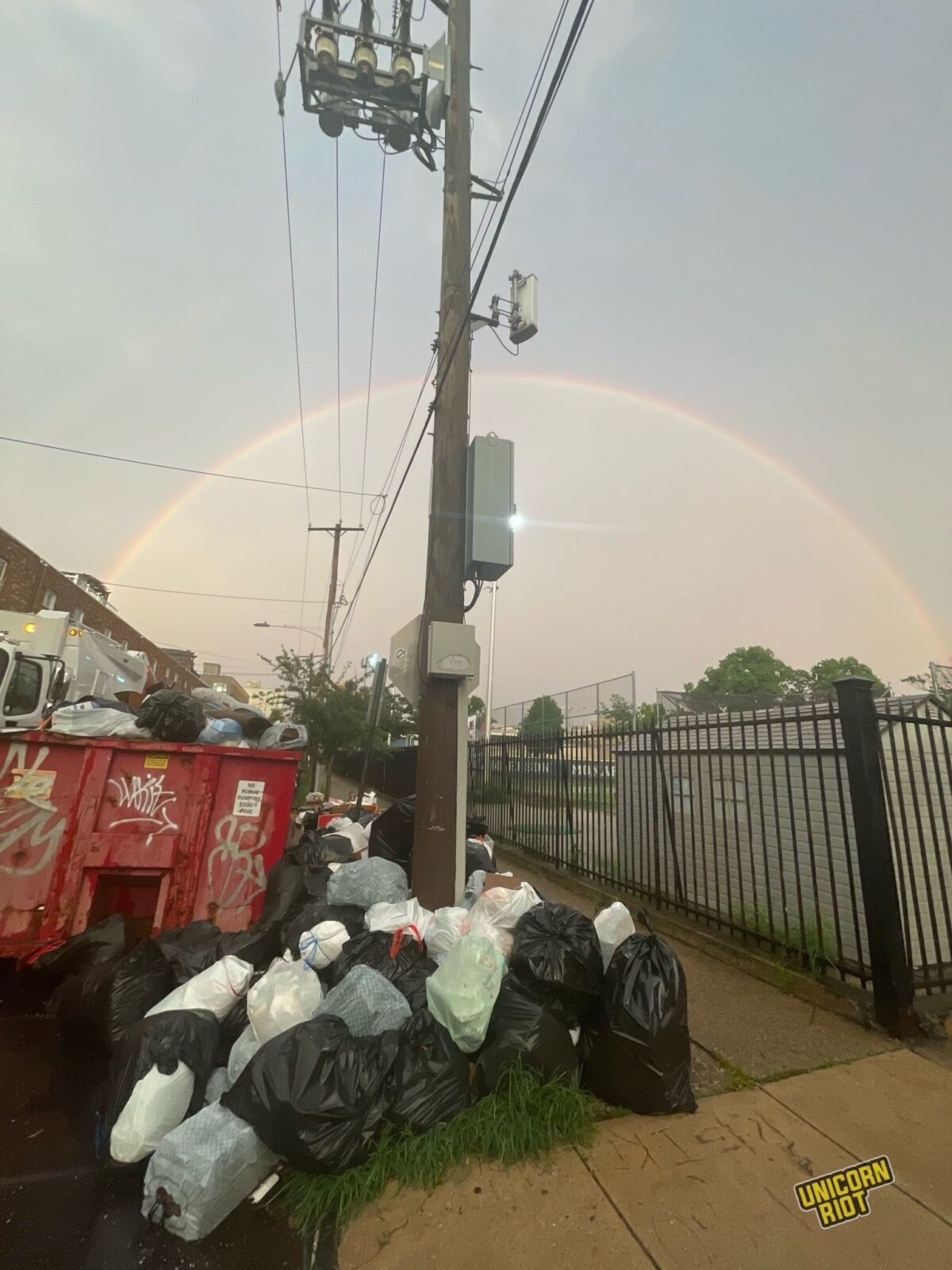
Meanwhile, trash continues to pile up around the city.

Failed contract negotiations have led nearly 10,000 members of AFSCME District Council 33 (DC33), the union representing blue-collar Philadelphia city workers, to walk off the job.

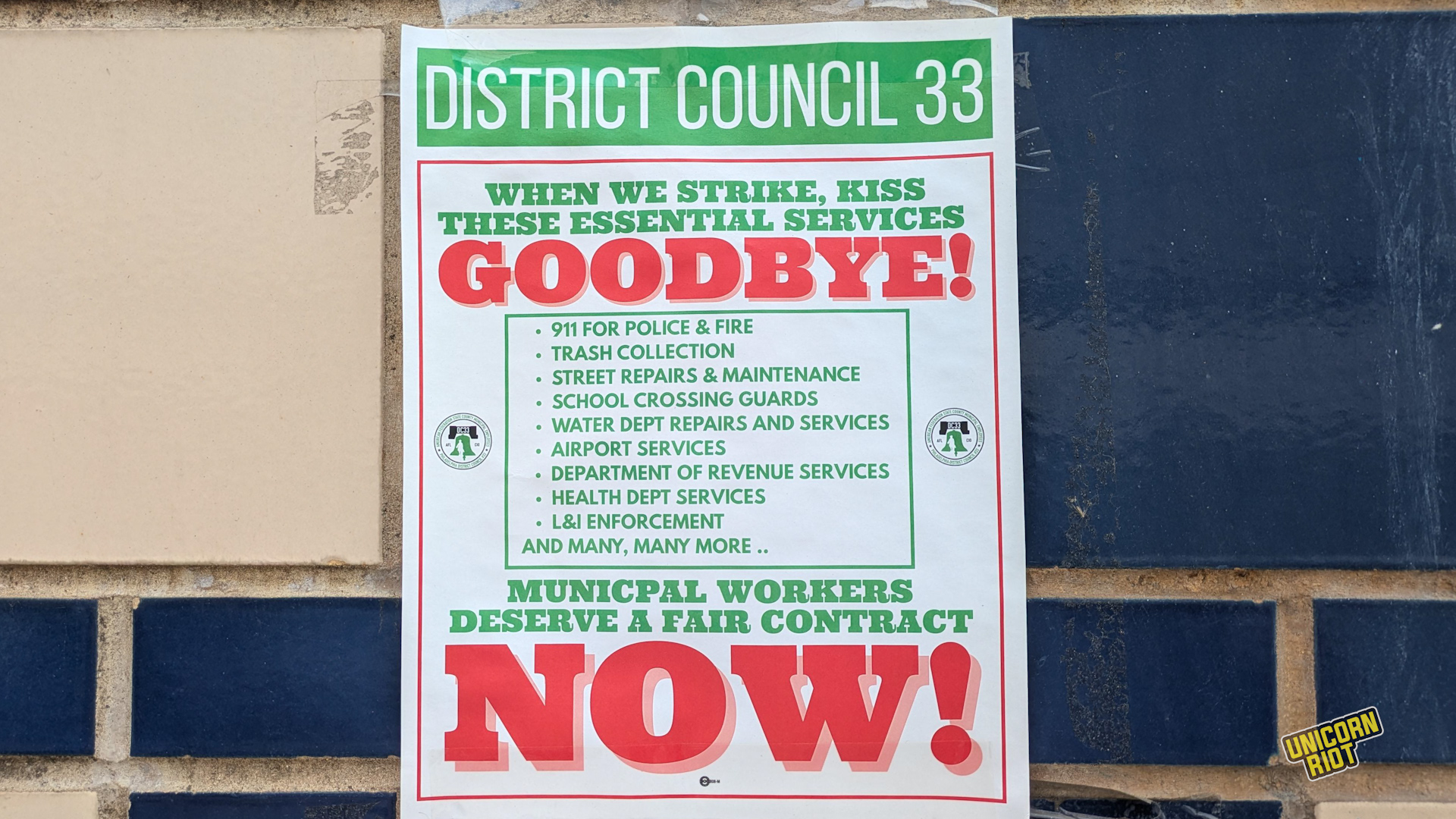
DC33 represents an array of city service workers including librarians, sanitation, the water department, 911 emergency dispatch, school crossing guards, airport maintenance, and street maintenance.

The historic strike by the largest working-class municipal union in Philly is the first of its kind in nearly 40 years. Trash pick-ups, street repairs, and other city services ground to a halt overnight.

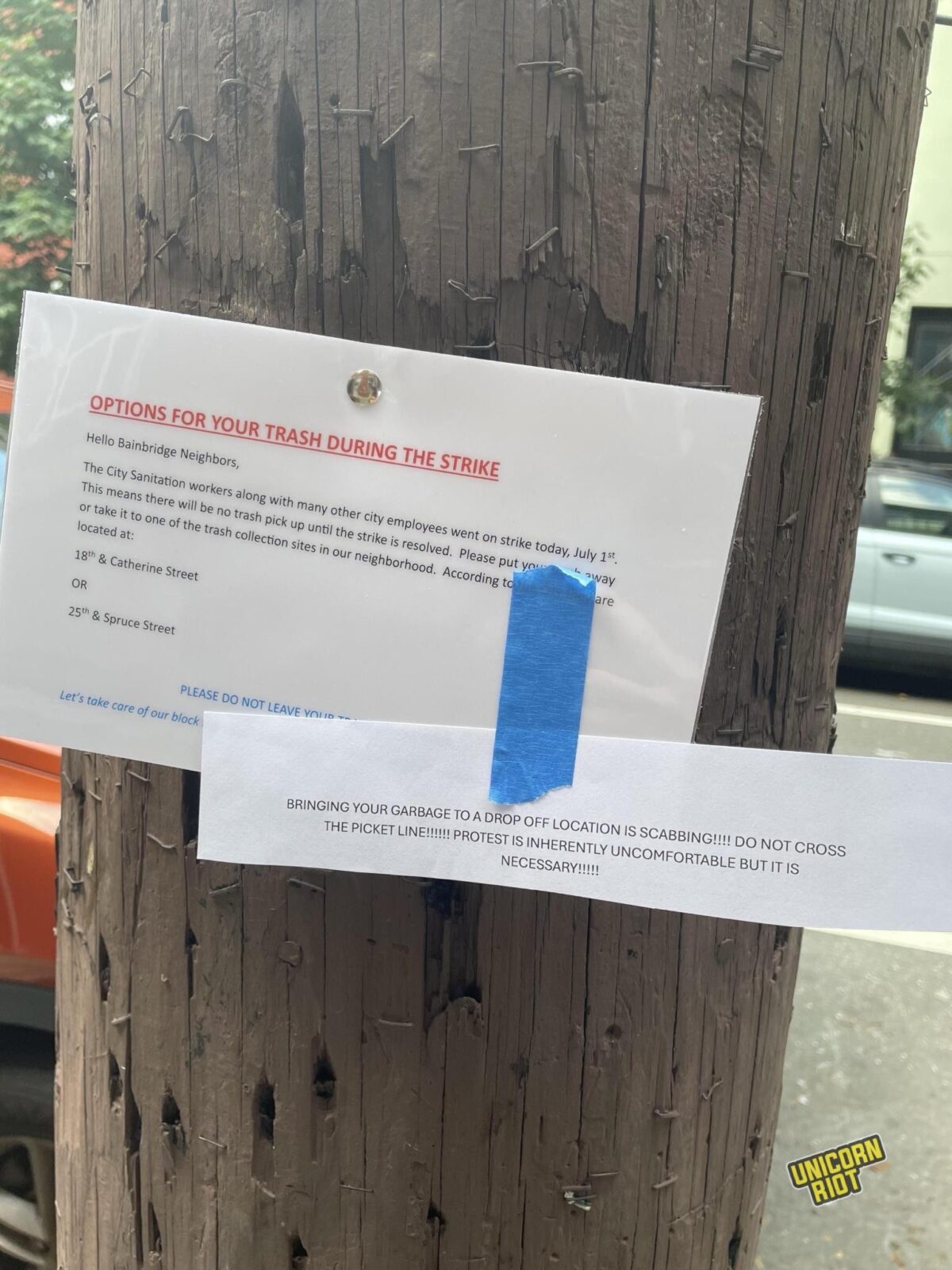
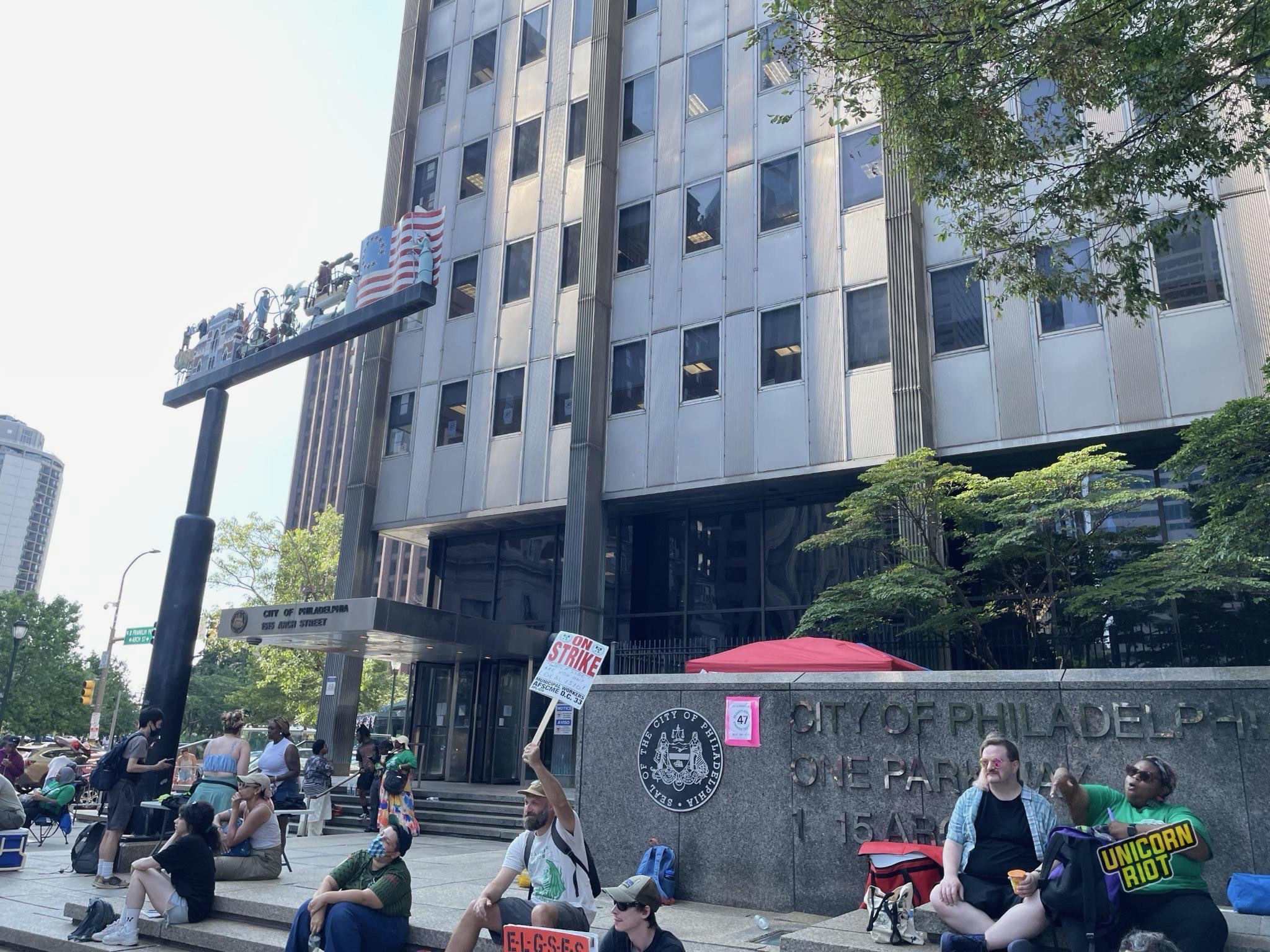
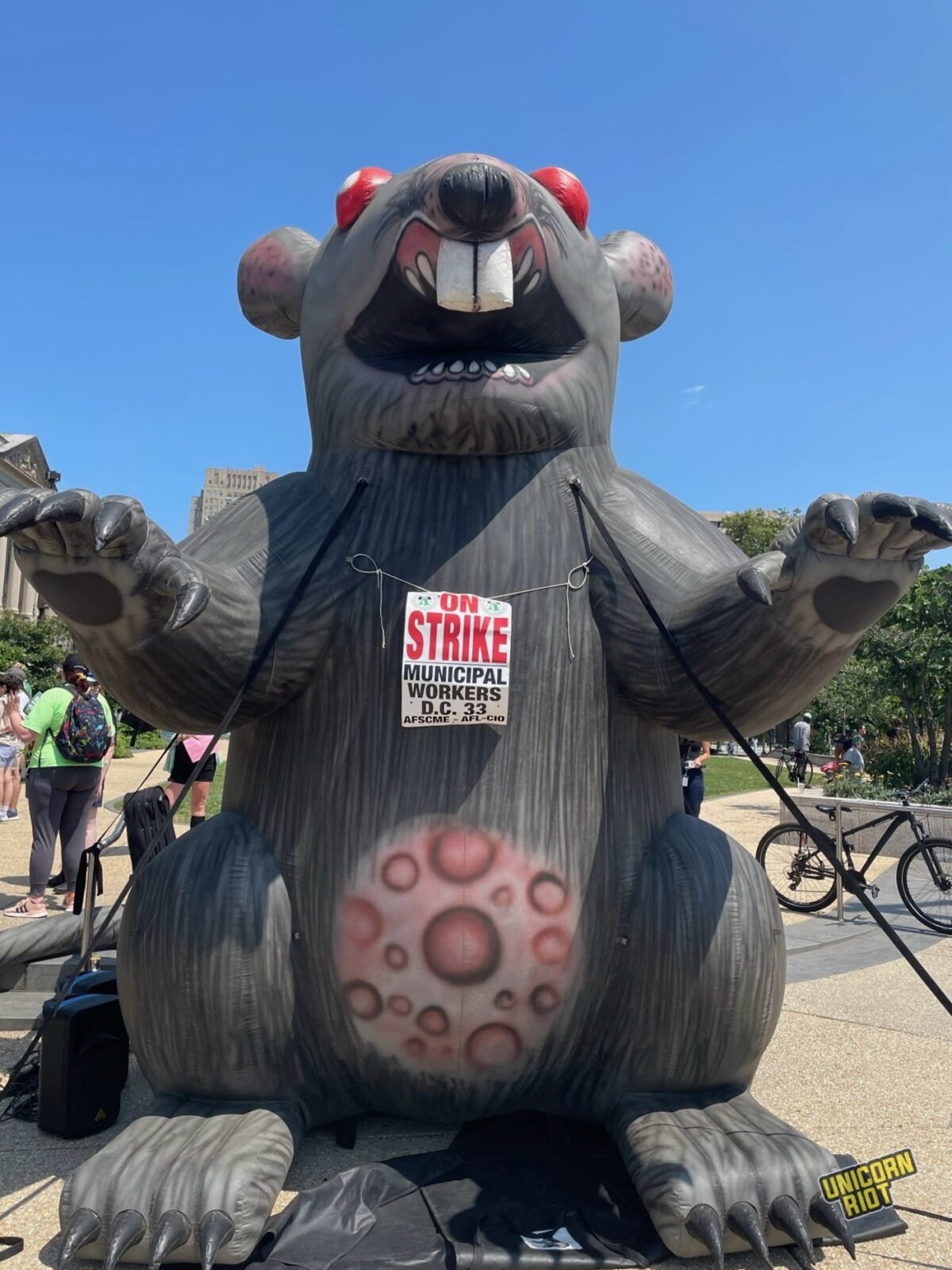
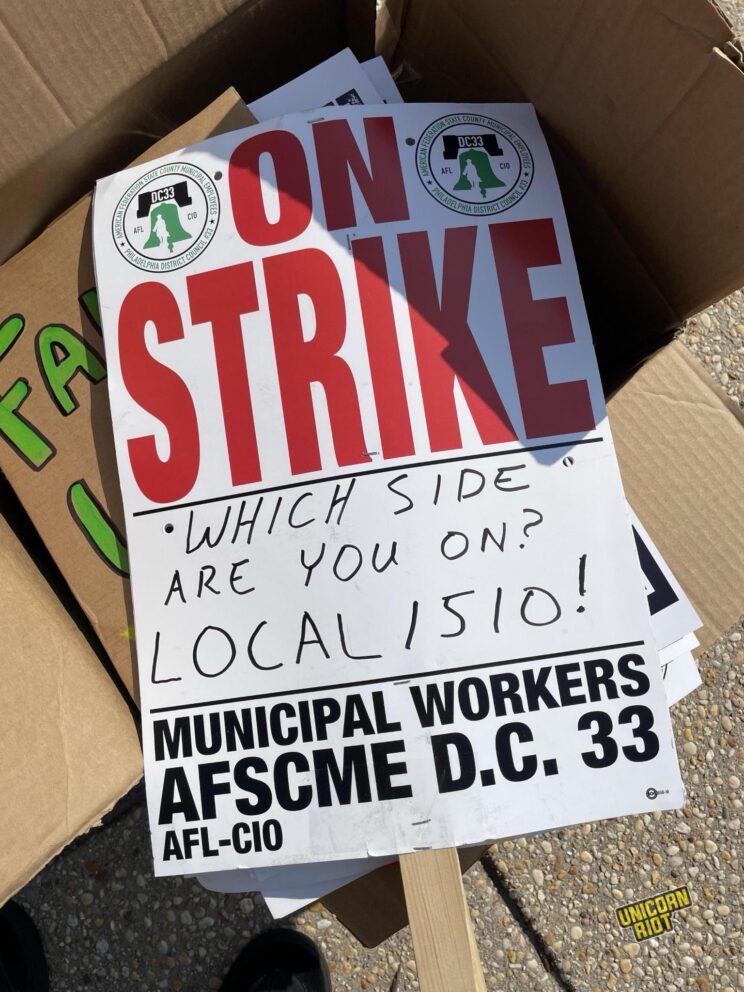
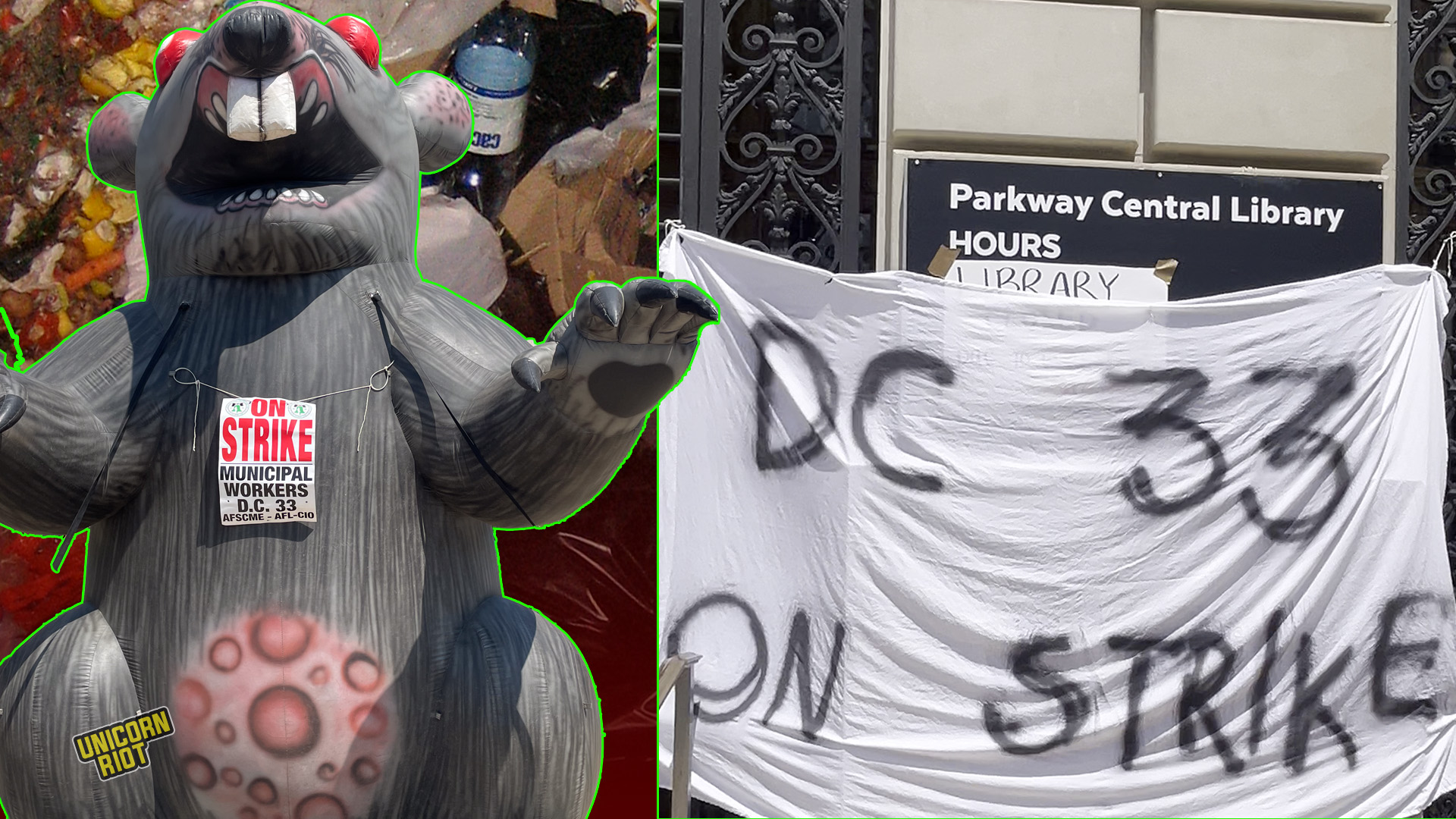
Picket lines have been active throughout the city since July 1. Sanitation sites and public libraries have reportedly been chained and locked to prevent scabs – non-union workers brought in to replace strikers – from breaking union picket lines. The official Free Library of Philadelphia website listed over forty locations closed with “work stoppage” as the reason.

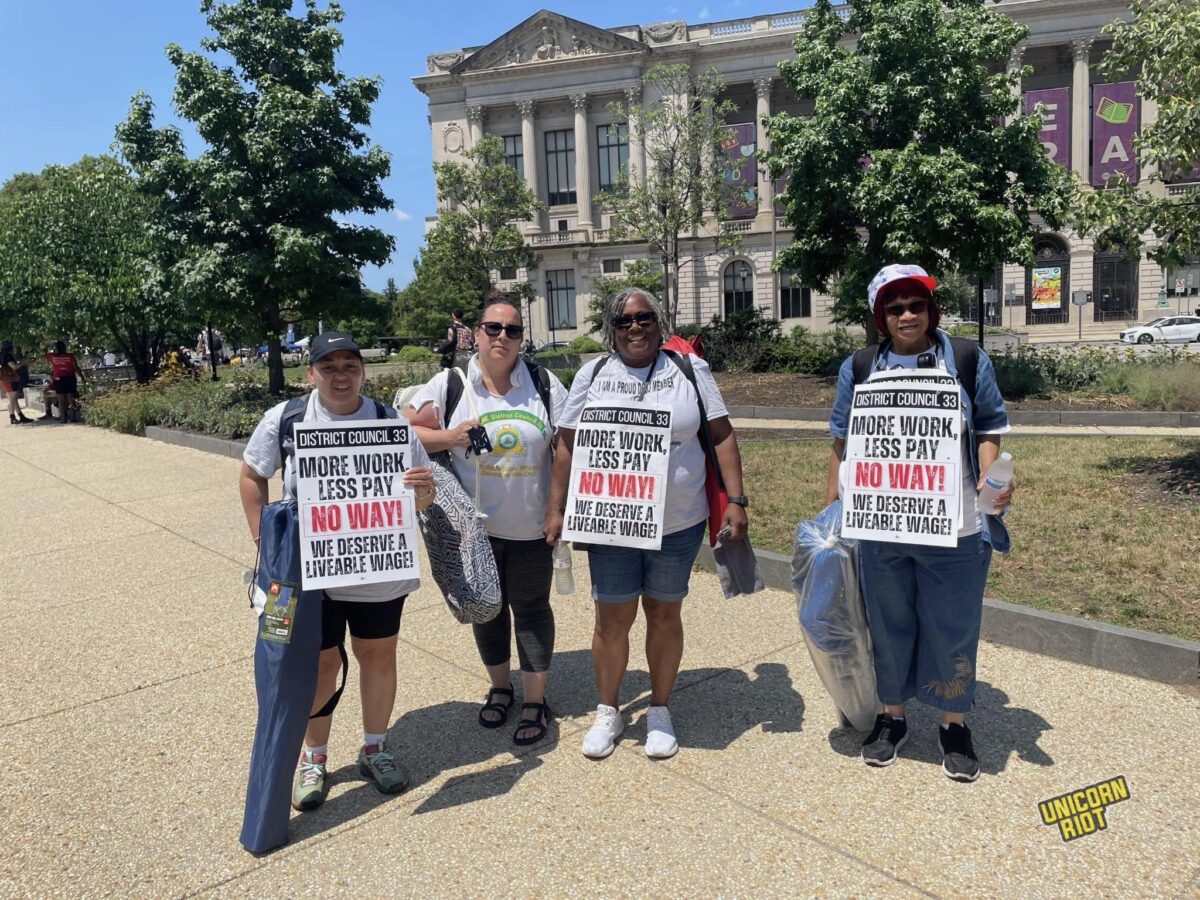
Striking DC33 workers rally outside the Philadelphia Free Library’s flagship Parkway branch on July 2, 2025.

Video from NBC10 shows a tense moment from Tuesday, July 1 when management at the Department of Sanitation in the Strawberry Mansion neighborhood tried to enter the Sanitation Convenience Center while union members confront the person. “We’re on strike, man, you know the rules. We not moving nothing… and that’s what it is. Respectfully…” The clash lasted a few moments before management was turned away and picketers locked the gate shut. “Tell that to the Mayor. It’s the Mayor’s fault, not ours. We’re on strike… and that’s what we’re gonna do until we get a fair contract.”

In a conjuring of C.L.R James’ notion of “proletarian self-activity,” workers throughout the city have taken matters into their own hands, leading to at least two arrests.

On the 3900 block of Ford Road, union worker Carnell Wilder, 59, was arrested in connection to an incident involving a Philadelphia Gas Works employee. Wilder allegedly approached the PGW worker, who was operating a digger loader and asked “why aren’t you striking?” before proceeding to deflate one of the tires with a knife, according to unverified police claims reported in corporate media. Wilder was arrested and transported to a medical center for hand injuries.

The following day, July 2, Jeanette Coppinger, a librarian assistant and union member, was arrested after allegedly blocking the entrance to the Northeast Regional Library on Cottman Avenue. Local news reported that a sheriff’s deputy read the injunction against blocking entry during the picket, but Coppinger refused to move. In court, Coppinger affirmed that she willfully violated the order “to make a statement.”

Even the city medical examiners have walked out. City attorneys complained “cooled storage for dead bodies is getting crowded, and there is a ‘backlog’ of cadavers that need to be examined in Philadelphia’s morgue that has increased due to the strike.”

A judge agreed, “[it] creates a clear and present danger or threat to the health, safety or welfare of the public,” and ordered some staff to “cross any picket lines established by Defendants or any other person if necessary to complete the full, faithful, and proper performance of their duties of employment for the City.”


Union City Workers’ Wages Well Below Local “Living Wage”

DC33 is the lowest paid of Philly’s four municipal unions and the only municipal union with majority-Black membership, the Philadelphia Inquirer previously reported. According to a recent report by NBC10, sanitation workers in Philadelphia earn the lowest salary of any major city in the US; they typically earn between $18-20 an hour. A living wage in Philadelphia County for a family with one child stands closer to $38.60, according to MIT’s Living Wage Calculator.

DC33 is currently asking for a 5% increases over each of the next four years; the city offered 2.75%, 3% and again 3% over three years, according to a July 3 Billy Penn report.

On day one of the strike in front of the Parkway Central Library at 1901 Vine Street, one union member carried her child while admonishing the current pay rate as “not enough to even pay for diapers.”

This isn’t the first time Mayor Cherelle Parker, the first Black woman elected mayor of Philadelphia, has faced organized community resistance.

Last year, Parker’s unpopular push to gentrify Chinatown with a 76ers stadium proposal was a disaster for the city, as she spent hundreds of thousands of tax dollars trying to convince her constituents that selling out Chinatown with a new stadium was a good idea. Chinatown residents and their allies rose to “Save Chinatown,” clashing with the mayor at press conferences, city council hearings and outside of City Hall. Despite heroic efforts from the Chinatown community, the stadium deal was approved last December. However, 76ers management reversed their decision with the city, humiliating the Parker administration.

Mayor Parker is again facing backlash after claiming that the city cannot afford the union’s proposal. Video is circulating on social media from 2021, where Parker is seen giving an impassioned speech in support of fair wages for DC33 and even quotes James Baldwin, “I can’t believe what you say, because I see what you do!”

Meanwhile, Parker created 16 new positions within her administration that offer six figure salaries. Parker, herself, enjoys a 9% salary increase that was carried through during the last month of the previous administration. Last year, she received an additional 3.1% Cost of Living Adjustment bringing her salary to $269,708.

Data from the Bureau of Labor Statistics show that garbage collectors are more likely to die on the job than police. Yet, at $64,982, police officers in Philadelphia receive a starting salary of over $20,000 higher than the city’s sanitation workers. This year’s city budget also includes $1.3 million for new police uniforms.

In Philly, the average sanitation worker makes between $39,000-42,000/year. A 5% increase, the union’s current demand, would bring that number up by about $2,100/year, on average. As negotiations continue, the Mayor demanded that “we must restore order before bargaining.” DC33 responded: “Order isn’t the issue—poverty pay is.”

No deal was on the table by the time July 4 approached, where the Wawa convenience store chain hosts its annual music festival celebration called Made in America.

In solidarity with the workers, LL Cool J announced that he would no longer be headlining the Fourth of July event. “I understand there’s a lot going on in Philadelphia right now, and you know, I never, ever, ever want to disappoint my fans, and especially in Philadelphia,” he said in a video on social media. “Y’all mean too much to me, but there’s absolutely no way that I could perform, cross a picket line and pick up money when I know that people are out there fighting for a living wage. I’m not doing that, you know?”

At 2 p.m., the union organized a picket line directly outside of the festival’s entrance, near the Free Library on 1901 Parkway. Scabby – a cartoonish inflatable rat used to shame union-busting employers – made an appearance while hundreds of picketers and their supporters gathered. Union members, a labor historian and even a small band playing old union hymns shared time on the mic.

By around 3:20 p.m., another performer and Philly native, Jazmine Sullivan, expressed her solidarity with the workers and refused to cross the picket line to perform. Her Instagram story read, “In this life we are only measured by how we uphold our morals and standards, by what we choose to fight for through participation or protest. Today I choose not to perform at the Wawa Welcome America concert and stand with Philly’s DC33 until the city and union find a way to bring fair living wages to our working class. I love my city and I believe in you. Hopefully we will get to celebrate when things are better.” 

The historical significance of a sanitation worker strike in the U.S. cannot be overstated. The 1,300-strong sanitation strike in Memphis, Tennessee, inspired Martin Luther King to give his 1968, “I’ve Been to the Mountaintop” speech. “Don’t let anybody tell you to go back on the job and paternalistically say, ‘Now, you are my men and I’m going to do the right thing for you. Just come on back on the job.’ Don’t go back on the job until the demands are met. Never forget that freedom is not something that is voluntarily given by the oppressor. It is something that must be demanded by the oppressed.” 

The person who picks up our garbage, in the final analysis, is as significant as the physician, for if he doesn’t do his job, diseases are rampant. All labor has dignity.”

Martin Luther King Jr., March 18, 1968

Standing with members of the sanitation unit on July 6, Greg Boulware, president of AFSCME DC33, strengthened the resolve of the strikers.

“We see scales, charts and graphs all over the country that are highlighting how far below the men and women who work in the City of Philadelphia are living below the living wage scale. That has to change … I don’t care how many SCABS they get to try to do our work, they can’t do the work that District Council 33 does.”

Greg Boulware, President, AFSCME District Council 33

On Monday, July 7 – the seventh day of the strike – three activists from the environmentalist Sunrise Movement had a “Special Delivery” for Mayor Parker. Inside City Hall, overflowing trash bags were dragged in front of room 185. The bags carried a written message, “MEET DC33 DEMANDS.” A sit-in had begun.

According to a Sunrise Movement Instagram post, “we picked up garbage from Piccoli Playground in North Philly, one of the mayor’s temporary dumpsites where trash continues to pile up and put us at risk.” The three were quickly arrested. One yelled, “Workers deserve dignity! Cherelle, pay your workers!” All three were released later that evening.

The same morning, in the Point Breeze section of South Philadelphia, striking workers reported a large police presence outside of Queens Memorial Library. One union member said that no scabs had been able to cross the picket. “SCAB LINE” was written in chalk at the library’s entrance. “WE SEE YOU SCABS – WE REMEMBER” was chalked in large letters on an adjacent wall. As of July 7th, the Philadelphia Free Library website listed 48 library locations closed due to “union work stoppage.”

Whispers of a city-wide general strike loom as other work sectors experience labor disputes. ASFCME DC47 plans for a strike authorization vote on Thursday, which would add 3,000 more strike-ready workers.

World Café Live is striking for union recognition (organizing with IATSE Local 8). The Philadelphia Federation of Teachers has voted to authorize a strike if they don’t come to a new contract agreement before their current one expires in August.

Penn Museum Workers United AFSCME Local 397, who voted to strike this Wednesday, went to social media to express solidarity with DC33: “The working people of Philadelphia deserve more than the crumbs Mayor Parker and Penn are putting on the table.” 

As the workers maintain their resolve with “One day longer, one day stronger,” Philadelphians continue to defy the Mayor’s orders to not put trash on the curb. Block by block, signs and notes are shared between neighbors expressing support for the striking sanitation workers. In the City of Brotherly Love, solidarity remains a love language for strike summer 2025.


Learn more about the local history of sanitation strikes from Michaela Althouse in the Philly Voice: Philly’s history of city worker strikes included Molotov cocktails, suburban weddings and 45,000 tons of garbage


Cover images by R. Martin. Garbage background via Perez Partensky, Wikimedia Commons. Composition by Dan Feidt.

Reading Group on Insurrectionary Organization – July 16th & 23rd, for New Pamphlet: ‘Some Excerpts by Alfredo Bonanno on the Insurrectional Anarchic Project, Informal Organization, Affinity, Autonomous Base Nuclei, and Active Minorities’

from Reeking Thickets Press

Printing Imposed PDF (8.5″ x 11″, black & white)
Covers for Printing (8.5″ x 11″, color)
Limited amount of physical copies available, come to ORCA Open Hours 7/9, 5-9:30pm for free pamphlets or email reekingthickets@proton.me to check availability and get copies at another time (free locally before 7/23, $3 after, plus shipping if not local)
Join us for two reading group discussions at ORCA (orcaphilly.noblogs.org/events/event/reading-group-bonanno-on-insurrectionary-organization/ – email ORCA at orca.philly@protonmail.com for address and accessibility info) where we’ll discuss the ideas in this newly compiled collection of writings by Alfredo Maria Bonanno in pamphlet form! Pick up a free physical copy of the reading at ORCA Open Hours on July 9th, 5-9:30pm  (you can also print/read the pdf file included in this post), and come to a casual first discussion (covering pages 1-43), at ORCA Open Hours at 7:45pm July 16th, and a second discussion (pages 43-96) at ORCA Open Hours at 7:45pm July 23rd. Please do the reading beforehand (though you don’t have to participate in the reading group to come to open hours these days, and cross-talk is welcome), and if you’d like, feel free to bring any jotted-down questions or thoughts that come up.
This 96pg. collection of writings by Alfredo Bonanno (including some crude, new, provisional machine-translations with cursory manual corrections and added explanatory footnotes) aims to bring together some of his most concise, yet in-depth explanations of many of the core concepts of the specific strain of contemporary insurrectionary anarchism that he helped develop, which are often misunderstood or glossed over in jargon: projectuality, autonomous base nuclei (which include non-anarchists), affinity, informal organization, active/specific minorities (and their tools of counter-information, theory, intermediate struggles, and armed struggle), limited/specific struggles, the methodological trio of permanent conflictuality, self-management, and attack, and how these all relate to the mass process of insurrection. The particular value of this approach in the context of the real domination of post-industrial, technological society is also explored, as well as the relation between riot and insurrection, ideas of propaganda, linguistic and cultural alienation/estrangement/appropriation, destructive revolutionary consciousness oriented towards the unknown, and the significance of democratic, nationalist, authoritarian communist, synthesis or platform anarchist, shallowly spontaneist or individualist, unionist, and movementist tendencies.
We hope to evade some of the frequent snags that arise around current interpretations of Bonanno and contemporary insurrectionary anarchist theory, and feel that the material in this collection is far from another stale debate of the organizational question, and holds real, critical relevance from multiple angles for some contemporary impasses, transmitting, still, a powerfully fresh and possibilizing potential. Much will hopefully be at least somewhat new here for even those well-versed in current discussions, and, read alongside the anonymous classic At Daggers Drawn With the Existent, Its Defenders, and Its False Critics, and Armed Joy – also by Bonanno, we feel this collection can offer a very solid, well-rounded overview for readers unfamiliar with insurrectionary anarchist positions.
We do not intend to frame Alfredo Bonanno as some sort of mythical, revolutionary immortal with this collection, nor ourselves as any kind of privileged interpreter. It is not some detached intellectual fondness for decades-old European theoretical tracts passed through language barriers that leads us to feel these texts are relevant (though these ones do also please us to read). In fact, Bonanno’s rigorous criticism of this kind of ideological abstraction goes far further than many of his loyal, straight-talking critics who profess this angle. Both positive and negative appraisals of the insurrectionary anarchist proposals often suffer from a lack of genuine engagement with some of its primary theoretical elaborations, including with Bonanno’s work (though not only; our focus on him here doesn’t mean to repeat the frequent misconception that the many other, even less examined thinkers and currents historically involved are somehow irrelevant to the genesis of contemporary libertarian insurrectionary approaches). Part of this is a relative lack of translations, the tendency Bonanno had to sometimes present his complicated, often ambivalent (we mean this in a positive sense) ideas in simplified or indirect ways when not specifically explicating each referenced idea, the way that concise yet in-depth explanations of these core concepts are found somewhat scattered throughout his very prolific output (throughout which he wrote in numerous, divergent styles and tones), and his use of terms with specific contextual meanings. The over-reliance on secondary sources about his thought helps determine a situation where his positions are often presented in shallow terms, more relevant to the popular representation of his theoretical body of work than its actual content (all the more elusive for his fierce hostility to pre-determined dogma). Sometimes the criticism, largely baseless to us, alleges it’s too movementist and cautious, others find a concealed vanguardism, organizationalism, yet others that it’s too spontaneist, or spectacular, massified, isolated from the masses, militarist, classically socialist, insufficiently anti-civ, obsessively anti-acronym, etc.. Bonanno was himself drawn into polemics with critics or mistaken supporters revolving around these phantom positions, sometimes seeming to anticipate misreadings and frame his wording with these in mind (which an `opposite’ misunderstanding could find apparent confirmation in). The acknowledgement of this confusion, coupled with the implicit assertions of the contemporary invalidity of any conflictual premises shaped in the Italian Years of Lead, is itself a frequent excuse for watered-down, movementist readings, or to dismiss his positions a priori. In fact, we also live, in a different way, in bloody times, and the lack of a current Western analog for the Red Brigades (besides the vicarious would-be models of Palestinian authoritarian formations) could just as well argue for a reading less weighted towards emphasis of the pitfalls of armed struggle. In this situation and more generally, relevant insurrectionary analysis often appears split between very introductory treatments and highly elaborated, niche levels, subject to layers and layers of strongly diverging interpretation.

The Return of Autonomous Demonstrations in Philadelphia: Brief Notes on the Recent Anti-ICE Actions and A Response to the Socialists in the Partisan

Submission

The autonomous demonstration has returned to Philadelphia. On June 10th and June 14th respectively, two self organized autonomous demonstrations were called to fight back against ICE and in solidarity with the rebellion in Los Angeles. To read a better understanding of what went down, I recommend you read the Unicorn riot account (https://unicornriot.ninja/2025/philadelphia-police-crack-down-on-anti-ice-marches-twice-in-one-week/) and an article I have deep disagreements with (https://phillypartisan.com/2025/06/15/headless-courage-anti-ice-protests-vs-police-brutality/). Both give brief overviews of what happened at these demos.

As an older anarchist, I was glad to see younger comrades organizing against ICE in a militant fashion. It is a rare thing to see publicly organized autonomous demonstrations in the United States despite the fact that they are common in many other places like Latin America or Europe. Autonomous demonstrations are critical for real combative street movements. For over a decade, the activist/organizer culture has plagued Philadelphia’s street movements with their cowardice and liberalism. The tension between the militant and the activist has played out in the meeting, communique and even in the streets. Organizers have often played a counter insurgent role in various struggles such as anti-gentrification direct actions from 2013 to 2018, OccupyICE in 2018, the George Floyd uprising, the Eddie Irizarry uprising and the Palestine solidarity encampments. In each of these struggles, anarchists and our friends faced conflict with activists. While it seems more hip to talk about “counter-insurgency” these days from some of the very same cowardly leftists, it bears reminding that anarchists in Philadelphia have struggled against those who would want to water down social struggles.

These dynamics are often difficult to grapple with as the dynamics are often highly racialized. Despite the longstanding history of Black anarchists and Black radical militancy in the city of Philly since the 60s, those who take risks and organize autonomously are often accused of being “white adventurists”. While it can be amusing sometimes as there will be white radicals so plagued with white guilt that they cannot imagine that perhaps a Black or Person of of color person may in fact want to fight back against the forces that oppress them, many Black and POC organizers also actively despise militants of every background despite their near constant exhortations about “revolutionary violence” so they can sell copies of their books and admission to workshops.

Either way, I want to congratulate whoever called for the most recent demonstrations. The type of bravery displayed by those who organized and attended these demonstrations is the type that we’ll need to fight back against the worsening conditions in the United States. Unsurprisingly, both of these demonstrations were met with overwhelming police repression. There are probably a number of reasons for this. Both Cherelle Parker and the so-called progressive DA Larry Krasner both made it clear that peaceful protest was acceptable but anything deviating from permitted protest would be treated harshly. I believe that the PPD are afraid of a rerun of 2020. Doubtless the LA rebellion has scared the shit out of them. Either way, it is clear that the autonomous demo frightens the State in a way that the nicely marshaled parades by various activist and socialist groups simply do not. I want to commend the young people for taking the streets regardless of overwhelming police numbers on both days. The rest of the “Left” in the city of Philadelphia has been quiet. It makes me proud to be an anarchist to see that we remain on the front-lines when it comes to organizing to fight back against ICE while much of the Lefts skulks in the shadows (and not in the cool way). Let’s all make sure to support the comrades who faced more serious charges for taking part in these actions.

Some socialists wrote a critique of the first autonomous demo that I feel like I should address. In my view the article takes a myopic view of autonomous struggles and relegates them largely to a reaction to a current moment despite the fact that autonomous demos were popular in Philadelphia way back in 2017.

So the article is titled “Headless Courage”, I thought this was kinda funny because it’s clear whoever wrote it has never engaged with the work of Philly’s own Black revolutionary Russell Maroon Shoatz with his critical essay “The Dragon and the Hydra” where he argues for a multi-headed resistance against the colony and capital rather than a single-headed one. The autonomous demonstration in theory is an example of multi-headed resistance. The idea of an autonomous demonstration is a moment where various different WELL ORGANIZED affinity groups with different goals and intentions (ideally coordinating with each other prior to the action) can converge and act together in a public manner. Unsurprisingly, this doesn’t always work in real life as there are often liberals who show up as individuals, seeking to derail the demonstration or accusing people of being cops. However, well organized affinity groups who can assert themselves solves this problem. Often many anarchists understand affinity to be a one time thing but it’s actually critical to understand that affinity is a long term organizational orientation based on building trust and reciprocal knowledge with your comrades. It seems that whoever wrote the article did not arrive to the demonstration with their own set of goals but instead decided to complain on the internet because no one listened to them! Organize yourself and yourself better. No one owes you allegiance or a rowdy demonstration.

Chiding the demonstration for being “peaceful” when people were de-arresting, throwing barricades in the street and engaging in some light types of vandalism feels like a cheap shot considering the overwhelming police presence. Most demonstrations never even have any of those things happen. It’s sad but true. Furthermore, It’s clear that some people at the demonstration attended with intention and were able to take part in ways they found liberating. The conclusions in the article are unclear as the author acknowledges that non-autonomous demonstrations are weak and ineffective. Yeah, welcome to the club. Anarchists have been saying that for years. Nothing the socialists described at the demo such as police violence or snitchjacketing is particularly new. That’s just par for the course at public demonstrations. The solution isn’t creating some commander militant though but rather building forms of organization that can facilitate un-governability. I would refer the author to the coordinated affinity group as an example. Unfortunately, that form in Philly has largely been eclipsed by whatever the Left is doing these days. The author also argues bizarrely that socialists should do ESL classes and then use the people who do those classes for a militant demonstration.
“but you can recruit people more honestly and form more articulate connections by tabling, going door to door, or mounting programs like free food distributions or free ESL classes that directly serve your community. As described before in the Partisan, we should think of these types of projects as the proper way to build people power, and mass actions as the way to “cash out” on whatever power has been built to make change in the most direct and literal way”

Unfortunately just because someone likes your ESL class or free food doesn’t necessarily mean that they are going to be interested in whatever type of demonstration that you want to do. Mass actions are the the product of random people from an ESL fighting the cops but rather the product of affinity groups building amongst themselves and together to build capacity to fight back. I dunno the author’s background but the whole part about “organizing the masses” is always corny to me cause leftists always seem to be confused when the masses are not interested in their political project. Often when white leftists talk about “organizing the masses”, they are talking about Black and brown people in the city. I think it may be hard to imagine for some crackers to understand Black and brown people are already organized just in ways that are often reactionary or liberal. Instead of thinking of people as monolithic subject for your revolutionary desires perhaps realize that individuals regardless of their class background are complicated. The mechanistic way of thinking about human beings on the Left continues to be a weakness.

For the younger people. Don’t stop! Focus on building affinity with one another in the streets. I feel like there has been a lot of chastising from both socialists, so-called legal support collectives and various cowards on the internet. At the end of the day, ya’ll are doing what the Left wishes it was doing. Keep training, making sure your Black bloc is on point, talking with your friends and refusing to follow orders. Whether it’s from cops, progressive politicians, leftists, crackers, organizers, liberal anarchists or whoever. If I had any recommendations, it would be to examine the history of social struggles in Philadelphia prior to this moment. You might learn a few things. I’ll include a reading list. But honestly, I’m just proud of ya’ll.

– ya local anarchist agitator

Some reading reccs:

Anti-Gentrification Actions Philadelphia: 2013 to 2018
The Dragon and the Hydra by Russell Maroon Shoatz
Spontaneity and Organization by Kimathi Mohammed
Activism as Recuperation (From a Movement for No Society)
In Defense of Looting by Vicky Osterweil
The Secret is To Really Complain (From Anathema Volume 10 Issue 2)
What the Fuck Does Reconstruction Even Mean to Ya’ll: A Critique of the W.E.B. DuBois School and the Black Left in Philadelphia (From Anathema Volume 10 Issue 1)
Archipelago: Affinity, informal organization and insurrectional projects