from Instagram

Anti-Yuppie Graffiti in South Philly
Philly Mayday Jawn
Submission
Ever since Haymarket Square Mayday has been ????Lit????. On this most special day Anarchists???? celebrate our explosive friendships with dance????, music, and hammers????. We’re calling???? all crimes against state oppressors, capitalist scum, gendered bull ish, racist enforcers.
This is a call-out for decentralized actions on and around Mayday in Philly. Look around you, do you see something you don’t like????? Do something you like. Don’t forget to bring your friends. Don’t forget friends that crime together????, crime together.
Happy Mayday, long live Anarchy!
Summer of Rage 2.❤️ LOL
Anathema Volume 4 Issue 3
from Anathema
Volume 4 Issue 3 (PDF for printing 11 x 17)
Volume 4 Issue 3 (PDF for reading 8.5 x 11)
In this issue:
- Arts & Culture
- Watching the Police
- What Went Down
- Cops: the Worse Kind of Criminals
- Power Concedes Nothing Without Some Hands
- If Afrin Falls it Will Have Been Too Late
- Afrin Has Fallen
- Opioid Epideminc
- Mariner East 2 Update
- Ungovernable Bodies at Oceti Sakowin
VANDALISMS: Payback
from It’s Going Down & Instagram

Right now, as these words are being typed, someone is spray painting an H&M store somewhere. Or at least that feels like a safe assumption to make.
Recently, H&M got into some hot water (yet again) for filming an ad in front of street art painted by REVOK, who then insisted they didn’t get permission to do so, which H&M replied was unnecessary because it was illegal…blah blah blah. We don’t care about REVOK’s (or anyone’s) intellectual property rights. The interesting part is when this story broke in graffiti writer circles all over the U.S, and the calls on social media to “Boycott H&M” quickly gave way to multiple vandalism attacks on stores.
[Video Link] [Video Link]


[Philly Anticap note: This is only a partial post of It’s Going Down’s VANDALISMS article showcasing Philly specific writers. To see the whole article click the above link.]
Keep Reardon On The Run!
from Philly Antifa
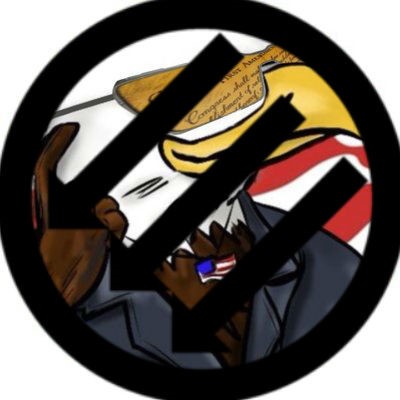
Oh gee the life of a neo-nazi sure is a rough one!
Ex-Philadelphian Mark Daniel Reardon can’t seem to catch a break. After we exposed him in 2017 for flyering Nazi propaganda on college campuses, immense community pressure and good works quickly evicted him from his apartment and he was fired from his job. Great work neighbors!
Typically stupid as Nazis are, Reardon did not learn the lesson that there are consequences for hate mongering. He continued his trashy Nazi path by travelling down to Charlottesville and taking part in Leif Erikson Day here in Philly. All the while spreading tons of racist, bigoted, sexist views from his badly done fringe cartoons he composed hidden in an even shittier apartment in Voorhees, NJ. After more good works by Antifascists of exposing his new address and his Nazi ideology being revealed so publicly, poor Mark felt the heat and has fled the country. YAY!
But, he STILL hasn’t learned.
He has set up a support account to fund his existence, which we think is rightfully bankrupt.
MakerSupport should be made aware that they are creating a safe space for Nazis, and that is an outrage and needs to stop!
Contact them at support@makersupport.com or https://twitter.com/GoMakerSupport
And tell them to shut down:
CW if you click VERY offensive racist, anti-semetic, violently homophobic/transphobic/sexist content
Lancaster, Pennsylvania: Locals Take Over Pipeline Office, Then Occupy Drill Rig
from Earth First Journal
from Lancaster Against Pipelines

A bus full of pipeline protesters. From Lancaster Against Pipelines facebook
Something extraordinary happened in Lancaster County yesterday.
A busload of fifty local residents took over the field offices of Williams/Transco at 805 Estelle Drive, Suite 101, in Lancaster. We dropped a 12 foot stretch of pipeline in Williams’s meeting room, sang songs through the hallways, and slapped a Condemnation Notice on the door before leaving. When a Williams employee complained about our visit, one of our residents deadpanned: “Sucks to be invaded, doesn’t it?”
Our message was simple and direct: we the people, whose lives and land are under assault by this toxic piepline, openly defy the “right” of dirty energy giants to profit at the expense of our health, safety, water, and land.
From there, the bus headed down to southern Lancaster County where Williams is drilling under the Conestoga River and desecrating federally recognized indigenous graves. The HDD process they’re using is the same one now contaminating drinking water along the Mariner East 2 pipeline.
We walked off the bus and sang our way straight onto the worksite, right past the workers, and up onto the drill rig itself. After police arrived, five bold residents locked arms and stood atop that monstrous machinery for another three hours, shutting down operations for the rest of the day.
By day’s end, the Drill Rig Five were arrested while defending our community. It’s a perversion of justice that law enforcement are sued to protect the financial interests of energy giants in Oklahoma over the health and safety of local residents. We look forward to the day when fossil fuel billionaires are stuffed into police cruisers for sabotaging our children’s future, rather than those of us peacefully working to protect that future.
Yesterday made one thing crystal clear: local communities are done waiting around for regulators, legislators, judges, and law enforcement to protect our most basic rights–pure water, healthy soil, clean air, and safe communities.
Until it’s illegal for dirty energy giants like Williams to seize farmland and force explosive pipelines next to our children’s schools, we’ll keep walking onto their destruction sites, dropping pipes into their corporate offices, and singing songs of defiance right onto their deathly drill rigs.
Momentum is shifting, and the industry knows it. That’s why they’re so desperate–and why we need to be more resolved than ever. And the march goes on!
Freight Train Traffic Disrupted by Anarchists
from Insurrection News
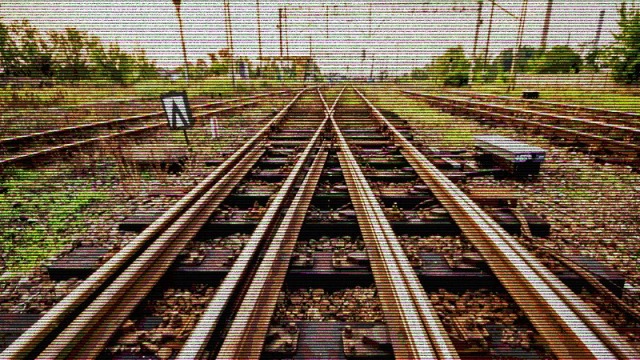
Received on 12.03.18:
Taking inspiration from Olympia Stand, we disrupted freight train traffic using copper wire. We did this three times over the last 30 days. Since hearing of the blockade we felt the need to act in solidarity and we know it was a while ago but time is a scam!!!!!
Obviously we took this action because we hate the economy, money, and the things that keep capitalism moving! We want to fuck with its flow with whatever means we had.
This action is also meant to be an attack on the social peace. Hierarchy and domination are a problem, and we want to attack all its forms, but submission, apathy, conformity, resignation, and stagnation also prevent us from being free. We want to end everything that holds this misery together. Fuck comfort and safety—nothing is safe! This supposed “security” people strive for is just creating more policing over our lives. We need to let go of security! How can we expect to move toward freedom without letting go of comfort and taking real risks?
The crisis is always urgent!
Anarchy as a struggle lived in the present!
Solidarity with anarchists and anti-fascists facing repression and torture in Russia
Solidarity to the anarchists in Hamilton fighting the rich and those who defend their peace of mind and property
Solidarity to the remaining J20 defendants
Also shout out & solidarity to whoever smashed the cafe windows of some buildings in West Philly recently
Solidarity Not Borders: From Athens to Philadelphia
from Facebook

Come to the Wooden Shoe to learn about non-state, non-NGO solidarity work with global migrants, with a focus on Greece. Collective member Sharon Jacobs will share experiences from months living and organizing with migrants in an Athens squat, and we will watch an episode of the subMedia show Trouble connecting the situation in Athens with migrant struggles around the world. We’ll discuss connections between Greece and other places where migrants face state repression and human rights violations, within a context of international conflict and imperialism.
This event is being held in solidarity with Refugee Accommodation and Solidarity Space City Plaza (https://www.facebook.com/sol2refugeesen/) and the #17m18ActionDay against anti-migration policies between states.
[March 18 from 7PM to 9PMat Wooden Shoe Books 704 South St]
Saint Paddy’s Day Antifascist Extravaganza
from Facebook

Come out to enjoy an evening of films and food centered around antifascism. Two films will be shown:
The Limerick Brigadistas-The true story of volunteers from Ireland who fought against fascism in the Spanish Civil War.
and
Antifa, A Documentary-A new film that explores the history and origins of the modern antifascist movement.
This is a free event!
Vendors will be selling books and baked goods, with all proceeds going to the legal defense fund for antifascists arrested protesting the recent Richard Spencer speech at Michigan State University.
[March 17 from 5PM to 9PM at A-Space 4722 Baltimore Ave]
CORRECTION: Jack “Pale Horse” Corbin Previously Falsely ID’d – Is Actually Daniel W. McMahon of Brandon, FL!
from Philly Antifa
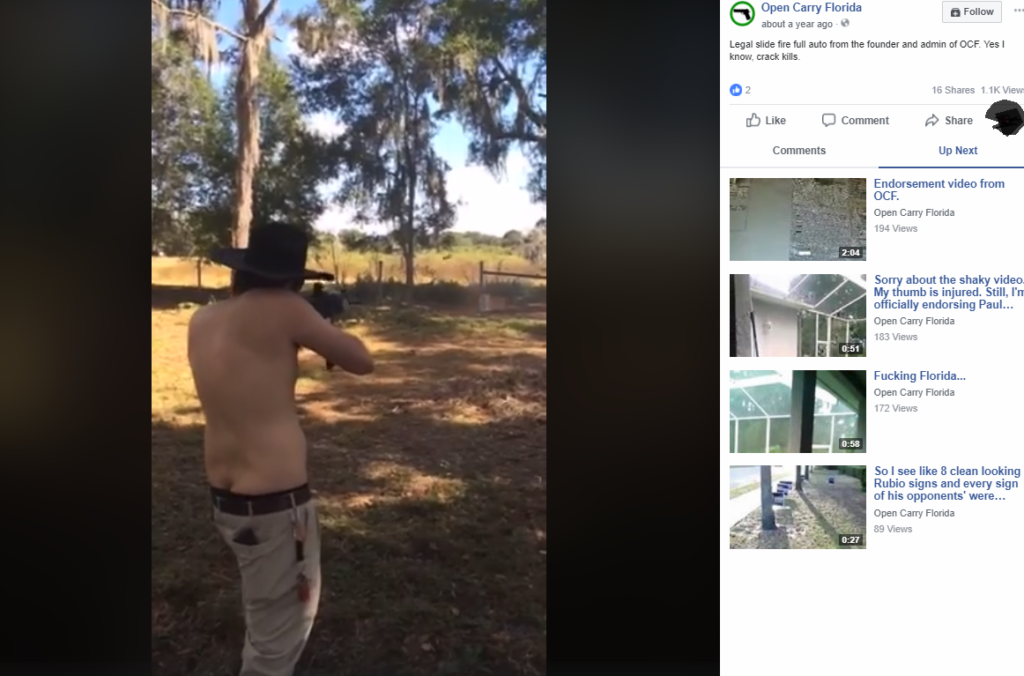
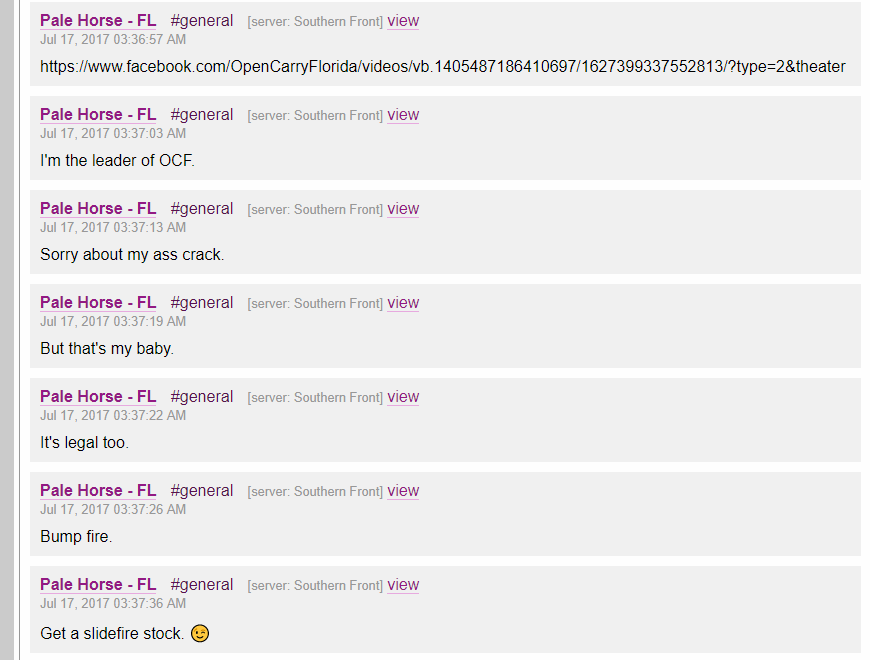
As many of our readers are probably aware, in the aftermath of the Unite the Right rally in Charlottesville, VA in August, there was a huge push among Neo-Nazis, especially those associated with 8chan’s nazi-infested “Pol” board, to dox and harass Anti-Fascists who participated in protesting the rally.
One nazi in particular, going by the alias Jack “Pale Horse” Corbin, was especially prolific in doxxing Anti-Racists and Anti-Fascists. Eager to unmask Pale Horse, Anti-Fascists within the TORCH network, as well as independent Antifa, rushed their research and made a critical error by falsely identifying Corbin as Jake Loubriel of Dania Beach, FL.
To be fair, not only is Loubriel a far-right racist Trump supporter, he has participated in doxxing Antifa, just not under the alias Jack Corbin. Corbin stole pictures of Loubriel from social media and intentionally used them as a red herring to throw off Antifa. This was an deliberate deception by Corbin; not an oversight by Antifa. Loubriel and Corbin are both living in Florida and have intersected on open carry and 2nd amendment pages.
Loubriel also appears to support Corbin doxxing and threatening Anti-Racists and Antifa. So while we should always strive for 100% accuracy in our reporting, and those who rushed to identify Corbin as Loubriel should take a serious lesson from this, they can take solace in knowing that the person falsely accused of being Jack Corbin is still a piece of shit far-right racist who has participated in the doxxing of Antifa, just not this Corbin piece of shit in particular.
For our part, we would like to apologize to our readers for re-posting and blindly accepting the dox of Loubriel. The information seemed legitimate and the source was trusted, but, obviously, we should have independently confirmed it as such.
After learning that Loubriel was not Corbin via an infiltrator, our intel department went to work trying to positively ID them once and for all. After much research, we are prepared to name Jack “Pale Horse” Corbin as Daniel William McMahon of Brandon, FL.
A Statement on International Women’s Day
from Philly IWW
As we come marching, marching, we bring the greater days.
The rising of the women means the rising of the (human) race.
No more the drudge and idler — ten that toil where one reposes,
But a sharing of life’s glories: Bread and roses! Bread and roses!
There is no major movement – social or political – that has not been touched indelibly by women. No movement more so, perhaps, than the International Labor Movement.
Where there have been principled, passionate, and strident gains for working people, women have been a crucial guiding force, though they have often gone unheralded. We recently saw that once more in West Virginia as their teachers, most of whom are women, defied the orders of their government and their union leaders by staging a wildcat strike.
That goes especially for our Union, The Industrial Workers of the World (IWW). It was a Union co-founded by women at a time when virtually all major, American labor organizations did not allow women; much less allow them leadership roles. Yet in its earliest years, its most visible and effective members were women – including Lucy Parsons, Mary Harris (“Mother”) Jones, Elizabeth Gurley Flynn, Dorothy Day, and Helen Keller. Among its greatest moments – including the 1912 Lawrence, MA Textile Workers Strike – depended on the mass mobilization and leadership of women, many of whom were immigrants.
Textile workers in Pennsylvania and New Jersey also marched under the banner of the “One Big Union” in the early 20th century. Unfortunately, whether by accident or on purpose, many of their words and deeds have been lost to history. They have largely gone unnoticed by the culture-at-large and are scarcely taught to children.
But the latest incarnation of the Philadelphia IWW – along with its contingency in the Harrisburg area – hasn’t forgotten their struggle. From them, we have acquired an ambitious, hard-earned legacy. That legacy is vision of a world beyond the exploitative wage system but what’s more, it is a vision in which all forms of bigotry and alienation – including sexism – are eradicated and the present, patriarchal orientation of our society is permanently recalibrated. Not only do we believe it to be the right thing to do but we believe our goals will be impossible to achieve one without the other.
On this International Women’s Day – March 8, 2018 – we recommit ourselves to the billions of working class people across the gender spectrum. We offer our support and our efforts, especially to those who find themselves on society’s margins due to their gender identity. We also strive to make our Union a more inclusive and affirming place for non-men; we will do our best to uproot any and all forms of toxic masculinity we find in our Union, our branch, and ourselves.
In our workplaces and in our communities, the Philadelphia IWW will fight sexism by any means necessary.
Antifascist Education (a discussion)
from Facebook

The Radical Education Department (RED) is hosting a discussion about anti-fascist education in both senses of this expression: i) educating ourselves about the deep and broad history of anti-fascism; and ii) mobilizing education as a weapon for anti-fascist struggles today.
The discussion will explore the connections between fascism, capitalism, the patriarchy, and racism, as well as the ways that liberal ideology abets fascist movements by misrepresenting issues such as violence and free speech. It will also point out the importance of linking the many sites of antifascist struggles at universities, prisons, public monuments, and beyond.
Ultimately, the discussion will map possibilities for countering a rising tide of fascism with a broad radical left politics that isn’t only on the defensive but goes on the offensive!
This event has been organized by John-Patrick Schultz and Gabriel Rockhill, who are founding members of RED, an autonomous collective dedicated to the construction of a radical internationalist Left through the training and federation of its cultural warriors. They will be joined in the conversation by two longstanding activists: Ania Loomba, who has recently been involved with the Campus Antifascist Network, and Kempster (Ghani) Songster, co-founder of The Redemption Project. For more information and/or to get involved: https://radicaleducationdepartment.wordpress.com/
[March 15 from 7PM to 9PM at Wooden Shoe Books 704 South St]
Food Drive for West Virginia Teachers
from Philly IWW

The Philadelphia Industrial Workers of the World is collecting non-perishable food items to donate to striking teachers in West Virginia. We will be driving the collected food to fellow workers next week.
If you want to contribute to the food drive, you can leave non-perishable food items in the food drive box at Wooden Shoe Books on south street.
Are you not sure what to donate? Here are some ideas:
1. Canned beans
2. Peanut butter
3. Canned fruit in fruit juice (not syrup)
4. Canned vegetables,
5. Rice
6. Quinoa
7. Nuts
8. Shelf-stable milk
9. Whole grain pasta
10. Pasta sauce
11. Cereal
12. Dried fruits
If the strike ends before we can deliver the food, we will be donating the food to the Cedar Haven Nursing Home strikers.
IWW Solidarity with West Virginia Teachers
from Instagram

We got your back West Virginia, solidarity photos are a start but we are also organizing a non perishables food drive this week that we will deliver next weekend! We will have a box for donation drop offs at wooden shoe by the end of the day and further updates will come out over the course of the week. #AnInjuryToOneIsAnInjuryToAll #SolidarityForever #55United #55Strong
The Teacher Strike in West Virginia: Interview with IWW Teacher Michael Mochaidean – JPS
from Radical Education Department
Introduction
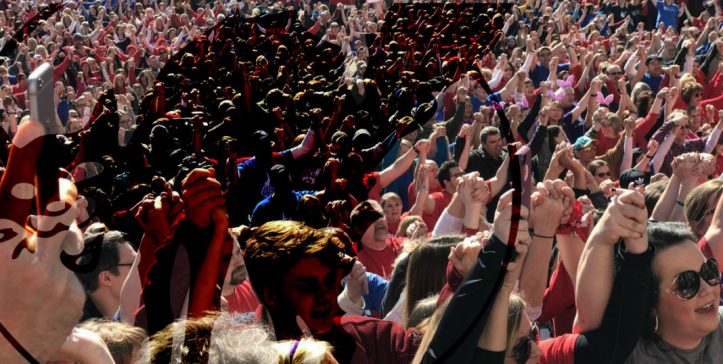
West Virginia has been rocked by a statewide strike by teachers, bus drivers, and other school employees. Today, March 2nd, the strike enters its seventh day.
Beginning on February 22nd, workers shut down public schools in all 55 of West Virginia’s counties, rejecting abysmal and declining teacher pay and the state’s attack on public employees’ health insurance. The Industrial Workers of the World (IWW), one of the unions helping to organize the strikers, reports the following worker demands:
-
A natural gas severance tax that creates a self-sustaining source of revenue for PEIA [Public Employees Insurance Agency] and public employee pay.
-
No regressive taxes, which ultimately affect working-class families more than the wealthy elite.
-
A permanent tabling to any and all legislation pertaining to co-tenancy and joint development, which allow large natural gas industries to engulf local landowners.
-
A pay raise of 5% per year over the next half decade.
-
A permanent tabling to any and all legislation pertaining to charter schools, voucher systems, and any attempts to privatize public schools.
On February 27th, Governor Justice announced an agreement with three of the major teacher unions in the state: a 5% pay increase for teachers as well as a 3% increase for state employees generally. Union officials and the governor alike pleaded for school employees to return to work, despite the fact that key demands remain unmet.
On March 1st, however–defying the governor and official union leaders–teachers refused to return to work, swarming the capitol and chanting “It’s not over.”
Meanwhile, that same day, even the modest pay raise was refused in the state legislature.
Below is an interview conducted via email between John Schultz of RED and Michael Mochaidean, a West Virginia teacher and member of the IWW.
JS: Can you give a brief account of how the statewide teachers’ strike in West Virginia began and developed? What role did the rank-and-file play, and what role did the IWW as well as the major teacher unions (AFT, WVEA, etc.) play?
MM: I am speaking here as an individual within the IWW, not as a representative for the West Virginia IWW or the IWW broadly speaking. […]
The statewide strike did not originate with the unions and their leadership, but rather with the rank-and-file of their membership. It began as an effort by members to do away with the strategies of leadership that seemed stale and unable to adapt to changing times. For example, leadership had endorsed Governor Jim Justice as a Democrat, but he soon changed his party and was in opposition to the unions and teachers by and large, so we felt that this strategy of endorsing and electing conservative Democrats would only backfire in the future. This movement was entirely rank-and-file in its beginning and as it has progressed over the past week. Both AFT and WVEA have worked jointly on these issues at the county and state level, with many members acting on behalf of the other.
This cross union solidarity raised the consciousness among many teachers of the need to perhaps consider uniting the associations in the future. The IWW is relatively new to West Virginia in the sense that we have no official chapter in the state and only a few disconnected members. However, the outpouring of support from IWW members has been immense. Wobblies from the southern states reached out to me after they listened to my interview with IGD and we began organizing for more direct control over the unions. We developed brochures, pamphlets, and literature to be distributed throughout the state to keep up the momentum for grassroots organizing within and outside the official associations. We also set up a strike fund to fund possible leafleting campaigns, renting halls, inviting speakers, and the like.
JS: What conditions as well as organizing strategies do you think helped make this strike a broad and powerful one? And what could others–not only unions, but social movements generally–learn from the West Virginia teachers?
MM: The anarcho-syndicalist tradition offers the best analysis, in my mind, as to how we can understand the teachers movement and its efficacy. The inherent contradictions in capitalism and the resource paradox nature of our state provided necessary conditions for public service personnel to slowly lose their rights as laborers. However, the history of West Virginia is one of mutual aid and community support that grows organically rather than through vanguard party structures. Therefore, anarchist traditions of mutual aid and support are more palatable and grew within the associations themselves. Furthermore, by framing this discussion as one of public employees versus the state, we engaged in the syndicalist tradition that workers of those areas should determine their destinies.
I would say that other social movements should try to look at what is happening here in the state as part and parcel of our current late stage of capitalism. Focus the discourse on larger, interrelated issues, but at the heart, deal with one issue that can connect all others. For us, it was our insurance plan. By tying the issues in our insurance plan to larger issues of worker autonomy, capitalism, and corporate elites profiting off of our labor, we could bring in these other points simultaneously without losing traction on the issue of healthcare.
JS: On February 27th, it was announced that the teachers’ strike would end: Governor Jim Justice had come to an agreement with leaders from three of the major unions organizing the strike. And yet the IWW-WVA points out that key demands haven’t been met: a tax on natural gas to help fund teachers’ health insurance and pay, for example. What does this deal signify about the major unions and their relationship to workers?
MM: Our statement [which can be found here] is reflective of the conditions of public employees who were overwhelmingly opposed to any compromise with the state that did not include long term funding for PEIA. The severance tax, proposed by Sen. Ojeda, has been continuously shot down by the legislature, in part because of the control the oil and natural gas industry lobby has in the state. Public employees seemed to feel that the deal was intended to fracture the unions and their support among all public employees, as well as the communities they serve. Thus, they decided to engage in another day of work stoppage (03/01) until these issues have been voted on.
We do not wish for rank-and-file members to leave their primary unions, but rather to engage in more direct efforts to hold their leadership accountable and ensure that whatever deals are made are done so with full knowledge by all of those involved.
JS: Teacher have often been on the front lines of union struggles in recent years. What role do teachers play within the broader struggles of workers in America? What possibilities are there for teachers to connect with and support other kinds of workers?
MM: Teachers had to take to the front lines in this state because other public employees – police officers, DOH, EMTs – are unable to call a walkout because their careers are deemed essential. Since we still have a relatively strong union presence for educators in this state, we used this avenue to push for benefits for all public employees, knowing that if we succeeded, they would succeed, but also that if we failed, they would fail, too.
Teachers are the public face of our communities, and work stoppages by educators can highlight the complexities of local autonomy, funding, and the economic conditions of our time.
JS: Where does the IWW in West Virginia go from here? Can you share some key short-term and long-term goals, not only as for teachers but beyond too?
MM: Short-term, we hope to push union leadership to not compromise on deals that their rank-and-file members reject. After all, it is the members that pay their salaries, so the members deserve to have a say in what is voted upon.
Long-term, we hope to grow the IWW in the state and in major areas where membership can be sustained. This strike has brought attention to issues we as an industrial union have been describing for over a century – the working class and the capitalist class have nothing in common. Business unions, while good in their own right, will make decisions for their members against their wishes. Since the IWW is entirely democratically run, we hope to raise awareness in the state about these ideas, how to continue organizing against capitalism and its effects, and connect the local struggles in our state with international struggles for worker solidarity.
JS: I’ll end with a broader question: what limits are worker struggles facing in the coming year, and what important possibilities are opening up for them? What do you think is needed for those struggles to become broader, more coordinated, and more powerful?
Currently, we are seeing electoral strategies touting the singular way that the working class can regain its rights in this state and in the country at large. The Democrats are pushing hard at midterms for a blue wave to bring a coalition of forces to Congress and state legislatures. However, in this state, we have a long history of conservative Democrats who differ little from the Republican Party. We do not wish to see this movement become simply another Wisconsin in 2011, where the working class struggle was diverted by establishment politicians into establishment politics. When that struggle ended, and we had lost, the momentum had been shattered. By not allowing our struggle to be co-opted, we can control the narrative, direct its course, and ultimately use direct action to gain our freedom.
Solidarity from WV.
