from Instagram

After reports of fascist flyers surfacing around Philadelphia, love city reacted quickly in removing them. #AntifaZone
Fascist Flyers Torn Down and Burned
“to the Nazi slapping kekistan stickers on super high poles: fuck you, we’re taller”
from Instagram

Submitted by some friends “to the Nazi slapping kekistan stickers on super high poles: fuck you, we’re taller”
Monday Feb 12th: Show some love to Debbie & Mike Africa for Valentine’s Day
from Philly ABC

MOVE members and partners Debbie and Mike Africa have been incarcerated since 1978, spending years apart from each other, their children and families and from our community. Right before Valentine’s Day, let’s show them a little love and send them a stack of letters so they know we are still fighting with them from the outside. We will also be sending out birthday cards to all political prisoners with birthdays in February– Veronza Bowers & Norm Lowry (the 4th), Kamau Sadiki (the 19th), Oso Blanco (the 26th), and Ana Belen Montes (the 28th). North Philly Food Not Bombs will provide a vegetarian dinner!
NOTE: AFTER THIS, LETTER-WRITING WILL RETURN TO 1st MONDAY OF EACH MONTH!
[February 12 from 6:30PM to 9PM at LAVA Space 4134 Lancaster Ave]
Rally Against the Rizzo Mural
from Facebook

Frank Rizzo’s legacy of brutality and bigotry contradicts the
“democratic, community-driven roots” from which Mural Arts’ mission to create “a city-wide conversation about history, memory and our collective future” stems. Frank Rizzo’s time as mayor of Philadelphia, during which he told his constituents to “Vote White” and attempted to run for a third term in office, was far from democratic or representative of the racially equitable future that Mural Arts claims to be working towards.
Far from promoting Mural Arts’ vision to make “positive changes within a community, such as enhanced unity and empathy amongst neighbors,” the Frank Rizzo mural is the most hated and vandalized mural in Philly.
Mural Arts spends more taxpayer money fixing this mural than on any other mural in the city.
Philadelphians should not have to pay another dime for this expensive commemoration of one of the city’s most notorious bigots. If Mural Arts truly believes in using public art to heal its community from trauma, it will find a way to take down this mural.
Join us on Tuesday to ask Mural Arts to take down this racist mural!
[February 6 from 12:00 PM – 1:00 PM at Mural Arts Philadelphia 1729 Mt. Vernon St]
Go Birds
from Instagram

We’ve seen these beautiful pieces of artwork floating around our social media the last few days
[Go Birds
Fuck The Patriots
Fuck 12
City Hall 2/4
After the Super Bowl
Bird Bloc]
“The Koch Brothers at Villanova” (Flynn and Dave in Forum)
from Radical Education Department
(Flynn and Dave’s article was originally published in Forum.)
RED’s Introduction to “The Koch Brothers at Villanova”
The article that follows was recently published in the Villanova student magazine Forum. It uncovers the hidden influence exerted by the billionaire industrialist Koch brothers on Villanova University’s campus. The Matthew J Ryan Center, Flynn and Dave show, receives large sums of money from the Kochs precisely in order to serve as their puppet in peddling neoliberal indoctrination under the disguise of the academic pursuit of
knowledge.
RED has a particular interest in the Koch’s secret influence at Villanova, since our group first banded together–under the name “Nova Resistance”–to disrupt a Ryan Center event. In early 2017, the center hosted a talk by the widely disgraced pseudo-intellectual Charles Murray, who became infamous in the 1990s for openly embracing the eugenicist view that workers, women, and people of color are genetically inferior to rich, white men. The event was billed as an expression of Villanova’s deep commitment to academic “free speech”–a ridiculous claim, given that the talk was secretly purchased by billionaires spreading an agenda that does not stand up to academic scrutiny, on a campus that refused to allow the “free speech” of an openly gay performance artist on campus. Moreover, it came to light that the university paid between $10,000 and $15,000 for additional “security” from the local police department out of fear that activists would exercise their purportedly constitutional right to protest the Charles Murray event. For more on our disruption of this corporate bank-rolled, over-securitized, pseudo-intellectual spiel, see this official statement.
Dave and Flynn’s article highlights a problem that goes far beyond Villanova University, however. Corporate and military interests regularly shape academic life on college campuses, in what some aptly call the military-industrial-academic complex. See, for instance, this article and this piece. The university system is not set apart from the forces of social domination that structure our society. It is neither a pure “ivory tower,” nor simply a harmless public service aimed at helping students find jobs. It is a site of social struggle. In it, reactionaries seek to advance, by any means necessary, an agenda of social domination. But history repeatedly shows the university can also be a means to infect society with radical, liberating social change.
The aim of the Left should not just be to protest corporate and military interests on university campuses. Such a reaction is defensive; it fails to make a lasting change, leaving the university at the mercy of reactionaries. Instead, the goal must be nothing short of a radical offensive: transforming universities into spaces from which to spread radical social change. This is precisely one of the reasons why we founded RED in the wake of our disruption of the smooth functioning of the military-industrial-academic complex at Villanova University.
– RED
2017:Year in Review
from Anathema
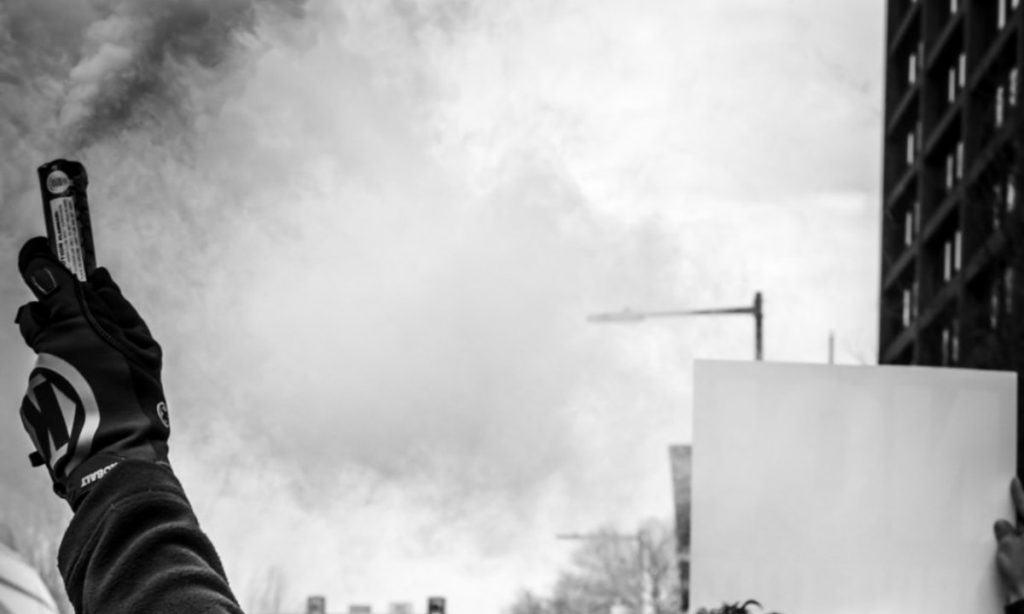
The following piece offers some thoughts on anarchist activity in Philly in 2017. Like any reflection worth its salt, this one is meant to inspire thought, conversation, and ultimately action.
Changes
The most noticeable change in the anarchist space has been its increase in size, alongside a deepening and broadening of anarchist activity in Philly. An ever-changing place, the anarchist space has seen an influx of new people and ideas. More punks, more overlapping with the left, and definitely more anti-fascism. Many of the struggles anarchists engaged in prior to 2017 have escalated, and anarchists have also opened new fronts on which to fight the social war. The anarchist space itself is constantly in flux; with people dropping in and out, relations between people changing, organizations forming and collapsing, new alliances and hostilities emerge. Each change affects our capacity, growing it, limiting it, moving it in different directions. Like all changes, these present both new opportunities and new challenges. How can we move beyond increasing our numbers to seeing our activity flourish? What would it mean to qualitatively assess the growth we’re experiencing?
Other aspects of the anarchist space have remained the same. We have yet to open large public conflictual spaces within big marches and protests. Theoretical conversation and deepening stays confined within one-on-one conversations and small groups. Assemblies and larger discussions continue to feel like spaces where many people show up with the expectation of being told what to do, of finding a group to join, of coming to a decision all together about what should be done, instead of being spaces where people arrive with their own initiative. As always, there is room to improve; this is not something we should shy away from.
The shift toward anti-fascism, fighting the right, and opposing Trump has affected local social conflict in interesting ways. Longtime anti-fascists expressed both bitterness and pleasure to see large sections of the population finally take seriously the dangers the far-right poses, a danger they have been fighting for years. One unfortunate effect of this shift towards anti-fascism has been a shift away from black revolts against policing and from anti-colonial struggles, as well as a shift away from insurrectionary interventions among anarchists. The rise of anti-fascism has birthed a curious and misguided belief among the mainstream that anarchists and anti-fascists are the same thing. What would it mean to understand the fight against fascism as part of a holistic struggle against all domination? How can we use this supportive climate to move forward without playing down our radical politics for the masses? How can we reimagine anti-fascism as proactive and offensive rather than reactive and defensive?
Strengths
Small and large autonomous actions proliferated! Last year saw consistent anarchist propaganda in the forms of graffiti, posters, and stickers in multiple neighborhoods, mostly in West and South Philly. A practice of attacks and sabotage against symbols and mechanisms of authority have become normal. The attack against a Philly police substation and several cop cars outside it was a notable escalation; Philly police property has not been successfully attacked in such a way, to our knowledge, for many years. The struggle against gentrification has continued without devolving into liberal activism, appearing mostly as targeted vandalism both in and out of demonstrations. How can this practice of attack be sharpened and expanded? What experiments in coordination, escalation, and diffusion can we try in 2018?
The May Day demo and the J20 march on South St were a dramatic escalation of anarchist street presence, creating short-lived spaces where people could freely express their rage against capital and the state without the threat of immediate arrest. This model of demonstrations, planned and promoted out of sight, have the potential to continue creating inviting space to experiment with attack on a scale impossible for a single affinity group to pull off alone. How can we keep creating space to collectively build our confidence and capacity to attack together in the year to come? How can we break out of the anarchist calendar and create moments of collective rage outside of a few anarchist holidays every year?
Support for local and national J20 defendants took many forms. The punk scene began to take political action in a way that hadn’t been seen in years. Lots of benefit shows and an all-day barbecue were organized. Meals, a rally, and benefit shows created a number of opportunities for the punk scene and the anarchist space to intermingle and draw new lines of solidarity.
Speaking of punk, at least twice in 2017 fascists were fought in or around punk shows. This return to the anti-authoritarian roots of the subculture is an example that can be carried over to other scenes and subcultures. How can we intensify the subversive potential of diy music, graffiti scenes, drug culture, or other alternative spaces? What would it look to begin transforming scenes and subcultures into rebellious countercultures?
The murder of anti-fascist protester Heather Heyer in Charlottesville, VA and nationwide debates around public monuments this summer led to a renewed interest in removing the monuments to former police chief and mayor Frank Rizzo. Public rallies and petitions pressured the city government to remove the Rizzo statue in Center City. At the same time, people vandalized the statue and mural, hung an anti-Rizzo banner, and put up posters depicting the statue being torn down. These actions worked to immediately discredit and attack the symbols of racism, and to pressure politicians to take action. This instance of national anti-confederate momentum being directed at symbols of racism and homophobia locally is an interesting example of adapting trends to fit our own contexts and desires. We might do well to learn from this and imagine ways to funnel popular sentiment in anti-authoritarian directions in the new year.
These practices, and the consistent rhythm they have created in the city and the anarchist space, are an accomplishment in themselves. What are ways to further spread and deepen these rebellious activities? What new ones can we imagine and experiment with?
Critiques
Anarchists have not yet been able to create large confrontational demonstrations. We have had little success with this here since at least before the Occupy movement, and this was also notable in 2017. In March, the MAGA march was confronted by the largest black bloc seen on the east coast in years, yet the opposition was mostly symbolic; the cops ultimately shut down the MAGA march. The Black Resistance march in February, which did clash with the police and vandalized a bank, led to arrests and injuries. Reports and many discussions of the march framed the protesters as passive victims, and the number of arrests and injuries left many feeling less empowered than they started. Attempts to create participatory confrontations were made during the International Association of Chiefs of Police (IACP) conference in October, but fell flat. The history of vicious police repression and Quaker pacifism in Philly have certainly contributed to this failure, yet it is up to us to create the activity we want to see.
Anti-fascist organizing has faced some challenges despite its sudden increase in popularity, as new methods are now needed. The wave of new people means that security and communication practices must be reviewed and tightened up.
When police killed David Jones in June, the response by anarchists was remarkably tame. The possibility of expressing an explicitly anti-cop position in solidarity with those who knew David never became a reality. David’s name was painted around the city, but it was the activists who made the most noise around David Jones’ death, asking for truth, justice, and at times community control of the police. This is not a call to dismiss the grief and suffering of those close to David whose ideas we disagree with, rather a suggestion to be honest about our politics and to act on them when police killings happen.
Our networks outside of the city seem to be lacking. Our location along the east coast means we could communicate and coordinate with anarchists in Baltimore, NYC, DC, Delaware and New Jersey. These types of connections could have made responding to the Vaughn prison revolt in February feel more possible. Additionally, international solidarity has not seemed like a priority for anarchists here this past year.
Lastly, and most straightforwardly, anarchists could have done a better job of presenting anarchy as a viable and desirable alternative to Trump and democracy. Despite a spike in activity by anarchists, many people still do not understand why anarchy is so appealing to us. We cannot look to the media to tell our potential accomplices and comrades why we do what we do. Only we can explain ourselves and what we fight for.
Reportback from the Eagles riots: A chance for solidarity, but more importantly, a chance for Joy.
Submission
On January 21st, we took the opportunity to take part in the temporary autonomous spaces created by the post victory fervor of thousands of football fans. Realizing that the soon to be victory of the Eagles was an ample time for us to strike back against the domination of civilization, the police, and the prison walls built by our own deteriorating mental, we met up with friends outside of Lincoln Financial field with the intention of freeing ourselves, albeit temporarily. We joined up with fellow members of the continuous class war in their celebration, singing, chanting, lighting fires, and using this opportunity to attack ATMs and throw a little bit of art on the dismal walls of south Philadelphia. We moved down broad street with a roving party that the Philly PD just couldn’t seem to shut down.
After the pigs threatened an individual with noise violations for playing music to the crowd, the atmosphere took a more exciting turn. South Philly sports fans who normally shrieked about the thin blue line became agitated at who they viewed as their protectors. We took this opportunity to begin chants such as “Fuck the Patriots” and “Fuck Tom Brady” which many didn’t notice quickly became abbreviated to “FTP” and “Fuck 12” (Brady’s number). The crowd began to swell, with people leaving and even more left their homes to join the party and follow what soon became an autonomous, spontaneous anti police demonstration.
We made our way to city hall where our moving party joined up with an even larger group, the smell of smoke and alcohol filled the air and the distinct sounds of chanting bellowed in our ears, drowning out the orders of the Philly PD. With growing anger, the police attempted to clear the street. We used this opportunity to use the hundreds of bottles littering the streets as projectiles, with many others soon following our lead. The riots moved slowly, untamed by the police as people continued to share their joy and release their rage against the city through attack. More and more riot cops materialized from the side streets as someone with a speaker played NWA’s “fuck the police” to the excitement of many within the crowd. We continued to throw projectiles, light things on fire, and paint the walls with many other folks, most of whom we had never struggled against domination with, but whom we certainly hope to have at the barricades with us in the future. The crowd moved towards 15th and JFK and eventually dispersed. At this time, we are unsure of anyone arrested for taking part in this spontaneous riot.
This action was super great for us and hopefully for the hundreds of others who took to the streets at our sides. It was a beautiful change of pace to strike back in such a low stress environment on such a large scale without the traditional cover of the black block. As insurrectionary anti-authoritarians, we’re far too aware of how damaging to our mental health the institution that is the state is, and how little we get to exercise our rage to the capacity we would like to. This battle in the on going class war was extremely refreshing, and most importantly it was fun. By striking back, we were reminded of the level of joy only experienced when we make our executioners fear us, to watch the uncertainty and terror that manifests in their eyes when they realize that they’ve lost control. We are reminded that within the chaos, we can be free. Most importantly, we are reminded of our own power and that class war and insurrection will never be a few small groups taking actions, but a writhing unstoppable horde of love and rage.
We took these actions in memory of all our comrades across this dying world who are no longer with us and those who are slowly slipping from our embrace, whether it be from toxic institutions pushed onto them, or ones they’ve summoned for themselves. A riot will always carry the ghosts of our losses, and our hopes for a world we hope to see one day. For this reason, we view every attack as a eulogy, and a chance for inspiration. We hope to see y’all in the streets February 4th.
Fuck Cops, Go Birds
Anathema Volume 4 Issue 1
from Anathema
Volume 4 Issue 1 (PDF for printing 11 x 17)
Volume 4 Issue 1 (PDF for reading 8.5 x 11)
In this issue:
- New Year, New Attitude
- 2017: Year in Review
- Guilt
- DOW Reaches 26,000
- Against Fearlessness
- Poem: “About Me: In English”
- What Went Down
- World News
J20 info session and support dinner
from Facebook

Greetings Friends,
Many of you may have heard that there was a substantial victory this past week in the cases of the more than 200 people (collectively referred to as the J20) arrested and charged at last year’s Inauguration Day protests in Washington DC. 129 people had their charges dropped, while 59 people still face multiple felonies and potentially decades of jailtime.
In an article appearing in The Intercept on Friday, one of the defendants, Miel Macchio, who was acquitted in the first trial, notes that “the dismissals are a testament to the success of the defendants’ collective defense strategy. By refusing to plea and instead coordinating their defense, the accused succeeded in thwarting the government’s effort to collectively punish dissent. ‘What we are [now] seeing, is a strategic narrowing of the government’s case,” Macchio says, “Those still facing charges are now much more vulnerable as a smaller group.'”
On this coming Sunday, January 28, from 5:30-7:30pm we will be hosting a J20 InfoSession and Support Dinner at 5835 Hadfield Street in West Philadelphia. This will be a chance for folks to gather in one place in order to be updated on the current situation, to learn how they can get involved and provide support for those still facing charges, and to generally share food and company together.
We will be making a big batch of vegan chili and some cornbread, but it would be great if others could bring and contribute food to the mix as well!
Again, the basic details:
What: J20 InfoSession and Support Dinner
When: Sunday, January 28 from 5:30-7:30pm
Where: 5835 Hadfield Street, Philly 19143
Hope you can make it!
In struggle,
Emily & Layne
Anti-Police Intervention at Women’s March
from Facebook

This banner was put up today after the Women’s march!
The order of police protection was a threat to trans folk and women of color.
Paying the state for your resistance march is not RESISTANCE in any shape or form, just mindless liberals pretending that they’re actually making a difference. The use of direct action is absolutely necessary for resistance.
Your kitty ears and signs are useless.
Go smash a bank window and kick a nazi in the nuts, ladies.
Shout-out to Philly Rebellion for a sick demo today.
The Cinema Committee Reflects on 2017 from Belarus to Philadelphia
from It’s Going Down
We’ve all heard the story before. People still tell it from the moldering dankness of their mom’s basement. It goes like this: George Soros contacts The Anarchist Antifa Supersoldiers and hands over bulging bags thick with gold in exchange for doing his bidding. Interesting story, right? Well, turns out plenty of shitholes on the internet tell it nearly every week. Since we can’t seem to convince anyone that we’re broke a a joke, and since everyone is calling everyone else a Russian spy, we thought it appropriate to celebrate our current predicament by weaving it all together in a simple and clear narrative. Contrary to popular reports, the international anarchist movement is beholden to neither George Soros or Vladimir Putin. All flags look the same to us. Every country is our homeland.
While the techno-overlords continued to blast the San Francisco Bay Area with their continuously stoked housing crisis, several individuals found it wise to begin burning down luxury housing developments in the city of Oakland. These fires began in 2016 and continued into 2017, each of them completely destroying their targets and costing ten of millions of dollars. The latest was in July when a luxury apartment block caught fire in the heart of Downtown Oakland. These arsons have been wisely left unclaimed by their authors. With the housing and homeless crisis plainly visible for all to see, the sight of burning luxury apartments is a simple message difficult to misinterpret.
Across the continent in Philadelphia, the local anarchist movement has grown quite strong in the past years and become popular for organizing and marching against Trump. Since the fall of 2012, local anarchists have printed their paper Anathema and chronicled events in their city and beyond. With housing costs rising and homelessness increasing, some individuals found it wise to sneak into some luxury developments and torch them to the ground. This arson took place in the Point Breeze neighborhood in 2017 and garnered wide attention in the local media. In another act of rebellion, a group of fifty people rampaged through a series of new developments and trashed everything that reeked of luxury. These two events happened within weeks of each other and sent a clear message against this new luxury development most liberals view as normal. Because of the fluid and toxic news cycle of our current era, few people remember these important activities outside of Philadelphia.
Vandals strike Christopher Columbus statues across NJ
from Mainstream Media
CAMDEN – Two Christopher Columbus statues in Camden County were among several targeted in a statewide vandalism spree, officials say.
Vandals daubed paint on monuments to the Italian explorer in Cooper River Park, Pennsauken, and Farnham Park in Camden, said Dan Keashen, spokesman for the Camden County Police Department.
“My understanding is that this was a statewide event,” he said.
The vandalism was discovered Monday, and crews cleaned the Camden County statues Tuesday morning.
Statues also were struck in Atlantic and Bergen counties, said Dominick Burzichelli, president of New Jersey Order Sons of Italy in America.In Bergen County, red paint was smeared on a pair of Christopher Columbus statues in two parks in the city of Garfield on Sunday, authorities said.
from Mainstream Media

A Christopher Columbus statue in Trenton’s Chambersburg neighborhood has become at least the fourth of the explorer’s likeness to be vandalized in New Jersey this week.
Lawmakers, officials and residents discussed the colonizer’s place in American history on Columbus Day in October.
Many lumped Columbus and his statues in with other historical figures that were being defaced across the country because of their ties to slavery and marginalization of certain racial groups.
A letter left at the statue in Trenton’s Columbus Park titled “F–k your new world” explains that the writers feel communities can be hurt by “progress that is quickly swallowing neighborhoods across the country.”
The note also says the group will be acting on Columbus statues throughout the state. It was signed, “Lovingly, NJ Anti-Facists.”
A statue in Dahnert’s Lake County Park in Garfield and two in Camden County were also splattered with red paint at some point in the last four days.
Philadelphia IWW Statement in Support of Operation PUSH
from Philly IWW
On January 15, 2018, prisoners across the state of Florida will cease working and participating in the prison economy. The prisoners pledged to make this a non-violent lay-down strike. The demands of the inmates are simple:
1. Payment for their labor
2. A stop to canteen price gouging
3. The reinstatement of parole
The Philadelphia IWW supports the efforts of the prisoners and asks for all fellow workers to stand in solidarity with the strikers. The prison system is predatory and racist; we commend our fellow workers behind bars for their courageous actions in the face of injustice.
Read the striker’s statement here.
Letter-writing in Solidarity with Trans Prisoners
from Philly ABC

Because of the new year and frigid weather this event is being held on Monday, Jan 22nd. Events will resume on first Mondays in February.
Our January event will highlight trans political prisoners in honor of J22: Trans Prisoner Day of Action and Solidarity. This annual event was initiated by Marius Mason, a trans prisoner in Texas, and is now being led by trans prisoners and their supporters from around the world. It is a chance for those on the outside to remember those behind bars, give real solidarity and support, and raise awareness about issues facing trans prisoners. It is a chance for those on the inside to have a voice and organize together.
Join us for dinner at LAVA on January 22nd at 6:30pm as we write to Marius Mason and Jay Chase! A representative from Marius’ support crew will be there to provide the most updated info on him and his case. We will also send birthday cards to prisoners with January birthdays: Fran Thompson (4th), Abdul Azeez (9th), Sundiata Acoli & Herman Bell (14th), Joe-Joe Bowen (15th) and Marius Mason (26th).
