[This post only contains information relevant to Philadelphia and the surrounding area, to read the entire article follow the above link.]
According to organizers, there were 2,700 No Kings rallies across the country on Saturday, with over 7 million coming out showing their opposition to Donald Trump and the actions since he returned to the White House. The protests were organized by a coalition of progressive and labor groups, including the 50501 Movement and Indivisible. The “No Kings” reference is in regards to the Trump administration’s authoritarian policies and executive overreach that is akin to that of a monarch. While most of the rallies were uneventful, there were some that saw opposition coming from Trump supporters, either lone antagonists or organized MAGA groups coming out to counter protest.
No Kings rallies in Colorado, Ohio, Kentucky, California, South Carolina, Oregon, Florida, Virginia, and Texas saw confrontations by individuals and groups associated with MAGA that resulted in approximately 22 arrests. There have not been any reports of arrests of anyone that participated in the rallies themselves.
In Wilkes-Barre, PA, a driver driving a red Jeep decorated with Trump flags allegedly flashed a gun at protesters. Police promptly arrested 52 year-old Michael Paul Kolarik from Scranton and charged him with counts of terroristic threats, recklessly endangering another person, simple assault and disorderly conduct. He bonded out on $50,000 bail and is scheduled to appear in court for a preliminary hearing on Nov. 5. No one was hurt and no shots were fired.
For his part, Donald Trump responded to the anti-Trump rallies with a 19-second AI-generated video posted on his Truth Social account, depicting him wearing a crown in a fighter jet labeled “King Trump” and dropping what appears to be feces on protesters. The video featured the song “Danger Zone” by Kenny Loggins playing in the background, which prompted Loggins to demand his recording be removed from the video. “I can’t imagine why anybody would want their music used or associated with something created with the sole purpose of dividing us,” Loggins said in a statement. “Too many people are trying to tear us apart, and we need to find new ways to come together. We’re all Americans, and we’re all patriotic. There is no ‘us and them’ – that’s not who we are, nor is it what we should be. It’s all of us. We’re in this together, and it is my hope that we can embrace music as a way of celebrating and uniting each and every one of us.”
This Saturday we will travel with our co-workers to No Kings protests, some to City Hall, some to Harrisburg, and some to DC.
As WSA, of course we will be there with our calls for an end to racism and the class system, and an end to genocide – resistance to fascism without mere reformism. We stand for working-class revolution from below!
While the cause we bring is more radical than the event the organizers are broadcasting, it’s crucial for us to be there.
The idea of boycotting or dismissing a mass mobilization for democracy against fascism, does not appeal to us. We want to be IN our workplace and present our views, and WITH our co-workers at Saturday’s protests. For some this will be the first protest they ever attend. Among workers at higher risk, in this time of repressive danger, their willingness to attend a protest is courageous.
We stand internationally with our comrades in the International Workers Association as we deal with this global authoritarian movement, this international threat to immigrant workers and erosion of rights. May the voice of workers this Saturday speak out in solidarity with all at risk, and call for transformation!
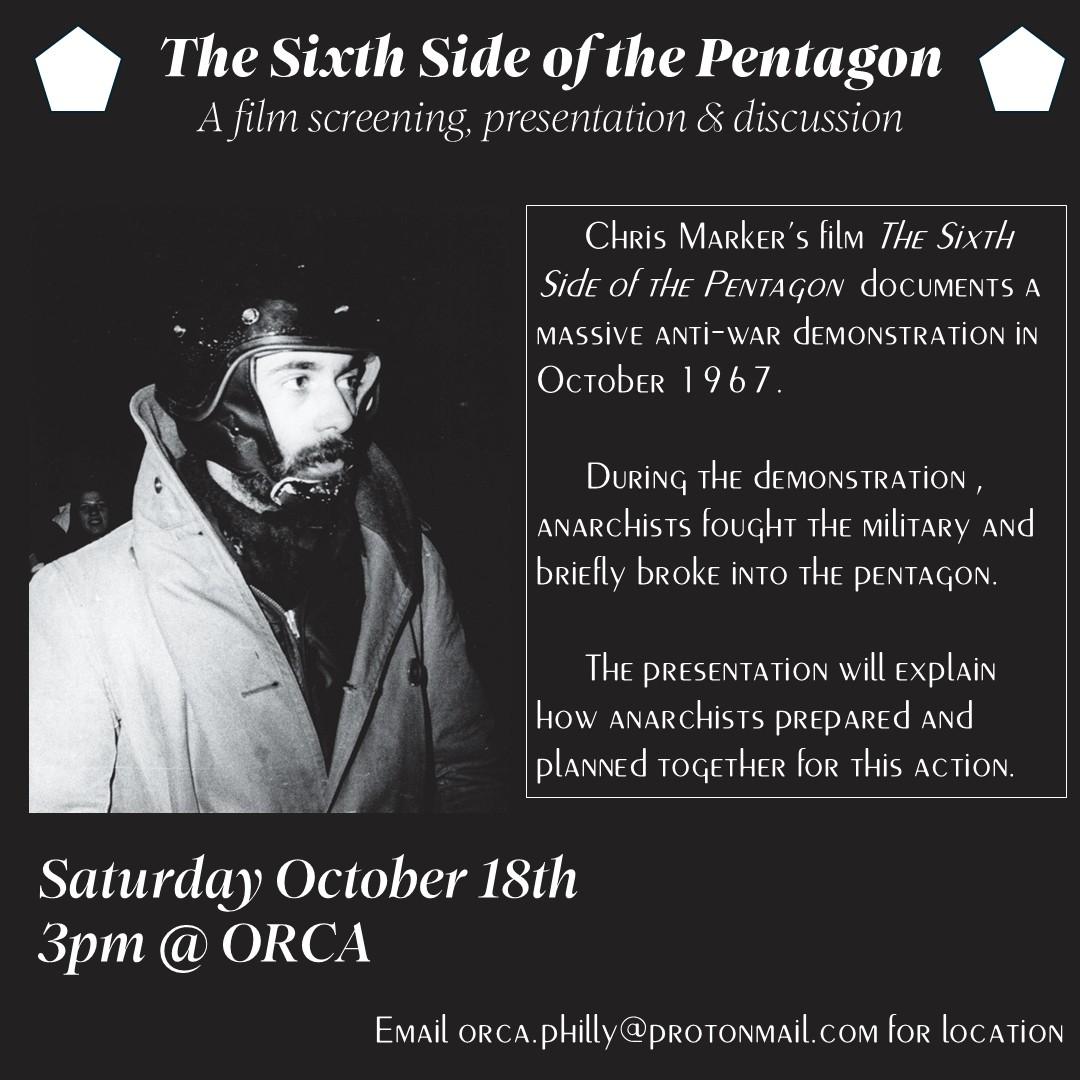
A film screening, presentation and discussion about Chris Marker’s film The Sixth Side of the Pentagon.
Chris Marker’s film The Sixth Side of the Pentagon (25 min) documents a massive anti-war demonstration in October 1967. During the demonstration, anarchists fought the military and briefly broke into the pentagon. The presentation will explain how anarchists prepared and planned together for this action.
Join us Indigenous Peoples’ Day weekend for a free teach-in on Andean resistance in Bolivia & Chile. Come learn, discuss, and take part in collaborative activities.
Making Worlds Bookstore & Social Center210 South 45th StreetPhiladelphia, PA, 19104United States(map)
Join us with local Philadelphia author and Ignatz and Eisner Award-winning cartoonist Ben Passmore for the launch of his upcoming graphic novel BLACK ARMS TO HOLD YOU UP: A History of Black Resistance (Pantheon; On-sale: October 7, 2025). This graphic highlights historical figures of the Black Nationalist Movement like Marcus Garvey and Audley Moore to George Floyd while incorporating a dark sense of humor throughout this retelling of Black Liberation.
Ben Passmore is the author of the ongoing comic book series Daygloayhole, as well as the Eisner Award-nominated and Ignatz Award-winning comic collection Your Black Friend. He also wrote and illustrated Sports Is Hell (Koyama Press), collaborated with Ezra Claytan Daniels on BTTM FDRS (Fantagraphics), and contributes to publications such as The Nib and the New York Times. He lives in Philadelphia.
I’ve been a fan of punk rock music since I was 15 years old and have been an active member of punk scenes in Philadelphia and Fargo, North Dakota. I still attend punk shows and participate in the scene whenever I can.
Though the “birth” of punk is always a contentious subject, it is fair to say that, with the Ramones forming in 1974 and releasing the “Blitzkrieg Bop” single in February 1976 in the U.S., and the Sex Pistols performing their first show in November 1975 in the U.K., punk is at least 50 years old.
Given this milestone, I believe it’s worth looking back at the heyday of the anarchist-inflected punk scene in Philly in the 1990s and 2000s, and how the political ideology and activism – encouraging opposition to capitalism, government, hierarchy and more – is still influential today.
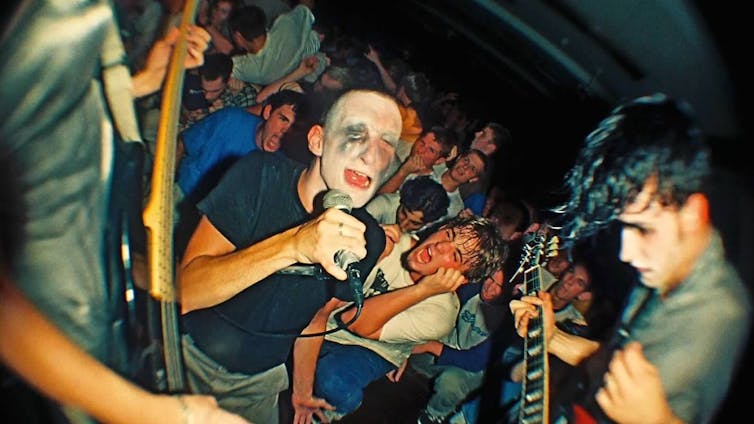
Philly hardcore punk band Ink & Dagger performs at the First Unitarian Church, circa late 1990s.Justin Moulder
‘Not your typical rebellion’
In Philadelphia, and especially in West Philly, a number of collectively organized squats, houses and venues hosted shows, political events and parties, along with serving as housing for punks, in the 1990s and 2000s. In some cases, the housing itself was a form of protest – squatting in abandoned buildings and living cooperatively was often seen as a political action.
Many Philly punks during this era mixed music subculture with social activism. As one anarcho-punk – a subgenre of punk rock that emphasizes leftist, anarchist and socialist ideals – I interviewed for my book told me:
“My mom … said, ‘I thought you were going to grow out of it. I didn’t understand it, and your dad and I were like, ‘What are we doing? She’s going out to these shows! She’s drinking beer!’ But then we’d be like, ‘She’s waking up the next morning to help deliver groceries to old people and organize feminist film screenings!’ We don’t know what to do, we don’t know how to deal with this; it’s not your typical rebellion.’”
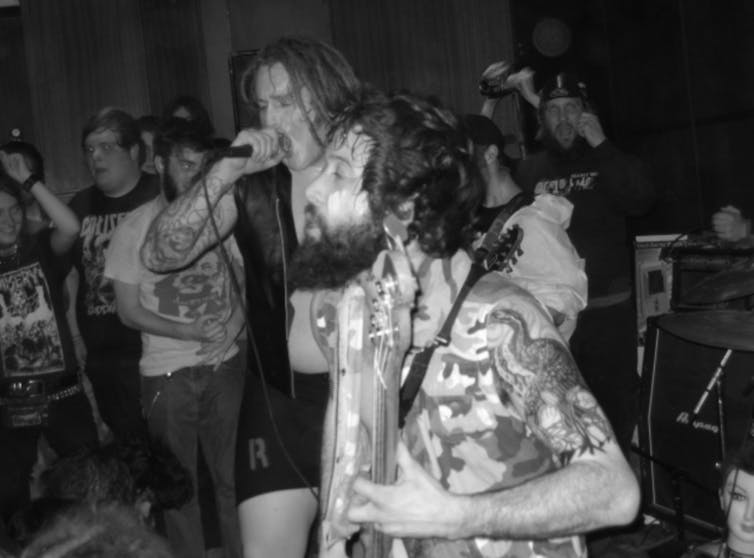
Philly punk band R.A.M.B.O. performs in January 2006, with Tony ‘Pointless’ Croasdale singing and Bull Gervasi on bass.Joseph A. Gervasi/LOUD! FAST! PHILLY!
This quote captures the complex and ambiguous rebellion at the heart of anarcho-punk. On the one hand, it is a form of rebellion, often beginning in one’s teenage years, that contains the familiar trappings of youth subcultures: drug and alcohol consumption, loud music and unusual clothing, hairstyles, tattoos and piercings.
However, unlike other forms of teenage rebellion, anarcho-punks also seek to change the world through both personal and political activities. On the personal level, and as I showed in my book, many become vegan or vegetarian and seek to avoid corporate consumerism.
“I do pride myself on trying to not buy from sweatshops, trying to keep my support of corporations to a minimum, though I’ve loosened up over the years,” another interviewee, who was also vegan, said. “You’ll drive yourself crazy if you try to avoid it entirely, unless you … go live with [British punk band] Crass on an anarcho-commune.”
Love and rage in the war against war
Philly’s punk activists of that era spread their anarchist ideals through word and deed.
For example, on its 2006 single “War-Coma,” Witch Hunt reflected on the ongoing wars in Iraq and Afghanistan, laying blame on voters, government and religion:
24 years old went away to war / High expectations of what the future holds / Wore the uniform with pride a rifle at hand / Bringing democracy to a far away land / Pregnant wife at home awaiting his return / Dependent on faith, will she ever learn? / Ignore the consequences have faith in the Lord / Ignorance is bliss until reality sets in / Never wake up again
During live performances, bands would commonly discuss what the songs were about. And at merchandise tables, they sold T-shirts and records along with zines, books, patches and pins, all of which commonly contained political images or slogans.
Some bands became meta-critics of the punk scene itself, encouraging listeners to recognize that punk is about more than music.
In “Preaching to the Converted,” Kill The Man Who Questions critiqued the complaints bands would receive for becoming too preachy at shows:
“Unity” the battle cry / Youth enraged but don’t ask why / They just want it fast and loud, with nothing real to talk about / 18 hours in a dying van / Proud to be your background band.
In West Philadelphia, punks also staffed the local food cooperative and organized activist spaces – like the former A-Space on Baltimore Avenue and LAVA Zone on Lancaster Avenue where groups such as Food Not Bombs and Books Through Bars, among others, would operate. I personally organized a weekend gathering of the Northeastern Anarchist Network at LAVA in 2010.
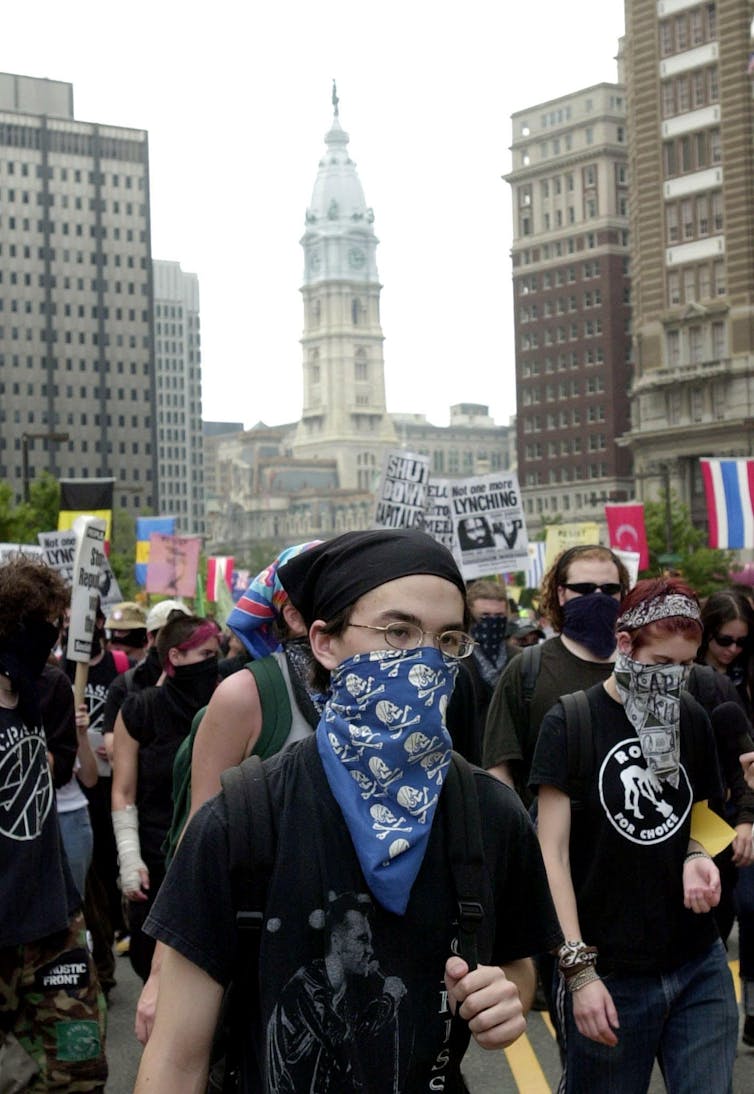
Masked protesters walk away from City Hall after a march on July 30, 2000, a day before the start of the Republican National Convention in Philadelphia.Roberto Schmidt/AFP via Getty Images
Punks raised money for charities and showed up to local protests against capitalist globalization and countless other causes. At the Republican National Convention in Philadelphia in the summer of 2000, black-clad punks whose faces were hidden behind masks marched in the streets along with an enormous cadre of local community organizations.
Punk not dead in Philly
Since punk’s earliest days, people have bemoaned that “punk is dead.”
In Philadelphia, I’ve seen how the anarcho-punk scene of the 1990s and 2000s has changed, but also how it continues to influence local bands and the values of punk rock broadly.
Many former and current members of the Philly anarcho-punk scene are still activists in various personal and professional ways. Among those I interviewed between 2006 and 2012 were social workers, labor organizers, teachers and professors, and school and drug counselors. For many, their professional lives were influenced by the anarchist ethics they had developed within the punk rock scene.
Anarchism and punk rock open up avenues for disaffected youth – in Philadelphia or anywhere else – to dream of a world without capitalism, coercive authorities, police and all forms of injustice.
In the words of R.A.M.B.O., one of the better known hardcore punk bands of the era and who released their latest Defy Extinction album in 2022: “If I can dream it, then why should I try for anything else?”