Establishing a Security Baseline for Anarchists and Radicals

from No Trace Project

The Tinderbox collective gave permission for this article to be published online.

This text was written in response to an ongoing need in Philly and elsewhere for tighter security practices. It also responds in part to the No Trace Project’s “To the International Anarchist Movement: Three Security Proposals”, which includes a proposal to establish security baselines locally. The authors write:

“Anarchists who carry out direct actions should analyze the risks associated with their actions and take appropriate precautions: dress anonymously, be mindful of video surveillance and DNA traces, and so on. However, this is not enough. If only those who carry out actions take precautions, it is easier for our enemies to target these individuals. This is, firstly, because they stand out: if only a handful of comrades always leave their phones at home, for example, this could be an obvious starting point for an investigation with no other specific leads. And secondly, because our enemies can get information about them through their friends who do not carry out actions: if someone doesn’t use social media but is mentioned on their friends’ social media, for example, an investigation could query their friends’ social media to get information about them. We should therefore establish a security baseline that everyone in anarchist networks agrees to follow, including those who have never carried out direct actions and have no intention of doing so.”

“It can be difficult to convince people to follow such a security baseline, especially if they think they have no personal interest in following it. If someone is reluctant, we should remind them that it’s not just their security that’s at stake, but also the security of other anarchists around them who may be carrying out or planning to carry out direct actions. Everyone who wants actions to happen has an interest in making anarchist networks as difficult as possible for the authorities to repress.”

In this text, we try to identify specific needs, for example for various kinds of communication with each another, and establish some baseline practices around meeting those needs that we can all share to make ourselves harder targets for state repression. We feel that this is especially urgent in this era of increased repression of many oppressed populations in the U.S. and of resistance more generally. This repression has been unpredictable, chaotic, and terrifying. We can empower ourselves to keep fighting for anarchy and liberation by establishing some shared practices in the Philadelphia anarchist/radical space that make us all safer.

That being said, the state’s response to strong radical struggles is never gonna be pretty or predictable, and we would offer similar recommendations about security practices regardless of who is running the country. These recommendations are based in part on the current level of radical activity that’s going on in Philly, but they’re also tailored to the level of activity that we’re working towards, to what we see as our potential. This might include the return of widespread prolonged uprisings in the streets. Or, in the absence of mass uprisings, it could also look like a broader and more escalated culture of direct action and attack, anarchist and liberatory ideas spreading more widely, and more autonomous practices being taken up by more people. These are just some examples, and everyone will have their own vision, but the point is that if we wanna become more of a threat, it makes sense to prepare to be treated like one.

We can learn from other countries and contexts, as well as our own, how the state might investigate and respond to something like a prolonged campaign of escalated direct actions and attacks. In those other contexts, when there are no immediate, obvious suspects, the state is forced to investigate in ways that teach us a lot about its resources and how we can mitigate those state responses. Here in Philly, it wasn’t so long ago that there was a house raid, which we can assume was attached to a broader police investigation, that targeted student activists in response to campus solidarity encampments and some light vandalism. So this kind of thing is not hypothetical.

Let’s imagine if there were an active investigation going on into an anarchist scene in Philly (or into whatever part of the radical space here feels relevant to you). We’ll also imagine that individuals are taking solid precautions around criminalized activities and that there are no obvious suspects for particular incidents. Based on information from elsewhere, this police investigation could look like the following:

  1. A first step would be for investigators to geolocate phones to keep track of certain anarchists’ locations, who they’re meeting up with, etc.
  2. Certain people’s phones would be wiretapped (not necessarily people who you would expect).
  3. A next step would be to plant bugs and/or cameras in anarchist spaces, outside (or inside) anarchists’ houses, and/or at known regular meetup spots. GPS trackers are also easy to plant on individuals’ cars.
  4. A further step would be physical surveillance. This could either be obvious, like occasional police patrols going by your house, and/or the kind that requires some amount of study to reliably detect.[1]

Based on your phone usage, for example, what would the police discover if you were one of the targets of this kind of surveillance? What would they find out about you if one of your friends was targeted? Keep in mind that we can never be completely “secure” and our lack of total security should never allow us to get trapped in inaction. But we should also consider what small steps we can take now towards better security, for ourselves and our friends’ sakes.

Our suggestion is to start by working on your own practices. Try to establish shared practices with your closest people and/or with individuals with whom you already do particular projects. Keep in mind that the level of security you choose for a specific project should depend on the project. For example, organizing a monthly free store in the park will look different from planning a three-person sabotage action. We don’t focus on that here because we’re trying to keep it short and sweet. But for more information about how to assess the specific security needs of a particular project, see the No Trace Project’s “Threat Library”.

The following are proposals based on mistakes we ourselves have made or seen elsewhere in anarchist and radical spaces. They’re intended to be up for discussion. If you have feedback on these proposals, please email phillysecuritybaseline@riseup.net.

Digital Communication

1) Texting & Calling

A general rule of thumb about this is when texting or talking on the phone (including on Signal), ask yourself, would I want what I’m saying read back to me in a courtroom transcript?

  • Do not use Signal to organize anything remotely illegal, including anarchist publication projects or other writing that claims or encourages criminalized activities.
  • If you need to, use Signal to schedule in-person meetings or conversations, at which you will then organize what you’re trying to organize.
  • Do not hint over Signal about organizing something spicy, that the conversation you’re trying to schedule will be spicy, etc. Please just act normal. Leaving out certain details or avoiding certain topics over text can feel uncomfortable at first, but if you keep it up it starts to feel more natural.
  • Avoid joining big group chats. If the police arrest someone who is carrying their device, or if they raid a house and seize devices while they’re still turned on, they can usually search these devices and this compromises every other individual who is in a group chat with the person whose device was seized. Is it worth it? Consider how you can arrange to get the info on that thread in a different way.

2) Social Media Usage

Social media profiles are either completely public or at the very least extremely easy for law enforcement, fascists, and other adversaries to access. Social media is the first thing cops will go to in order to learn more about local radical or anarchist networks, precisely because it is so easy to access. If you consider that everything you say on social media can be read by law enforcement and is at the very least being passively stored in some data warehouse for later use, it starts to feel very silly to continue handing them info (any kind of info) on a silver platter. Let’s make it harder for them! 🙂

  • We recommend not using social media for most projects. For projects with a social orientation, like an anarchist social center or bail fund, sometimes social media can help spread awareness of the project. But social media should not be used to organize, gauge the effectiveness of our organizing, or communicate about radicalism in any other way than posting information about events or projects.
  • Consider not having personal social media, since this is such an incredibly easy resource for police investigations. It hands them a lot of insight into particular individuals’ personalities and personal lives, helps them trace social and political networks, charts people’s activities, and so on.

Getting rid of social media accounts can feel impossible because it feels like we’re sacrificing something that is important for our happiness and well-being, and technically we are — these platforms are designed to get us addicted to the dopamine hits that we get from them. But this isn’t just about giving something up, it’s also about the possibilities that not using social media offers us. Imagine the worlds we can open up for ourselves once we minimize our use of these alienated digital ways of relating to each other and make more time and space for the happiness and personal well-being that comes from relationships rooted in real connection. Something to think about…

The bottom line: do not talk about other anarchists or anarchist actions on social media. Do not give out any non-public information that would be useful for a police investigation.

Face-To-Face Communication

1) Where We Talk

  • Don’t discuss illegal actions that have happened, actions that you are planning, or other sensitive information, around phones, or indoors, on your porch, in your backyard, etc.
  • Go for a walk, meet in a park, etc.
  • When planning more intense actions, try meeting at an agreed-upon spot and then walking somewhere else, ideally to somewhere you haven’t been before or don’t typically go to.
  • Don’t make it obvious who you talk about sensitive subjects with (for example, asking someone else to “go for a walk” when you’re in the middle of a group of people).

2) What We Talk About

  • Don’t brag about actions that have happened or imply involvement in actions.
  • If you think it makes sense to share sensitive information with someone, try asking them first if they’d like to hear it. It’s a disservice to tell someone more than they need to know without their consent. On the off chance that that person is later subpoenaed to a grand jury, or interrogated by law enforcement, it’s so much easier for them to say nothing when they genuinely don’t know anything.
  • Don’t discuss involvement in actions after the fact, including with the people you did the action with. Depending on what the action was, a scheduled debrief soon afterwards can be an exception to this. The point is to not casually reminisce, especially months or years later.
  • If you’re involved in a publication or website that discusses and/or promotes illegal actions, keep your involvement a secret.[2]

Use of Phones/Devices

  • Absolutely do not take your phone (or any other networked device, including laptops, networked watches, baby monitors, car GPS) to anything at all illegal. Do not bring phones or other networked devices to a conversation in which private or confidential information is shared. Understand that if you do so, you are bringing a potential snitch to the action or conversation. This is very serious.
  • Avoid taking your phone to other meet-ups or events at which mapping of social networks (which having your phone there could provide to police) would be helpful to the authorities. For example, radical workshops and presentations, trainings, jail support, etc.
  • Consider not bringing your phone when meeting up with friends either, since this obstructs law enforcement’s ability to map networks as well and it’s always nice to know that none of your opps[3] are listening and learning from you and your friends talking about your private lives, political views, scene drama, etc.
  • Many anarchists in Philly have started leaving their phones at home at all times or almost all times, and we encourage this practice to spread further. It is important that there be a broader culture of not taking our phones with us everywhere, so that the few people who already do so don’t stand out as much.
  • Do not enable biometric authentication (facial recognition, fingerprint) on your devices. The cops can compel you to use this to unlock and gain access to your devices; they can’t force you to enter your password.
  • Encrypt your phone and laptop, if you have them. Remember that if the device is turned on, encryption will be easy for the cops to bypass. If you’re involved in struggles or activities that carry a risk of your house being raided, it should be standard practice to turn off phones and computers before going to bed. This ensures that they’re effectively encrypted and mitigates the seizure of devices during early-morning house raids.
  • Do not use unencrypted devices for activities related to anarchy or radical organizing; ideally, don’t use unencrypted devices at all.

Reading and Research

  • Use Tor Browser to read articles about criminalized activity or articles that are relevant to future actions you might do.
  • Consider using a VPN at all times while you’re on the internet. We recommend downloading Mullvad VPN; it just runs in the background and you hardly notice it. Using a VPN drastically reduces the ability of adversaries to access your data, even without using Tor Browser.
  • Use Tails OS to research illegal actions. Tails leaves no trace of activity on your computer, and forces all internet connections through the Tor network.
  • Use Tails OS to moderate sketchy websites.
  • If you’re interested or already involved in doing more intense actions, and will be using the internet to research these or write/send in communiques about them, you can add additional precautions to using Tails. These are not necessary for everyone, but are a best practice and are especially suitable if you are already known to the police as a radical or anarchist and thus more likely to be under some kind of surveillance at some point.
    • Get a computer in person that you exclusively use for Tails.
    • Make sure you’re using a USB stick for Tails that has not been used before or tampered with.
    • Never connect this laptop to your home wifi network — go somewhere else that has internet.[4]

Note that not everyone in an affinity group or constellation has to be doing these tasks, so if your shared resources are limited, just make sure your group has access to at least one of these kinds of computers if you are interested in these kinds of activities.

Writing

  • Use Tails for sending communiques.
  • Especially for heavier actions, consider not writing a communique if the action seems to speak for itself. Or, write a short communique that is mostly just descriptive and avoids noticeable word choice, slang, writing style, and other potential identifiers. The police use linguistic forensics to plot out who writes what.[5]

Action

Talking to the Cops

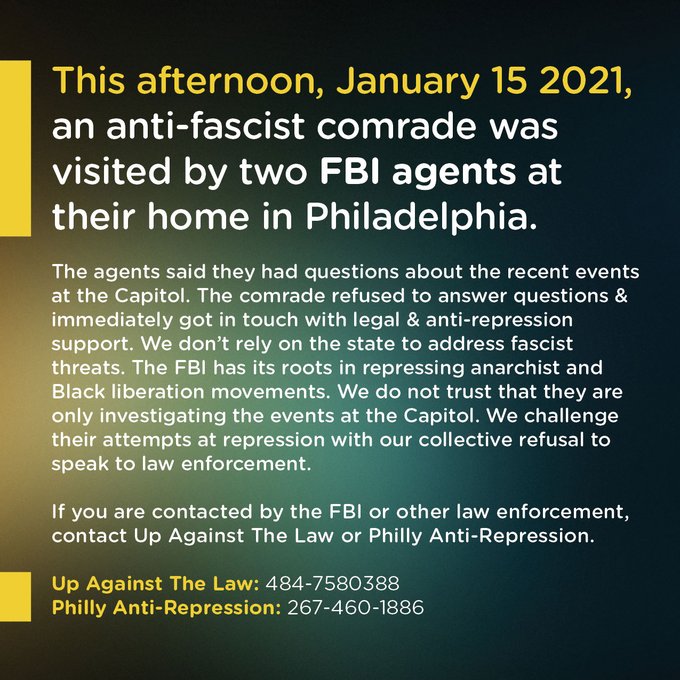
  • Do not talk to the cops. This one is non-negotiable. This includes being detained during a demo, getting an FBI visit, being interrogated in jail, cops knocking on your door or stopping you in the street asking about something random or unrelated to anarchist activity (in reality it might not be unrelated at all), being approached by the prosecution of a case, being subpoenaed to testify at a grand jury, etc.
  • In all cases, tell them you can’t talk to them without your lawyer (it’s ok if you don’t actually have a lawyer). You will probably be required to give your name and birthdate (and possibly your address) when arrested and that’s fine. If it’s an FBI visit, ask for their card.
  • Afterwards, contact Up Against the Law or another local anti-repression group and then discuss with your comrades if it makes sense to put out information about the incident to others in your networks. Not every interaction with the police needs to lead to a public statement (for example, traffic stops, apolitical arrests, mass demo arrests, and so on), but in the case of an FBI visit, grand jury subpoena, or any other attempted interrogation by law enforcement, it’s usually good to spread this information far and wide as it is likely linked to a broader investigation into your networks. Discuss what the police asked and how they asked it; what, if anything, would be interesting for others in struggles to know about; and, if so, how this info can be circulated to other comrades. This also reduces the isolation of being singled out by the law, which can feel much worse if you feel alone in it. This brings us into our next and final topic…

Discussing Repression

  • The state knows who got arrested and what the charges are; it knows that the FBI visited your home, that someone got a subpoena for a grand jury, and so on. Basic information about repression and police investigations should be shared widely so other people are aware of what level of attention anarchists are attracting from law enforcement and can move accordingly.
  • Pretty much all information that is in the cops’ and prosecution’s hands (for example, what is written in the affidavit of probable cause for an arrest) is ok to be shared with others. When you describe why someone got arrested, make sure you are referring to the state’s information about it, or to something you read in the news (“The cops are saying that…”, “The defendant allegedly did…”, “I read that…”, etc.) Don’t speak from your personal experience and don’t say that the accused person did something illegal, just that they are accused of doing it.
  • Do not speculate about why someone might have gotten a particular charge, etc. Be content that you don’t know anything and could honestly say to the cops that you can’t tell them anything if for some reason you were questioned about the situation.
  • If for some reason law enforcement interrogated you or asked you questions about an anarchist scene in Philadelphia, specific individuals, etc, it is your responsibility to inform other anarchists about the interrogation. There is no reason not to do this unless you gave them information in the course of that conversation and are trying to cover that up. If you didn’t answer their questions, there’s no reason not to let other people know about the conversation.

Case Studies for Further Reading


1.For more information on physical surveillance and how to detect it, see “Measures Against Surveillance”, which has examples from Germany.

2.In the U.S. and elsewhere, there have been cases in which people moderating a website that reposted criminalized actions were charged and served prison time (see for example the SHAC 7 case). There is also now a precedent elsewhere for individuals allegedly involved in anarchist newspaper publications (ones that “reward and justify criminal action”) being charged with being in a criminal organization, as well as the publication being used as the jumping off point for an investigation (into widespread attacks) that didn’t have any other leads (see writings on the §129 case in Munich such as “Petrol, Printer Ink, and Paranormal Activity”).

3.No Trace Project note: Term meaning opponents/enemies.

4.According to AnarSec’s Tails Best Practices guide, an adversary like the NSA is potentially capable of breaking Tor through a correlation attack. So if you’re using wifi at a public space and they do a non-targeted correlation attack, the internet address in that situation won’t lead back to you personally. In Jeremy Hammond’s case, he was already under surveillance and the state carried out targeted correlation attacks at his home that were then used as corroborating evidence in his case: “Specifically, they correlated Tor network traffic coming from the suspect’s house with the times their anonymous alias was online in chatrooms.”

5.See “Who Wrote That?” from Zündlumpen .

6.There have been many cases in the U.S. in the past two years alone in which comrades were identified by police as suspects and later convicted in part because they drove a car or motorcycle to the site of the action.

Becoming Harder Targets for State Repression: A Presentation and Discussion on Security Culture and Basic Opsec

from Making Worlds Books

Registration is required to attend. Register before the event here.

Please arrive 15 minutes early to register for the event and browse books. Buying a book before or after the event is a great way to support the Making Worlds project!

In today’s political climate, it’s more important than ever that rebels develop tighter security practices. How can we protect each other from state repression and make our activities less visible to the state? This presentation will go over the basics of security culture, tech security, and operational security. We’ll provide an introduction to security considerations for people who are newer to being politically active, while also touching on current debates around how to become harder targets for the state.

Facilitated by Philly Anti-Repression, a resource for people in the Philadelphia area dealing with state repression.

  • Friday, July 18, 2025
  • 5:30 PM 7:30 PM
  • Making Worlds Bookstore & Social Center 210 South 45th Street Philadelphia, PA, 19104 United States (map)

Secrets for Signal Success

from Instagram

7pm Friday May 2 “Secrets for Signal Success”

Come hear conversation about the ways that Signal may and may not be useful for your digital safety from surveillance by various entities. Hat will be passed to help activists in Michigan who have been facing increased legal attacks.
7pm Friday May 2 “Secrets for Signal Success”

Come hear conversation about the ways that Signal may and may not be useful for your digital safety from surveillance by various entities. Hat will be passed to help activists in Michigan who have been facing increased legal attacks.
[At Wooden Shoe]

DONT USE MOLOTOVS: Some notes on safely burning teslas (or other cars)

Submission

Seeing the wave of tesla arsons has made us incredibly happy. But we are worried to see that many of these attacks have used molotovs

-molotovs aren’t guaranteed to ignite/explode. There have been many cases where police have recovered intact molotov cocktails from attacks. that is a shitton of forensic evidence that detectives WILL exploit.
-Even if the bottle does shatter, the shards of glass still likely contain tons of valuable forensic evidence
-Molotovs are loud and immediately create a big flame, all of which kills the element of surprise needed for arson attacks, which runs the risk of you getting captured or the fire gets extinguished much quicker

ALTERNATIVES: Fire starter cubes, sometimes paired with liquid accelerant in plastic bottles

Fire starter cubes are probably the best way to burn a car.
-they are guaranteed to self destruct
-they are discreet. By the time the vehicle has been engulfed in flames you will have had ample time to escape
-they are widely available, small, lightweight, and incredibly simple to use

Instructions:
We haven’t tested if a singular small cube is sufficient, but we recommend using at least a pack/bundle of them per vehicle. Placing them on top of a front tire is the best for both electric and gas vehicles. Placing them under the vehicle next to the tire could also be a good option as the flame is even more hidden, but we havent tested it ( if you do it this way it would probably be smart to also incorporate a plastic bottle of accelerant to ensure the flames are high and and strong enough)

Whatever design you use, you must test it beforehand and guarantee that every part of the device will be destroyed in a timely manor.

Dont smash windows if youre going to burn something because it is loud and increases the risk of leaving dna. be careful not to touch anything at the scene of the crime

Exercise abundant caution obtaining and handling materials. The no trace project (notrace.how) has great resources for avoiding surveillance and mitigating forensic evidence.

Stay anonymous, get home safe, and go torch the ever loving shit out of every part of this miserable society.

-Anarchists Against Electric Vehicles, Electricity, and Vehicles

The Responsibility of Criminals

Submission

A new short zine (The Responsibility of Criminals) questioning how one acts under political persecution and certain risks of being a political criminal.

[Screen Reading PDF]
[Printing PDF]

Safety Under Surveillance: A Discussion For Organizers

from Instagram

Join us next Thursday, January 16, at @thewoodenshoebooks for a discussion on security culture, or how to protect yourself and your organization under a surveillance state! There will be a brief presentation followed by an open discussion. Hosted by Food Not Bombs South Philly and The Wooden Shoe. All are welcome & masks required.

Safety Under Surveillance: A discussion for organizers
January 16, 2025 | 6 pm
The Wooden Shoe
704 South St

To the International Anarchist Movement: Three Security Proposals

from No Trace Project

This text is addressed to the international anarchist movement, which we’ll define as the sum of individuals fighting for anarchist ideas around the world. This movement is in conflict with its natural enemies — the State, fascist groups, and so on — and must protect itself if it is to survive in this conflict. In this text, we make three proposals for the international anarchist movement to consider in the coming years in order to allow anarchists to continue attacking while limiting their chances of getting caught.

1. Share knowledge internationally

Our enemies organize internationally through cooperation between police and intelligence agencies and new developments in science and technology — the increasing precision of DNA forensics and the proliferation of drones being just two examples. This means that a repressive technique used in one country may soon appear in another where it is not yet being used. It also means that an effective countermeasure used by anarchists in one country may be effective in another. We should therefore share knowledge of repressive techniques and countermeasures on an international level.

Ideally, any experience of repression or experimentation with countermeasures that might be of interest to other anarchists should be written up, translated into several languages, and made public. When anarchists are arrested and brought to trial, we can often obtain court documents that reveal how they were caught: we should exploit this and publish analyses of such documents, bearing in mind that information obtained in this way may be partial or distorted. We should experiment with new countermeasures and write and publish reports on these experiments (except in cases where the State might adapt and weaken the countermeasure by reading the report). We should try to collect information at the source: read police training manuals, steal police files, analyze data leaks from police servers.

A specific feature of the international anarchist movement is its decentralization. We see this not as a weakness but as a strength: in addition to preventing the hierarchies inherent in centralized organizations, it makes it harder for our enemies to target us because they cannot topple the whole movement by disrupting one part of it. However, this decentralization also makes it harder for us to share knowledge across borders. To overcome this, we see two options: developing informal bonds with other anarchists by meeting at international book fairs and other events, and using the Internet. We propose using the No Trace Project as an international platform to share the knowledge that is suited for sharing on the Internet, not as a replacement for informal bonds but as a useful supplement to spread information beyond existing informal networks.

2. Establish a security baseline

Anarchists who carry out direct actions should analyze the risks associated with their actions and take appropriate precautions: dress anonymously, be mindful of video surveillance and DNA traces, and so on. However, this is not enough. If only those who carry out actions take precautions, it is easier for our enemies to target these individuals. This is, firstly, because they stand out: if only a handful of comrades always leave their phones at home, for example, this could be an obvious starting point for an investigation with no other specific leads. And secondly, because our enemies can get information about them through their friends who do not carry out actions: if someone doesn’t use social media but is mentioned on their friends’ social media, for example, an investigation could query their friends’ social media to get information about them. We should therefore establish a security baseline that everyone in anarchist networks agrees to follow, including those who have never carried out direct actions and have no intention of doing so.

We can’t say what this baseline should be, as it will depend on each local context, but we can give some ideas. As a bare minimum, everyone should help hide information from our enemies by not speculating about who is involved in an action, not bragging about one’s own participation in an action, not talking to the police, and encrypting any computer or phone used for conversations with other anarchists using a strong password. Discuss sensitive matters exclusively outdoors and without electronic devices, and don’t make it obvious to your social environment who you are having sensitive conversations with (e.g. don’t ask someone to “go for a walk” in front of people who aren’t involved in the project being discussed). In addition, we think everyone should stop using social media (and definitely stop posting photos of other anarchists, even with their consent, because this helps the State map anarchist networks) and leave their phones at home at all times (not just during actions). Carrying your phone with you has security implications for everyone you interact with.

It can be difficult to convince people to follow such a security baseline, especially if they think they have no personal interest in following it. If someone is reluctant, we should remind them that it’s not just their security that’s at stake, but also the security of other anarchists around them who may be carrying out or planning to carry out direct actions. Everyone who wants actions to happen has an interest in making anarchist networks as difficult as possible for the authorities to repress.

3. Explore new horizons

Our enemies evolve over time as they refine their strategies and techniques. We should prepare not for the battles that already took place, but for those yet to come. We should therefore go beyond our current security practices, anticipate the evolution of our enemies, and develop new countermeasures.

Here are three issues we think the international anarchist movement should explore in the coming years.

Drones

Aerial surveillance is rapidly becoming cheaper and more efficient. How should we react to the presence of police drones at riots, anarchist events, and so on? How can we detect or take down drones? Should we prepare for the risk of drones being used for routine aerial patrols, and if so, how?

Facial recognition technologies

In 2023, a journalist tracked down German left-wing militant Daniela Klette, who had been in clandestinity for decades, by using facial recognition technology to match a decades-old photo of her with a recent photo from Facebook taken during a dance class. What can we do against this threat? How can we prepare for the increasing integration of facial recognition technology into public video surveillance systems?

Lack of insight into police activity

Until a few years ago, radio scanners were used by anarchists to monitor police frequencies, for example to learn about nearby police activity while carrying out a direct action. In most contexts, this is now impossible because police communications are encrypted. Can we develop new techniques to functionally replace radio scanners or, more generally, to gain insight into police activity in a given area?

About the authors

We’re the No Trace Project. For the past three years, we’ve been building tools to help anarchists understand the capabilities of their enemies, undermine surveillance efforts, and ultimately act without getting caught. We plan to continue in the years to come. We welcome feedback. You can visit our website at notrace.how, and contact us at notrace@autistici.org.

This text is available as a zine (in Letter and A4 dimensions).

Let’s prepare ourselves, and may luck be on our side.

💿💻DⒶTA CARE MEET-UP🪛🖨️

from O.R.C.A.

Anarcho-Feminist Tech group meeting up at O.R.C.A. Monday 11/18 7-10pm

Data Care is a coworking group that comes together to independently work on deleting files, tightening digital security, troubleshooting & researching. Bring your own project, spitball with other nerds.

A few of us will be working on deleting extraneous internet accounts & burning gmail. 

We’ll be using hot spots. 

Not Liking Someone Doesn’t Mean They’re a Cop: On Bad-jacketing

from North Shore

Read the full text, including visuals, online as a PDF.

Find the full text ready for printing as an imposed PDF.

Since the commencement of Operation Al-Aqsa Flood, millions around the world have taken to the streets in support of Palestine against the genocidal Zionist entity. We are, globally, in an unprecedented moment of anti-imperialist mobilisation, which threatens not only the Zionist occupation but the colonial powers that uphold it.

This text was written through the summer and early autumn of 2024 from Anishinaabe and Haudenosaunee territory (so-called Southern Ontario, Canada), where people, many new to the left, have been facing intensified violence and harassment from both police and Zionists. Protests are regularly met with arrests and other attacks, which have created a climate of fear among attendees and organisers.

At the same time, that fear, combined with a disconnect from previous generations of struggle and an often-unchallenged fear of militancy, has led to practices that end up putting our comrades in more danger. This text hopes to address one such recurring issue.


what is bad-jacketing?

“Bad-jacketing” (or “cop-jacketing,” “fed-jacketing,” or “snitch-jacketing”) is the practice of accusing people of being a cop, informant, fascist, or other kind of bad actor on specious or non-existent evidence.

The term has been used since at least the 1960s, where it primarily described COINTELPRO operations that bad-jacketed legitimate members of the Black Panther Party and other organisations. It was, ironically, rumours from infiltrators consolidating their own positions that led to organisations not only isolating but, in some cases, severely beating or executing innocent individuals.


why is bad-jacketing a problem?

A 2015 text titled “No badjacketing: the state wants to kill us; let’s not cooperate” by the Twin Cities GDC, Local 14, says:

  1. At the least, it pushes away people who have, or are willing, to do work and make sacrifices for the movements.
  2. Worse, it silences entire groups by sowing mistrust within them and making discussion of strategy and tactics difficult.
  3. Very commonly, those accused of acting as informants become so alienated from their accusers that they actually become snitches.
  4. Worst-case scenario, people die. That worst-case scenario is all too common and real, and there is a famous regional history to it as well, in the case of Anna Mae Aquash, a Native American woman from Canada who had worked and sacrificed tireless for the American Indian Movement, or AIM.

Southern Ontario in 2024 is, of course, not the US in the 1960s and 1970s. Our contemporary movements do not act on false accusations of snitching by killing the accused. And while we know that the police are trying to infiltrate us and turn people into informants, the vast majority of these accusations are definitely not coming from people on the state’s payroll.

The biggest threat that bad-jacketing poses to us, here and now, is that it singles people out for state repression. Militants are more likely to be on the receiving end of these accusations, but also, anecdotally, people of colour, neurodivergent people, and anyone who “does not belong” (and, of course, people who fall into all of those categories). In doing so, the people who make these accusations in effect carry out the work of the state. They reproduce the oppressive dynamics of the outside world and push people out – often, the very people our movements are supposed to be fighting for. By pushing them out, bad-jacketing then denies support to people who are often already at heightened risk of criminalisation. It makes people into easy targets, signaling to the police that they can get away with brutalising, arresting, and jailing someone without outcry from the community.

During the 2020 Black liberation uprisings in the US, posts flooded our feeds, warning of “agents provocateur.” Decontextualised videos of police unloading bricks spread like wildfire among both far-right and far-left social media networks. Fascist fear-mongering about out-of-town “ANTIFA” inciting riots trickled down into leftist hyper-vigilance against “white outside agitators.” These warnings often ventured into the realm of conspiracy theories, where protests with unknown organisers or cop cars on fire were signs of a police set-up.

All this has had devastating consequences. The normalisation of this paranoid urge to see false flags around every corner has empowered people “on the left” to share images and openly work to identify individuals carrying out illegal actions. Contrary to what they may believe, these people’s efforts to “root out infiltrators” have in many cases now become the actual basis for the state to arrest and jail its opponents.

Beyond that, bad-jacketing leads to feelings of insecurity and distrust that can tear apart a movement – even without any real infiltrators being involved. Both online and on the ground, we can hear breathless accusations that someone at a protest is an undercover Zionist operative, often for no reason beyond that “they make us look bad.” Zionists, constantly on the lookout for ammunition against us, gladly stoke the flames. Projects like the “Shirion Collective,” a Zionist doxing campaign that claimed on social media to be training undercover operatives, see and celebrate when the left eats its own. We must be equally vigilant against these psychological attacks, which are more subtle and yet can do more damage than any one undercover’s testimony.


“professionally trained to make us look bad”
– Kristina Beverlin on Isaiah Willoughby

On October 5, 2021, Isaiah Willoughby, a Black man, was sentenced to two years in prison for lighting a fire outside an abandoned police precinct in Seattle in June 2020. Willoughby acted because of the murders of Manuel Ellis, his former roommate, and George Floyd at the hands of the police.

When it happened, Kristina Beverlin, a white woman who now wears a kufiya and a “Free Palestine” hat in her profile picture, immediately blasted out a photo of Willoughby. She tweeted that he “just tried to start a fire at the abandoned precinct” and called on “everyone in Seattle to retweet the photo of this man.”

In subsequent tweets, she stated her belief that “SPD wanted the precinct to catch fire to make the peaceful protesters look bad, after SPD had looked like monsters for days.”

It was her initial tweet that appeared in a court affidavit against Willoughby, and her photo that the police disseminated to identify him. In other words, it was this white woman’s insistence that the police wanted someone to set fire to the precinct, and that anyone who did so could only have been directed by the police, that sent a Black man to prison. Like any other white vigilante, the self-deputised liberal peace police will discipline, with violence if necessary, Black or people of colour who step out of line. Unlike any other, she does it in the name of anti-racism, with an hashtag in the same breath.

Similarly, social media users widely disseminated photos of a white woman suspected to have carried out the arson of the Atlanta Wendy’s where police murdered Rayshard Brooks. That she was white was proof to them that bad actors with no connection to the movement were behind property destruction during the uprisings, and that without those bad actors, the protests would have been peaceful. As it turned out, the woman in question was Natalie White, who Brooks had called his girlfriend on the night of his death. Two Black men, Chisom Kingston and John Wesley Wade, were later charged for the Wendy’s arson as well. As of December 2023, White and Kingston had accepted plea deals for probation, a fine, and community service, while Wade was scheduled to go to trial.

In both these examples, the people who sought to identify state agents “instigating” at protests were ultimately the people who acted as cops. The gravity of these actions cannot be overstated – they, and we, already know that police kill and torture Black people on the streets, and prison guards do the same against their captives on the inside.

Following the May 2022 leak of the US Supreme Court’s decision to overturn Roe v. Wade, Jane’s Revenge shared a communiqué about the fire-bombing of a predatory anti-choice “pregnancy centre” in Madison. The action sparked the usual uproar among the right about “woke ANTIFA terrorists” waging war against Christianity. But rather than defend the action’s righteousness, much of the left instead occupied itself with speculation about whether cursive graffiti and a “too-neat” circle-A meant that it was a false flag. The underlying logic here was that if something looked “too perfect,” if it made the right too angry, it couldn’t possibly be real. We may talk of rioting against the Supreme Court, but no one seriously means it.

In response to the right-wing outrage campaign about Jane’s Revenge, the FBI offered a bounty of up to $25,000 for information. Days later, in January 2023, the US Department of Justice indicted two people for graffiti on anti-abortion centres in Florida, actions that were also broadcast through Jane’s Revenge. The Florida investigation eventually produced in a total of four arrests, all but one of the defendants being women of colour. Worse, the Florida 4 were prosecuted under the FACE Act, a law intended to protect abortion access. Meanwhile, an investigation that involved 11 different state agencies and the FBI’s Joint Terrorism Task Force culminated in the March 2023 arrest of Hridindu Sankar Roychowdhury for the Madison fire-bombing. Though the right jumped at the opportunity to gloat, widely publicising the defendants’ photos and personal information, charges against Roychowdhury and the Florida 4 received little attention from the left. Roychowdhury pled guilty after being denied pre-trial release and was sentenced to 90 months (7.5 years) in federal prison on April 10, 2024. Three of the Florida 4, after taking felony pleas that avoided convictions under the FACE Act, were also handed down prison time on September 12 of this year, ranging from 30 days to 1 year and 1 day. Popular support may not have prevented those prosecutions, but the significance of solidarity shouldn’t be understated. Instead, much of the left’s message to militants turns out to have been: “we’ll call you feds, and when it turns out we were wrong, we’ll abandon you anyways.”

Though we never had our own Third Precinct moment, left networks in Ontario fell victim to many of the same conspiratorial impulses. Reposted Instagram stories warned of “suspicious piles of bricks” left as bait near march routes and even “black blocs from Montréal” coming into town to start riots.

While, regrettably, no such riot materialised here in 2020, the bad-jacketing of the black bloc has a long history in Southern Ontario, as in other regions. A particularly egregious example came in the wake of the Toronto G20 in 2010, where liberals convinced themselves that the property damage was all an inside job and set out looking for proof. They singled out a muscular white man in combat boots and “cop-like” black pants for looking suspicious, digging up every image of him they could find. All of this crowd-sourced evidence built a convenient case for the police, who arrested and jailed the target of their suspicions.

A pattern emerges: subsequent repression draws only a fraction of the concern that the broad left had earlier put into interrogating the legitimacy of an action. This is one of the most insidious functions of badjacketing and disavowal – it aids the state project of disappearing people. Speculation about false flags, made exponentially worse by social media and algorithms that egg on endless engagement, steals away energy that could be spent preparing for the repression to come. It turns actions into abstractions ripe for every person to project their own arguments. That abstraction removes militants’ humanity from the picture, enjoining us to forget that real people, putting their lives on the line for the movement, must have lit the match or thrown the brick. The collective failure to adequately show up for each defendant and prisoner in this section – and many more not named – goes beyond a culture of disposability. It is a mass forgetting that makes each of us who partakes in it complicit in the work of the police, prisons, and the carceral state to not only extinguish our resistance but also erase our memory of its very possibility – and our memory and connection to the people who’ve sacrificed to keep that possibility alive.


when people are occupied, resistance is justified

The movement for Palestine has long been one of the most hyper-surveiled and attacked. Only when it comes to the Palestinian struggle will even the most mild, pacifist expressions of support land someone on McCarthyist blacklists like Canary Mission, extensive repositories of personal information stretching back years. It is no wonder, then, that people are – correctly – concerned about being targeted by our enemies, which include not just the settler colonial state itself but also Zionists who self-organise outside of it.

Unfortunately, this has once again meant a dangerous resurgence of bad-jacketing. In February 2024, social media posts from the “Shirion Collective” sparked mass outrage and panic among supporters of Palestine. Announcing an “Operation Global Insight,” the posts claimed to be launching an “undercover operation” in key locations such as Toronto. “Volunteers willing to wear keffiyehs and walk [masked] in these demonstrations” would “be provided an hour long basic training by one of [their] ex-Mossad team leads.” Further, “individuals with Arabic-sounding names and Middle Eastern appearance may be uniquely positioned for deeper infiltration and will receive cash compensation for their vital role in [the] operation.”

Though the collective is, without a question, real, there is plenty of reason to believe that the reaction to the post was disproportionate to their actual abilities. Sensationalist claims of Mossad ties in an emoji-studded public tweet do not paint a picture of a sophisticated intelligence operation. Neither do their existing “exposés” on social media, which, despite techno-babble buzzwords about AI, are largely limited to reposting other people’s footage and open-source information that anyone with access to Google could easily retrieve. The description of walking around at protests and “law enforcement presence” suggests no actual knowledge of how Palestine solidarity groups organise or bring in new members. A few people with bad intentions joining a march of hundreds or thousands, where every angle is already recorded and streamed live on Instagram, can hardly be characterised as “infiltration.”

If that were not enough on its own, the White Rose Society, an anti-fascist research group, shared internal screenshots from Shirion’s Telegram channel that confirmed the post’s real purpose was to sow fear and distrust. One Shirion volunteer is quoted as saying:

We won’t need to do anything. They will:

  1. Tone down
  2. Police their own
  3. Maybe even beat up their own just because they think those are us

That summary of their goals succinctly re-states the risks that bad-jacketing poses to our movements.

Even before the Shirion scare, claims that someone was secretly a Zionist or cop were already commonplace. People who wear the symbols or fly the flags of the Palestinian resistance have been accused of being “agitators,” sent by Zionist organisations like B’nai Brith to make protestors look bad. Over-the-shoulder glimpses of someone’s phone or poor fashion choices have been presented as evidence that a protestor is actually an undercover. Online, Palestinians have been accused of being Zionist sockpuppets off of little more than bad feelings. And, naturally, even minor disagreements or political critiques will end in allegations that so-and-so is a fed. While, thankfully, conspiratorial crowds here have not at least yet handed over one of our own to the cops, these accusations are sometimes accompanied by calls to act against someone. In one case recently, a queer person of colour known to other attendees was followed, harassed, and filmed aggressively at a protest because someone had decided for no clear reason that they were a Zionist in disguise.

As the police continue to crack down on us, it is all the more crucial that we learn from the mistakes of the recent past. We cannot let our rightful vigilance lead us to attack our own comrades. Nor should we water down our political lines, our demands, or our tactics for fear that the media and the right will smear us – they do that regardless. It may not be possible to eliminate some, faint chance that an infiltrator is behind a resistance flag, a punch thrown at a Zionist, a brick through a window, but far more likely is that some brave person, who has chosen to more boldly and unabashedly confront this genocidal system and its supporters, is responsible. For that, they deserve our support and our solidarity against whatever repression may come, not our condemnation.


knowing our enemies

An over-emphasis on undercovers may lead to an under-emphasis on other security vulnerabilities. Rather than acting according to a one-size-fits-all checklist or, worse, reacting to threats only as they appear, it’s important to proactively identify and individually study threats in order to understand how to address them. That is to say, what – specifically – is your enemy trying to do? How do they do it? The process of answering these questions is known as threat modeling.

Accounts like Shirion, Leviathan, or StopAntisemitism are real threats, as any of their victims know all too well. But OSINT, as well as everyday acquaintances, are much likelier to be the source of their information.

Your personal Instagram or TikTok page might already give away your identity, the protests you attend, your work or school, and the identities of your friends and family members. Your employer might publicly share profiles, including photos, of all of their staff on their website. Tools like PimEyes and FaceCheck.ID allow anyone willing to pay for them to run facial recognition technology and search the Internet for a given face.

If you’re a student, a Zionist classmate could easily recognise you from criticising racism in class and look up your personal information in a school database. A right-wing former colleague could remember you for being politically outspoken at your shared workplace. Knowing the true identities of everyone at a march will do nothing to prevent doxing if, for example, that march is being streamed online, your face is exposed, and your social media is public.


what about the real infiltrators and provocateurs?

Infiltration – actual infiltration, where someone comes into our organisations and our lives, pretending to be our friend, only to hand information over to the state – should not be taken lightly. But our baseline understanding of it often takes the form of a few convenient tropes, reinforcing existing biases against militancy and justifying dismissiveness towards criticism. These tropes prevent us from truly knowing our enemies.

The late Matt Cicero wrote that:

[there is a] misconception that all infiltrators act as agents provocateurs who try to manipulate activists into taking illegal, violent, unpopular, and ineffective actions. But as Gary T. Marx points out in his theory of social movement infiltration, social movements are damaged by “opposing organizational, tactical, and resource mobilization tasks.” In other words, infiltrators suppress social movements by fomenting divisions and internal conflicts, diverting energies toward defending the movement rather than pursuing broader social goals, sowing misinformation or damaging reputations, obstructing the supply of resources (money, transport, meeting spaces), or sabotaging planned actions. Many infiltrators are thus better described as agents suppressants, who are there to gather intelligence and channel groups away from militant action. 

[…]Incidents of provocation can be high-profile and sensational, such as undercover police posing as members of the black bloc at Montebello. This can lead activists to paint all militant action as the work of agents provocateurs, even if there is no evidence that this is true. Conversely, because of the low-profile of most agents suppressants, activists are often unaware of their role and impact in pacifying and controlling social movements.

The spectre of the provocateur itself, then, carries out the suppressant role of “put[ting] a damper on evolving movement militancy.”

The single-minded focus on the agent provocateur often goes hand-in-hand with a short-term view of state repression as having only two main goals:

  1. Criminalising individuals in order to take them off the board while making an example out of them; and
  2. Smearing the movement in the media, stigmatising it to the public, by associating it with criminality.

But as Cicero describes, the state is additionally engaged in a long-term project of suppression and counter-insurgency. The police cannot arrest every dissident – but they don’t need to jail us all to successfully maintain the colonial order. The central goal of counter-insurgency is to preserve legitimacy and control.

To that end, some further goals of state repression include, but are not limited to:

  1. Exploiting existing tensions in the movement in order to sow discord and distrust;
  2. Defanging the movement by discouraging forms of action that exceed accepted norms of protest; and
  3. Collecting intelligence to inform repressive operations, for the purposes of criminalisation and suppression.

We should examine the issue of infiltration with all of these goals in mind. David Gilbert says, “[t]here is no simple litmus test to differentiate sincere militancy from provocation or honest caution from suppression.” The same extends to the search for infiltrators more broadly. Most of the time, the only truly conclusive proof that someone is a police infiltrator comes from seeing the evidence against you that they’ve handed over to the state after you’ve been charged. That isn’t of much help – by the time you have those court documents in your possession, the damage will already have been done. That is assuming that the information they collect ever goes to court at all. RCMP documents from the G20 suggest that there may have been as many as 12 undercover officers. Far fewer than that were ever exposed by name, and the remainders’ identities may never be known.

People who’ve experienced the profound betrayal of finding out that someone they knew was an undercover or informant often end up drawing conclusions that are diametrically opposed from one another. But a common thread persists through most of their takeaways: there are few ways to prove for certain that someone is a cop, and many ways that the hunt for infiltrators itself instead undermines our work and furthers the state’s goals.

Accordingly, we should turn our energies to proactively building a security culture that protects us from both infiltration and other security threats. Much has been written on this subject already. In short: solid security practices should mean that an undercover cop is prevented from gathering meaningful information even if we do not know who they are, and that security risks are dealt with regardless of whether an individual is specifically acting on behalf of the state. If you do everything right, a plainclothes still won’t know who among the bloc smashed that ATM, even if they saw it happen with their own eyes.

As the ever-green “Why Misogynists Make Great Informants” reminds us, many of the greatest threats to our movements may not officially collaborate with the police either. In the Toronto anti-fascist scene alone, multiple people accused of misogyny and sexual violence/gender-based violence later went on to renounce the left, consort with their former opponents, and attack (verbally, physically, and with legal threats) their former comrades. None of those people, to our knowledge, were undercover cops, nor were they secretly fascists all along. Looking for a non-existent smoking gun to show that someone was lying about their identity would – and did – only delay people from taking necessary action against them when the myriad of other red flags should have been more than enough.


naming our enemies

The epidemic of bad-jacketing is inseparable from the problem of peace policing. Many organisers advocate for a policy of de-escalation at all costs, even in the face of potentially deadly violence from police and Zionists. They speak of “agitators” who disrupt and “escalate” “peaceful protests” – a nebulous euphemism that they apply to both the Zionist who shows up with a knife and the militant who comes prepared to fight back.

We should be clear: our enemies are not “agitators.”

Our enemies are the police, who brutalise us and lock us away to enforce settler colonial order. Our enemies are Zionists and other white supremacists, who assault and harass us in the streets, and stalk and threaten us in our everyday lives. Our enemies are politicians and other establishment liberals, who carry out colonial and imperialist genocides, here, in Palestine, and around the world, all the while crying crocodile tears about a so-called humanitarian crisis that they created. Our enemies are legacy media institutions, who smear resistance as terrorism and mobilise support for each of these attacks.

We must take care to differentiate between antagonistic and non-antagonistic contradictions, and to distinguish between enemies and potential friends. Too often, we see organisers reject co-strugglers in order to appeal to liberal institutions that will never be on our side. They may frame the conservative path as the only strategic option, rejecting open support for armed struggle, militant direct action, and anything else that would create “bad optics.” Disagreements from co-strugglers are treated as threats worse than that of liberal media, who we must appeal to for sympathy, or Zionists and cops, who we must appease for our safety.

When our enemies attack us anyways, these organisers pin the blame not on the perpetrators but on the co-strugglers who deviate from their line. They forget that to be attacked by the enemy is not a bad thing but a good thing. Our enemies do not strive for unity with us, knowing that ours is an antagonistic contradiction, knowing that our collective liberation requires their annihilation. It is better that we, too, abandon any notions of conciliation and recognise our enemies as enemies.

For all these reasons, we urge people to draw a clear line of demarcation between the enemy and ourselves. Abandon the euphemisms and name our enemies. When we struggle through our differences, let us do so with a shared understanding of what we are for and what we are against.


by every means necessary

Not only is bad-jacketing dangerous, it is disempowering and demobilising. It forecloses entire realms of possibility, insisting that we limit ourselves to the same set of legal, non-violent tactics. It threatens state violence against people who do not comply with those limitations being imposed upon their actions. Many people cannot take the risk of arrest. But something being risky does not make it impossible. Just because some of us cannot act does not mean that no one should.

While its meaning is sometimes lost, respecting a “diversity of tactics” means refusing to impose non-violence upon our co-strugglers and declining to condemn those that destroy property or take up arms. As a group of autonomous UCLA students writes in the wake of vicious assaults on their encampment:

We have noticed a trend of the desire to appear peaceful for the media taking precedent over the right of protestors to self defense, mirroring the world’s response to Palestinians’ right to self defense in the face of blatant fascist attacks and eliminationist violence.

We cannot allow our resistance movement to demand obedience over safety in the same way as western imperialist forces against the colonized.

Without drawing false equivalence with a people living under active bombardment and military invasion, the liberal urge that leads people to denounce burning precincts or fake clinics as “giving police an excuse to crack down” is the same that denounces the Palestinian resistance for “giving Israel an excuse to destroy Gaza.” We must refuse any invitation to distance ourselves as the “good,” “peaceful,” “innocent” ones. Instead, we affirm the right of Palestinians and all people to resist colonial domination by any means necessary.

We would remind our co-strugglers, too, that our enemies do not care about the truth, and they have no conscience. We see this in the viciousness with which the police enforce an unprecedented ban on overpass protests in Toronto, where people rallied on the sidewalk to wave flags and chant. We see it in the eagerness with which a long list of electeds, including the Prime Minister himself, leapt to denounce a protest of a Jewish hospital that never happened. We see it in the adamance with which Zionists call the very existence of Palestinians a terrorist threat against them, no matter how young, no matter how innocent, no matter how non-violent. Right-wing propagandists will fabricate scandals out of thin air, and the establishment will happily take up their version of the story. Even if each and every one of us swears to turn the other cheek to our assailants, as long as we challenge the colonial status quo, in our enemies’ eyes, we will never be peaceful.

Another path is possible, and the movement to Stop Cop City sets a powerful example. In February, a journalist asked spokesperson Mary Hooks of Vote to Stop Cop City whether organisers condemned arsons of police vehicles. She answered:

Hell no. No. Not at all, And to be honest with you, Atlanta deserves more than that. Real talk, they’re lucky, this city is lucky, this country is lucky. Atlanta has its hands in literally murdering Palestinians right now. You think we give a damn about some equipment? Not at all. Not at all.

But some of us, we cannot take that risk. And those who can, bless them. Bless them. I cannot take that risk. But Lord knows, I’ll sit with my lighter and be like, damn.

[…]We need every, every means necessary to deal in the police state we are dealing with. So I don’t care, no, and I would imagine my comrades would say the same. No, not gonna condemn nobody for doing righteously what they need to do when our city has silenced every quote-unquote proper, democratic process.

The movement’s aboveground and clandestine elements are two parts of a whole. Both are necessary for our victory.


Listen to Isaiah Willoughby speak in his own words on Kite Line Radio:

kitelineradio.org/tag/isaiah-willoughby/


Support defendants and prisoners from the George Floyd Uprisings:

uprisingsupport.org


Contribute to the Florida 4’s commissary and find other ways to support through the Anti-Repression Committee of South Florida:

linktr.ee/sfl_arc


more on peace policing

“ACAB Includes Peace Police: Three Report Backs from Palestinian Solidarity Actions” (November 2023) on Archive.org, online at archive.org/details/acab-includes-peace-police-en-print-8/page/2/mode/2up

“Peace Police are Police: How Protest Marshals Sabotage Liberation and Protect the State” (December 2023) on North Shore Counter-Info, online at north-shore.info/2024/03/11/peace-police-are-police-new-zine-classic-image/


more on security

“Confidence. Courage. Connect. Trust. A proposal for security culture” (November 5, 2019) on North Shore Counter-Info, online at north-shore.info/2019/11/05/confidence-courage-connection-trust-a-proposal-for-security-culture/

“Doxcare: Prevention and Aftercare for Those Targeted by Doxxing and Political Harassment” (August 26, 2020) on CrimethInc., online at crimethinc.com/2020/08/26/doxcare-prevention-and-aftercare-for-those-targeted-by-doxxing-and-political-harassment

The Threat Library by the No Trace Project, online at notrace.how/threat-library/

“Threat Modeling Fundamentals” by Håkan Geijer on Riot Medicine, online at opsec.riotmedicine.net


more on infiltration

Fuck the (Hamilton) Police, online at fuckhps.noblogs.org

“Infiltrated! How to prevent political police from undermining grassroots solidarity” (May 1, 2017) in Briarpatch Magazine, online at briarpatchmagazine.com/articles/view/infiltrated

“Living among us: Activists speak out on police infiltration” (July 1, 2011) by Tim Groves, online at briarpatchmagazine.com/articles/view/living-among-us

“Stop Hunting Sheep: A Guide to Creating Safer Networks” (2011) on Sprout Distro, online at sproutdistro.com/catalog/zines/security/stop-hunting-sheep/

“The G20 Main Conspiracy Group: The Charges and How They Came to Be” (2012) on the No Trace Project, online at notrace.how/resources/#toronto-g20-main-conspiracy-group

“Why Misogynists Make Great Informants” (Spring/Summer 2010) by Courtney Desiree Morris on Incite! National, online at incite-national.org/2010/07/15/why-misogynists-make-great-informants-how-gender-violence-on-the-left-enables-state-violence-in-radical-movements/

Developing Action Capacity: A Path

from Scenes from the Atlanta Forest

“We are not special. Our skills are not overly technical or advanced, and our tools are simple to acquire. If you are reading this, you are capable of doing what we do.”

– APD Patrol Car Torched in Lakewood

While I agree with this sentiment, the reader is left with many questions about how to develop such a capacity for action, even if they are motivated. What exactly does it take to not get caught carrying out heavy actions like arson? This is especially important in the long run; not getting caught for a single arson is one thing, but being able to continue carrying out attacks in the face of heightened repressive attention is quite another.

For anyone who wants to carry out actions like this, but isn’t doing so yet, I’ve sketched an outline of the steps I think are necessary to sustain hard-hitting attacks on domination (limited to the topic of “operational” considerations, i.e., acquiring skills). This brief outline is intended to orient you and provide a “learning path” — each step has recommended reading that actually goes into the appropriate amount of depth on the subject. Use the Tails operating system to visit these links, which runs from a USB drive and leaves no trace on your computer. What I’ve written here is by no means definitive, and I hope to spark a dialogue about any operational aspects I may have neglected, as well as anything outside this scope that is important for sustaining and intensifying the capacity for action.

Deepening bonds

For anyone who doesn’t already have an action group, deciding who to act with is the first obstacle to overcome. I prefer to act in groups of two or three; it’s easier to maintain a high level of trust and agility with just a small handful of people. Most actions don’t require more than three participants, and when they do, action groups can collaborate. I prefer not to act alone because some aspects of actions are less risky when there are at least two people (for example, having a lookout).

In deciding who to act with, there is a tension between flexibility and consistency. Acting in several different configurations allows you to develop trust and experience with more people, which makes you more resilient in the face of arrests, burnout, or interpersonal splits. On the other hand, acting in a more consistent configuration can make it easier to develop a higher capacity for action in a shorter period of time.

Action groups only form because someone takes the initiative to propose them to a comrade with whom they want to deepen affinity and trust.

Affinity

Deciding who to approach in your network should be based on a sense of affinity between you, as this will determine what the action group decides to focus on. Affinity means sharing analysis, discovered through getting to know each other, that leads to prospects for action. It means knowing that you share goals and want to act in similar ways to pursue them.

The long-term exploration and deepening of affinity across a network, beyond a specific action group, opens up many more possibilities for the configuration of action groups to adapt over time, as well as for collaboration between them. I’ve chosen to use the term “action group” rather than “affinity group” to emphasize that affinity exists in many different constellations, each with its own potential.

Recommended reading:

Trust

Trust is contextual — you may trust someone to be a good friend, but that is different from trusting them with your freedom. Deciding who to approach in your network should be based on trust that they can live with the possible consequences of their actions without betraying their comrades, even if it means a long prison sentence. Trust is qualitative in a way that can’t be reduced to a simplistic formula. It’s based on an intimate knowledge that can only come from singular experiences within a relationship. However, there are established practices for deepening trust that are still worthwhile.

Recommended reading:

Laying the groundwork

Once there are two or three people who want to experiment with acting together, I recommend starting with actions that do not have particularly serious consequences if you get caught, such as breaking windows. This allows you to assess whether the configuration is a good fit, practice any skills that are new to anyone, establish operational approaches and a good “workflow” for the tasks involved, and develop an interpersonal dynamic that meets everyone’s needs, all in a relatively low-stakes environment. Progressively increasing the intensity of the action also gives you the opportunity to practice moving through fear so that decision-making, communication, and execution in high-stress situations can remain unimpeded.

Operational security

“Operational security” means the practices that allow you to get away with crimes. I recommend that your action group first discuss each of the highlighted resources at the No Trace Project before taking action, in an outdoor and device-free location. Many of these discussions are well suited for larger affinity constellations than your action group. This will take a considerable amount of time, but an in-depth discussion of these topics will provide a necessary foundation. Don’t make the mistake of assuming that everyone is already on the same page. These conversations will also be an opportunity to discuss how you will prepare for any repression that may result from your actions.

Action planning

With this foundation in place, you are now in a strong position to begin action planning. As you gain experience, organizing and executing actions will become much more natural. What was initially a lot to keep track of will eventually become second nature. This is another reason why it’s a good idea to start with actions that aren’t particularly risky.

Recommended reading:

  • How To Have A Fun Night To Forget: This will give you a quick overview of the steps involved in taking action.
  • Threat Library: This will give you a framework for planning the operational security measures for a specific action (for example, what surveillance detection measures you will take before going to a meeting).

Materializing your dreams

Before your action group engages in actions that will be more intensively investigated, it is especially important that you become competent in two operational security practices:

DNA minimization protocols

DNA minimization protocols are necessary to avoid leaving evidence at a crime scene. However, these precautions are not perfect, so the action should be conducted in such a way as to leave nothing behind that could have DNA traces on it. I recommend learning and practicing this skill long before you actually need to use it for high-risk actions.

Recommended reading:

Surveillance detection

If there is no evidence left at crime scenes, and you have established practices that prevent targeted digital surveillance from providing leads, investigators will be forced to use physical surveillance to try to incriminate you. The main goal of physical surveillance is to surveil the suspect during an action (as they did for Jeff Luers), and if that doesn’t work, to surveil the suspect while they are preparing for an action (buying materials, doing reconnaissance, etc.), all the while mapping the suspect’s network to find more suspects.

Detecting physical surveillance is a skill that takes a lot of practice, so I recommend that you start learning it long before you actually need to use it for high-risk actions. If you are ever the target of an investigation, this is the only thing that will prevent the police from following you to an action or preparation for an action.

Recommended reading:

Action techniques

Of course, skills related to action techniques are also important. For example, there are many ways to start a fire. Some are better than others in terms of reliability and effectiveness, but your approach should always be adapted to the specific scenario (target, exit plan, expected response times, etc.). Whatever techniques you end up using, it’s important to stay open to innovation rather than limiting yourself to following a guide.

Action technique is also related to operational security: for example, if you decide that the incendiary device(s) need a delay, it’s critical to be very confident that the delay won’t fail, as this would leave evidence for investigators to take samples from. Thoroughly test its reliability under the same conditions, and build in redundancy by using multiple delays on each device. Depending on the circumstances and terrain, you may even want to make a plan for noticing if any fires don’t start, such as choosing an exit route that provides a line of sight and pausing along it until you see the light of the flames.

Recommended reading:

Connecting constellations

The next step in developing capacity for action requires going beyond one’s own group. This is where things get really interesting: coordination between autonomous groups allows them to accomplish far more than they could on their own, while their autonomy wards off hierarchy and centralization. Of course, conspiring with more people involves risk and must be balanced with the need for compartmentalization — the need-to-know principle can help here.

Affinity is the strongest foundation for a common project among these groups — while affinity within an action group is based on interpersonal experience, affinity between action groups is based more on affinity with the project than with each other. The long-term search for affinity beyond your action group is what makes this foundation possible. Informal organization can then grow between action groups, which is a model that has been experimented with since the ’70s. Informal organization is born and shaped by the pursuit of specific goals, such as preventing the construction of Cop City through diffuse sabotage. “It doesn’t have a name to defend or assert, only a project to bring about”.

This outline touches on what I think are the minimal steps necessary to develop a capacity for hard-hitting action, limited to the topic of acquiring skills. Much more is needed — learning other skills beyond this baseline, experimenting with informal organization while navigating its challenges, developing analyses to understand the changing terrain, studying the vulnerabilities of domination, and focusing on all the other aspects that contribute to sustaining and intensifying action.

[READ]           [PRINT]

Found On No Trace Project

intro to internet security and tails

from Instagram

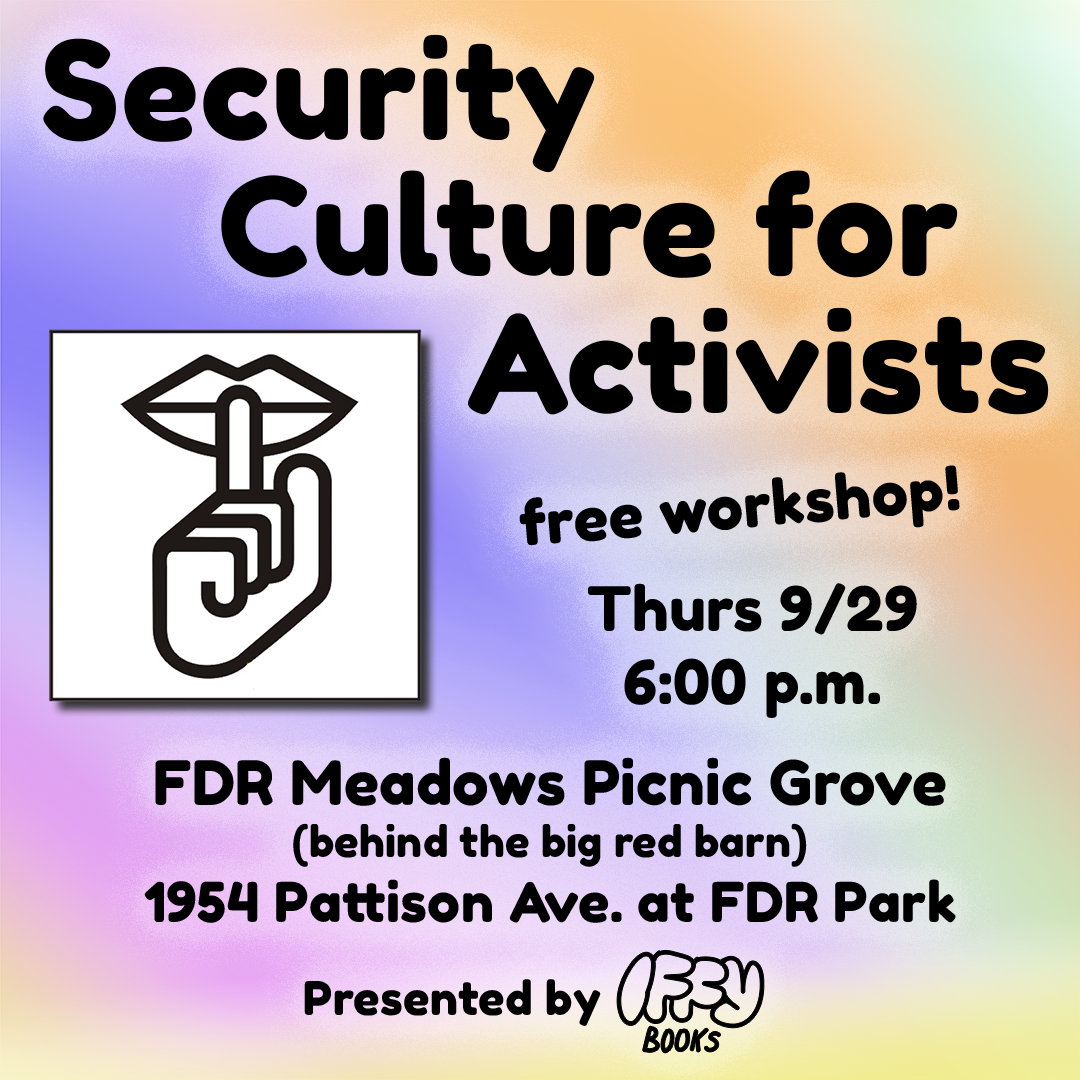
Security Culture for Activists Workshop at FDR Meadows

from Iffy Books

September 29 @ 6:00 am7:30 pm

Flyer image with a rainbow gradient background, a simplified illustration of an index finger covering lips in the "shh" position, and the following text: Security Culture for Activists / free workshop! / Thurs 9/29 6:00 p.m. / FDR Meadows Picnic Grove (behind the big red barn) / 1954 Pattison Ave. at FDR Park / Presented by Iffy Books

At this workshop we’ll discuss strategies for maintaining privacy when working on activist projects. We’ll focus on ways location data from your phone can be used against you, and how to keep you and your friends safe.

➡️ This workshop is part of Meadowfest, a series of events at the FDR Meadows from September 24th to October 2nd. Click here to learn more.

A second antifascist was visited by the FBI

from Instagram

A second antifascist was visited by the FBI in Philadelphia yesterday. Well, sort of. The weird thing is the FBI wasn’t even looking in the right ‘state’ as the person they were seeking out lives in New Jersey. That’s some real Grade A police work! Anyway. The state is up to something – possibly in collaboration with far right conspiracy theories that ‘antifa’ had something to do with the right wing violence on January 6th. News flash: ‘antifa’ had nothing to do with that whole shitshow, that scene was a wholly white supremacist riot. Be safe friends, MAKE SECURITY CULTURE YOUR #1 PRIORITY. They are only trying to intimidate us – don’t let them – be brave!

Anti-Fascist Comrade Visited By FBI

from Twitter

[This afternoon, January 15 2021, an anti-fascist comrade was visited by two FBI agents at their home in Philadelphia.

The agents said they had questions about the recent events at the Capitol. The comrade refused to answer questions & immediately got in touch with legal & anti-repression support. We don’t rely on the state to address fascist threats. The FBI has roots in repressing anarchist and Black liberation movements. We do not trust that they are only investigating the events at the Capitol. We challenge their attempts at repression with our collective refusal to speak to law enforcement.

If you are contacted by the FBI or other law enforcement, contact Up Against The Law or Philly Anti-Repression.

Up Against The Law: 484-758-0388
Philly Anti-Repression: 267-460-1886]

Gentrifying Activist Spaces – PSL Philly

from Google Drive

[Document Here]